
Selling a House in Atlanta: Local Rules, Costs, and What to Expect
By Carson Whaley · Updated August 26, 2026 · 8 min read
Atlanta doesn't make you pass a city inspection to sell, but it will fine you $1,000 for an unregistered vacant house, split your paperwork between two counties, and hand your closing to a licensed Georgia attorney. Here's what's genuinely local about selling inside the city, with current numbers, from a team buying Atlanta houses right now.
The First Thing to Know: Atlanta Doesn't Add a City Inspection
Sellers relocating from the Midwest often ask when the city inspector shows up. In Atlanta, the answer is never. The city has no point-of-sale inspection ordinance for existing homes: no pre-sale city inspection, no municipal certificate to obtain before you can transfer title, no escrow held for city-mandated repairs. The Office of Buildings issues certificates of occupancy for new construction and changes of use, not for the resale of an existing house. Whatever condition your house is in, you can legally sell it tomorrow.
What the city does enforce is vacancy. Atlanta's vacant property registry requires owners of vacant residential buildings to register with Code Enforcement within 30 days of vacancy (90 days after acquiring ownership), pay $100 per property, and renew annually. Failure to register carries a $1,000 fine per property. If you're selling an empty house, that ordinance, not any inspection rule, is the local law most likely to cost you money while you wait.
The other quirk is geography. The City of Atlanta straddles two counties. Most of the city sits in Fulton County, but a meaningful slice of the east side, including parts of Kirkwood, East Lake, and Edgewood, lies in DeKalb. Your deed gets recorded, your taxes get billed, and any probate matter gets heard in whichever county your property (or your late relative) actually belongs to. Check the county name on your most recent tax bill before you assume; plenty of Atlanta owners guess wrong.
What the Atlanta Market Looks Like in August 2026
Inside the city limits, the median sale price was $425,000 over the three months ending June 2026, up 1.1% from the same period a year earlier, and the typical home now takes about 50 days to sell, versus 47 days a year ago (Redfin, July 2026). The wider metro runs cheaper, with a median around $385,000 and flat-to-slightly-down prices year over year (Redfin, 2026). Translation: prices are holding, but nothing is flying off the shelf. Buyers average one offer per home and negotiate below list.
The distress side of the market is louder. Georgia foreclosure filings rose 77.8% year over year in Q1 2026, the second-highest jump of any state, and metro Atlanta accounted for more than half of Georgia's foreclosure starts (ATTOM). Combine that with Georgia's fast nonjudicial process, roughly 37 to 60 days from notice to a first-Tuesday courthouse auction, and Atlanta has an unusual number of sellers working against a hard deadline this year. Our Georgia selling guide walks through that clock in detail.
What Selling Costs in Atlanta
Here's the good news: Atlanta adds almost no local cost layer on top of Georgia's, and Georgia's is one of the cheapest in the country. There's no city or county transfer tax on top of the state's, no municipal point-of-sale fees, no mandatory pre-sale repairs. What you pay depends almost entirely on how you sell, not on the city.
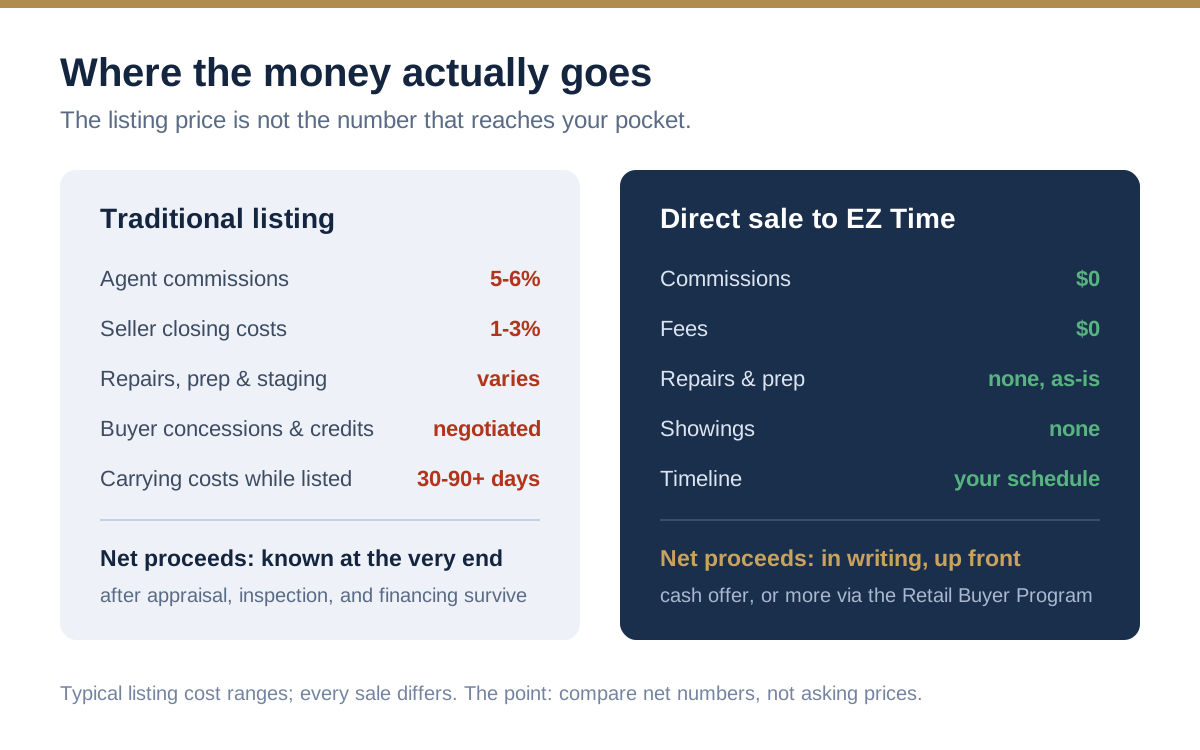
Itemized on the city's median $425,000 sale:
- Agent commissions: commonly 5-6%, so $21,250 to $25,500. By far the biggest line.
- Georgia transfer tax: $1 for the first $1,000 plus $0.10 per additional $100 (O.C.G.A. 48-6-1), customarily seller-paid. On $425,000 that's $425, about 0.1%.
- Closing attorney fee: often $500 to $1,200, split by custom and contract. Georgia requires a licensed attorney to conduct every closing, so this line exists in every sale.
- Title search and owner's title insurance: varies; often negotiated.
- Repairs and inspection credits: whatever the buyer's inspector finds and the due diligence renegotiation extracts. In Atlanta's older stock, this is routinely five figures (more on why below).
- Final water/sewer bill: Atlanta's Department of Watershed Management rates are among the highest in the nation, a legacy of the federal sewer consent decrees that drove rates up 252% between 2002 and 2012 (AJC; Clean Water Atlanta). Your payoff at closing is small, but buyers absolutely factor the monthly bill into what they'll pay.
- Nonresident withholding: if you live outside Georgia, the buyer withholds 3% of the price for the Department of Revenue (O.C.G.A. 48-7-128), reconciled on your Georgia return. Out-of-state heirs and landlords, flag this early.
When you sell directly to us, the commission line goes to zero, we cover standard closing costs including the transfer tax and attorney fee, and repairs are priced into the written offer instead of renegotiated after an inspection. If your house is in decent shape, ask about our Retail Buyer Program, which typically nets more than a typical cash offer with the same easy process. Either way you get one itemized number to compare against a listing, line by line.
Atlanta's Housing Stock: What Buyers Flag Here
Intown Atlanta runs on 1920s to 1960s Craftsman bungalows and frame houses, and those houses share a set of issues every experienced Atlanta inspector goes hunting for.
Old drain lines. Houses from the bungalow era were plumbed with cast iron drains and clay sewer laterals, and both are near or past the end of their service life. Cast iron rusts from the inside; clay joints invite tree roots, and Atlanta's intown streets are lined with mature oaks doing exactly that. The city maintains the mains, but the lateral serving your house is your problem, and buyers know it: a sewer scope is now a standard ask in Grant Park, West End, and Kirkwood, and a failed one becomes a four- or five-figure credit request.
Polybutylene supply pipe. Metro Atlanta builders installed polybutylene aggressively from 1978 to 1995 because it was cheap. It reacts with the chlorine in treated municipal water, turns brittle, and fails without warning, and many Georgia insurers now surcharge or refuse to renew policies on homes that still have it. If your 1980s house has gray plastic supply lines, expect the buyer's inspector to name them and the buyer's insurance quote to reflect them.
Water and sewer economics. Because Atlanta's consent-decree-driven utility rates run so high (roughly double what New Yorkers pay for water and sewer, per the AJC), anything that wastes water, an old slab leak, a running toilet, an unmetered irrigation line, costs more here than in most cities and gets flagged faster.
None of this means an old Atlanta house can't sell. It means the traditional path involves an inspection negotiation that's rougher here than in cities with younger stock. We buy these houses as they sit; cast iron, clay, polybutylene and all, with the repair budget shown in the offer rather than extracted after due diligence.
The Selling Situations We See Most in Atlanta

The estate bungalow, heirs in three states
A Craftsman in Pittsburgh or Capitol View that's been in the family for sixty years, now shared by siblings scattered across the country. Where the probate happens depends on where the deceased lived: Fulton County Probate Court sits downtown at 136 Pryor Street, and DeKalb County Probate Court in Decatur handles east-side estates. Georgia gives estates real options, including a No Administration Necessary order when heirs agree and a year's support award for surviving spouses, and once authority issues, one representative signs. We present offers to all heirs on one call, buy contents included, and hold the written offer firm while the court process runs. The full picture is in our inherited house guide.
The registry-clock vacant house
Owners usually learn about the $100 registration and $1,000 non-registration fine from a code-enforcement letter, often stapled to citations for grass and boarding. Meanwhile the insurance is lapsing, because most homeowner policies restrict coverage after 30 to 60 days of vacancy. Selling the vacant house resolves the registration, the citations, and the monthly bleed in a single closing, and once we own it, the compliance obligation is ours.
The first-Tuesday deadline
Georgia auctions foreclosed homes on the first Tuesday of every month on the courthouse steps, and the statutory minimum from notice to sale is about 37 days. With metro Atlanta generating over half the state's foreclosure starts, this is the most urgent call we take here. A completed sale before the auction pays off the loan and ends the process, but the timeline only works if it starts when the notice arrives. The mechanics and your full set of options are in the Georgia guide.
How an Atlanta Closing Actually Runs
Georgia law treats real estate closings as the practice of law (O.C.G.A. 15-19-50), so a licensed Georgia attorney conducts and controls every Atlanta closing, ours included. In practice that means the attorney's office runs the title search through the county records, clears old security deeds and code liens, prepares the deed, hosts the signing, and wires proceeds the same day or the next business day.
The recording step is where the two-county split matters one last time. Deeds for Fulton-side properties are recorded with the Clerk of Superior Court at 136 Pryor Street SW; DeKalb-side deeds go to the courthouse at 556 North McDonough Street in Decatur. The transfer tax is paid at recording. Your closing attorney handles all of it; you just need the right county on the paperwork from day one, which is why we confirm the parcel's county during our first walkthrough.
On timing: a financed retail sale typically runs 30 to 45 days from contract, after surviving a 7 to 14 day due diligence window in which the buyer can walk for any reason. A cash closing with us runs two to three weeks when title is clean, because there's no lender, no appraisal, and no inspection contingency, just the attorney doing the title work. The rest of our footprint and process is on the Atlanta page and the Georgia hub.
One last local truth: nothing about selling in Atlanta requires permission from the city. The rules that bite are the vacant registry, the county line, and the foreclosure calendar, and all three reward moving sooner rather than later.
This article is general information about selling a house in Atlanta, not legal or tax advice. For advice on your specific sale, estate, or foreclosure, talk to a Georgia-licensed attorney or CPA.
From the buyers
How EZ Time Home Buyers Can Help in Atlanta
We buy houses in Atlanta as-is, in any condition, on your timeline. You'll get a written cash offer with the math shown line by line, and if that number doesn't fit your situation, the Retail Buyer Program is a second path that typically nets more than a typical cash offer while we do the work. No commissions, no fees, no repairs, either way.
Frequently Asked Questions
Does the City of Atlanta require an inspection before I can sell my house?
No. Atlanta has no point-of-sale inspection ordinance for existing homes: no pre-sale city inspection, no municipal resale certificate, no city-mandated repairs. Certificates of occupancy apply to new construction and changes of use, not resales. The city ordinance that does catch sellers is the vacant property registry: $100 to register a vacant house within 30 days of vacancy, and a $1,000 fine for failing to.
Is my Atlanta house in Fulton County or DeKalb County, and why does it matter?
Most of the city is in Fulton County, but parts of east Atlanta, including areas of Kirkwood, East Lake, and Edgewood, sit in DeKalb. The county determines where your deed is recorded (Fulton's Clerk of Superior Court at 136 Pryor Street SW, or DeKalb's courthouse at 556 North McDonough Street in Decatur), where your property taxes are billed, and which probate court handles an estate. The county name is printed on your property tax bill; check it before assuming.
How much is the transfer tax on a typical Atlanta home sale?
Georgia's transfer tax is $1 for the first $1,000 of the price plus $0.10 per additional $100 (O.C.G.A. 48-6-1), and Atlanta adds no city or county transfer tax on top. On the city's median sale of $425,000 (Redfin, July 2026), that works out to $425, roughly 0.1% of the price, customarily paid by the seller. When you sell to us, we cover it along with standard closing costs.
Will old plumbing keep my Atlanta house from selling?
It won't stop a sale, but on the traditional path it will show up in the price. Atlanta's 1920s to 1960s bungalows commonly have cast iron drains and clay sewer laterals that fail sewer-scope inspections, and 1978 to 1995 houses may carry polybutylene supply pipe that many Georgia insurers surcharge or won't renew. Retail buyers turn those findings into credit requests during due diligence. We price plumbing into our written offer upfront and buy the house exactly as it is.
Related Guides
Ready to see both of your numbers?
Tell us about your property once and get a written cash offer, plus what our Retail Buyer Program could net you instead. No repairs, no fees, no pressure to accept.