
Selling a House in Georgia: Laws, Taxes, and How the Process Actually Works
By Carson Whaley · Updated August 26, 2026 · 11 min read
Three facts shape every Georgia home sale: a licensed Georgia attorney must conduct your closing, the state's nonjudicial foreclosure can go from notice to courthouse-steps auction in as little as 37 days, and the transfer tax is one of the nation's smallest at roughly 0.1% of the price. Here's how the whole process works, what it costs, and where the traps are, from a team that buys houses across Georgia every month.

What Georgia Law Actually Requires You to Disclose
Georgia surprises sellers relocating from other states almost immediately: there is no statute requiring a seller disclosure form. The state runs on a caveat emptor framework, buyer beware, with one carve-out that courts enforce without mercy. You must disclose latent defects you actually know about, meaning problems a buyer couldn't find through a reasonable inspection, and you can never actively hide a defect or answer a direct question falsely. Georgia courts call the quiet version of this "passive concealment," and it supports a fraud claim that no as-is clause will shield you from.
So the form is optional. The duty is not.
In a listed sale you'll still fill out a disclosure statement, because the Georgia Association of Realtors contract package includes one and buyers expect it. Once you complete it, every answer on it becomes a representation you can be sued over, which is why agents coach sellers through it so carefully. In a direct sale there's usually no form at all, just the underlying legal duty, and honestly that's the cleaner arrangement: when you sell to us, you tell us the roof leaks and the basement takes on water in March, we price those as repair line items, and there's nothing left to litigate. Concealment only pays against a buyer who didn't budget for problems. We already did.
One practical rule covers everything: if you know about it and a buyer couldn't easily see it, say it. Termite history, a buried oil tank, the foundation guy's quote you didn't act on, all of it. Disclosure in Georgia costs a little negotiating leverage. Concealment can cost the whole sale price plus attorney's fees, years after closing.
The Standard Process, Start to Finish
A conventional Georgia sale runs through six stages. Financed deals typically take 30 to 45 days from contract to closing; a cash sale can compress to two or three weeks because four of the six stages shrink or vanish.
1. Pricing and prep. Comps, repairs, staging, photos if you're listing. Weeks to months depending on condition.
2. Contract. Most listed sales use the GAR purchase and sale agreement. Georgia's signature feature is the all-purpose due diligence period, commonly 7 to 14 days, during which the buyer can walk for any reason or none and keep their earnest money. Treat any offer as provisional until that window closes.
3. Inspection and renegotiation. Inside due diligence, the buyer inspects and usually comes back asking for repairs or credits. This is where retail deals shrink or die.
4. Financing and appraisal. The buyer's lender orders an appraisal and underwrites the loan. A low appraisal reopens negotiation; a denied loan ends it, often three or four weeks in.
5. Title examination. The closing attorney's office searches the county records, then clears whatever surfaces: old security deeds never cancelled, code liens, an heir who never signed off.
6. The attorney closing. This is the part that makes Georgia different. Under O.C.G.A. 15-19-50, conveyancing and real estate closings are the practice of law, and the Supreme Court of Georgia has held repeatedly (Formal Advisory Opinion 86-5, and In re UPL Advisory Opinion 2003-2) that only a licensed Georgia attorney may conduct a closing, and that the attorney must control the process from beginning to end, including preparing and overseeing execution of the deed. No escrow companies, no notary-only signings. In a financed purchase the closing attorney formally represents the lender, not you, so sellers with complicated situations sometimes hire their own attorney to review documents, a few hundred dollars well spent on an estate or divorce sale. At the table, the attorney explains the settlement statement, collects signatures, records the deed, and disburses funds, usually by wire the same day or the next business day.
When you sell directly to us, stages 3 and 4 disappear (no inspection contingency, no lender) and stage 1 shrinks to a walkthrough. The attorney closing stays, as it must for any legitimate Georgia buyer, and it's your best consumer protection: a licensed professional whose bar license depends on handling your payoff and your proceeds correctly. The full sequence is on our how it works page.
Selling an Inherited House and Georgia Probate
If you inherited a Georgia house, your selling timeline depends on how title passes, and Georgia offers more routes than most states.
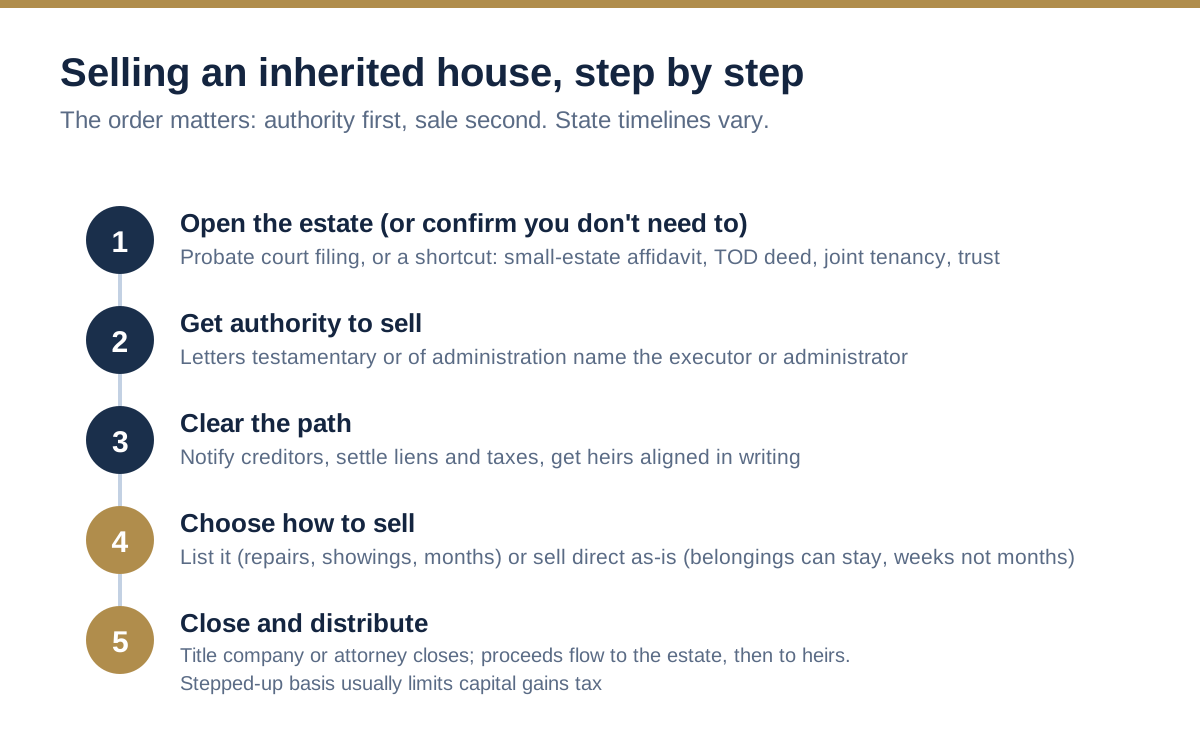
Standard probate. The will is offered for probate in the probate court of the county where the deceased lived. Solemn form probate, with notice to all heirs, is the norm because it becomes binding quickly; common form requires no notice but stays contestable for four years. Once the court issues letters testamentary (or letters of administration when there's no will), the personal representative has authority to sign a deed, typically 2 to 6 months after filing depending on the county and whether anyone objects.
No Administration Necessary. Georgia's shortcut. When the owner died without a will, the heirs all agree on who gets what, and creditors are paid or on board, any heir can petition under O.C.G.A. 53-2-40 for an order declaring no administration necessary. The order lets title pass to the heirs without appointing an administrator at all. For an unencumbered family house with cooperative siblings, it's often the fastest path to a sale.
Year's support. Unique to Georgia in its strength: a surviving spouse or minor children may petition under O.C.G.A. 53-3-1 for twelve months' support from the estate, and property set aside as year's support is preferred ahead of nearly all other claims against the estate. Probate courts can and do award the family home itself, which both transfers title and can wipe out junior claims. If you're a surviving spouse facing an estate with debts, ask a probate attorney about this before anything else.
Whichever route applies, we can evaluate the house and put a firm written offer in place while the court process runs, so the estate can close within weeks of authority issuing. The mechanics of who signs and when court approval matters are covered in our probate sale guide, and the tax picture (usually favorable, thanks to stepped-up basis) is in the inherited house guide.
Foreclosure Pressure: Georgia's Clock Is the Fastest in the Country
Georgia is a nonjudicial, power-of-sale state. Nearly every security deed here contains a clause letting the lender sell the house at auction without filing a lawsuit, and the statutory timeline is startling if you're used to judicial states where foreclosure takes a year or more.
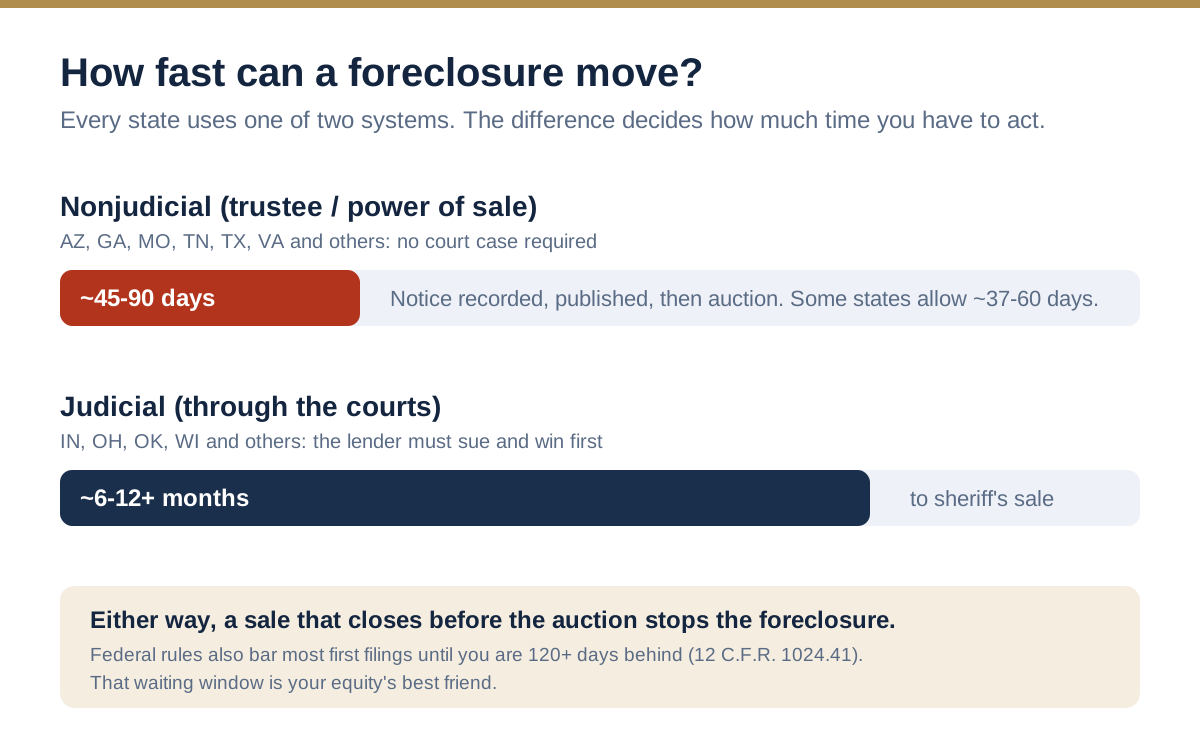
Here's the sequence. The lender must send the borrower notice of the sale no later than 30 days before the sale date, by registered or certified mail or overnight delivery (O.C.G.A. 44-14-162.2). The sale must be advertised once a week for four consecutive weeks in the county's legal organ newspaper. Then the auction happens on the first Tuesday of the month, between 10 a.m. and 4 p.m., on the county courthouse steps. Add it up and the minimum from notice to gavel is about 37 days; two months is common. There is no statutory right of redemption after a Georgia nonjudicial foreclosure sale. When the crier finishes, the house is gone.
One small mercy: if the auction price doesn't cover the debt, the lender can't chase you for the deficiency unless it reports the sale to a superior court judge within 30 days and gets the sale confirmed, including a finding that the property brought its true market value (O.C.G.A. 44-14-161). Many lenders skip confirmation on residential loans. But "probably no deficiency" is thin comfort when your equity just evaporated at auction.
The math that matters: a first-Tuesday sale routinely brings less than a negotiated sale would, and every dollar of your equity above the payoff is what's at stake. A completed sale before the auction date pays off the loan and ends the foreclosure entirely. We close Georgia purchases in two to three weeks when title is clean, which beats the clock if you start when the notice arrives rather than the week before the sale. Your full menu of options, including the loss-mitigation routes that let you keep the house, is in our stop foreclosure guide, and the timing mechanics of selling ahead of an auction are in can I sell my house before foreclosure.
What Selling Costs in Georgia
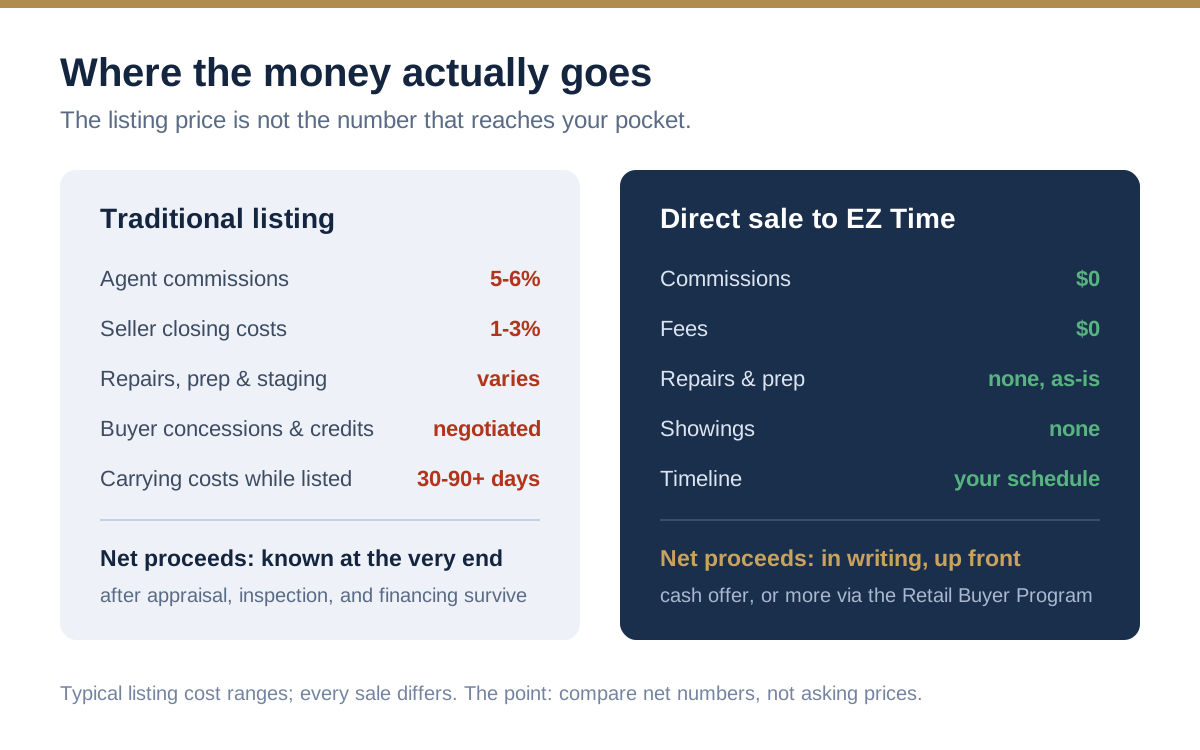
Georgia is a cheap state to sell in, by closing-cost standards. The costs that bite are the ones tied to how you sell, not where.
| Cost | Listed sale | Direct sale to us |
|---|---|---|
| Agent commissions | Commonly 5-6% of price | None |
| Transfer tax | ~0.1%: $1 for the first $1,000 plus $0.10 per additional $100 (O.C.G.A. 48-6-1), customarily seller-paid | We cover it |
| Closing attorney fee | Often $500-$1,200, split by custom and contract | We cover standard closing costs |
| Title search and insurance | Varies; owner's policy often negotiated | We cover it |
| Repairs and buyer credits | Whatever inspection negotiation extracts | None, priced upfront |
| Prorated property taxes | Your share through closing day | Same, it's your tax |
| Nonresident withholding | 3% of price if you live out of state (O.C.G.A. 48-7-128) | Same rules; see below |
Two clarifications sellers ask about. First, Georgia's intangibles tax ($1.50 per $500 on long-term notes, O.C.G.A. 48-6-61) is a loan-recording tax on the buyer's mortgage, not a seller cost, and in a cash sale nobody pays it at all. Second, the transfer tax is genuinely tiny: on a $250,000 house it's $250.
What actually moves the needle is the first row plus repairs. On that $250,000 house, a 6% commission is $15,000 before you've fixed a single item on the inspection report. Our offer works differently: we show you the after-repair value from your local comps, the itemized repair budget, and our margin, in writing. And if your house is in decent shape, ask about our Retail Buyer Program, which typically nets more than a typical cash offer by matching the house with an end buyer while we handle the process. We won't pretend it's a listing-price windfall, but it is a real number you can compare line by line against a listing. Run your own numbers in the cash offer calculator in about two minutes.
Georgia Scenarios With Their Own Rules
You live out of state
Georgia treats nonresident sellers differently at the closing table. Under O.C.G.A. 48-7-128, the buyer must withhold 3% of the purchase price and remit it to the Department of Revenue when the seller lives outside Georgia. The withholding isn't extra tax, you reconcile it on a Georgia return, but it's real money held back at closing. Three softeners: sales under $20,000 are exempt, gain excluded on a principal residence under IRC Section 121 escapes withholding, and you can sign an affidavit of seller's gain (Form IT-AFF2) so the 3% applies only to your actual gain rather than the full price. Inherited houses with stepped-up basis often have little gain, which makes that affidavit worth its weight. The closing attorney handles the paperwork either way; just flag your residency early so nobody's surprised at the table.
The house sits empty
Vacant houses draw code enforcement everywhere, but Georgia cities are formalizing it. Atlanta runs a vacant property registry with real fines for non-registration, and Macon-Bibb applies a blight tax that multiplies the property tax bill on houses cited for disrepair, details on our Macon page. An empty house also strains insurance: most homeowner policies restrict coverage after 30 to 60 days of vacancy. If you're holding an empty Georgia house from another state, the carrying math rarely improves with time.
Heirs scattered, house in Savannah, nobody local
The most common estate call we get: three siblings in three states, the family house in Savannah or a smaller market, and no one able to manage a listing from afar. Georgia helps here, because the personal representative alone signs once letters issue, and closings can be handled with mailed or remote document packages coordinated through the closing attorney. One walkthrough, one signer, wires to each heir per the estate's instructions.
The first Tuesday is three weeks away
Tight but sometimes makeable. A payoff already in escrow is the strongest ground a lender's counsel has for postponing a sale, and postponement requests need to land well before sale week. Call your servicer today, then call us; we'll tell you the same day whether your timeline is realistic, honestly, because a contract that can't close before the auction helps no one.
The Short Version
Georgia is one of the simpler states in the country to sell a house: no mandatory disclosure form (though the duty to disclose known hidden defects is very real), a trivial transfer tax, and an attorney at every closing making sure the money and the deed move correctly. The state's one sharp edge is the foreclosure clock, 37 to 60 days from notice to a first-Tuesday auction with no redemption after. Whatever the situation, the sequence with us is the same everywhere in Georgia: one walkthrough, a written itemized offer, and an attorney-supervised closing on your date.
This guide is general information about Georgia law, not legal or tax advice. For advice on your specific sale, estate, or foreclosure, talk to a Georgia-licensed attorney or CPA.
From the buyers
How EZ Time Home Buyers Can Help in Georgia
We buy houses across Georgia, and everything above is the world we work in every week. If the timelines or repair math in this guide are pushing you toward a direct sale, we'll give you a written cash offer with the math shown line by line: after-repair value, repair budget, our margin. And if the cash number doesn't work for you, our Retail Buyer Program is a second path that typically nets more than a typical cash offer while we handle the work, with no commissions or fees on either path.
Frequently Asked Questions
Do I need an attorney to sell a house in Georgia?
Yes, for the closing itself. Georgia law treats real estate closings as the practice of law (O.C.G.A. 15-19-50), and the Supreme Court of Georgia has held that only a licensed Georgia attorney may conduct a closing and must control it from start to finish. In financed deals the closing attorney represents the lender, so you can hire your own attorney to review documents if your situation is complicated. In our purchases, we pay the closing attorney as part of covering standard closing costs.
How much is the transfer tax when selling a Georgia house?
One of the smallest in the country: $1 for the first $1,000 of the price plus $0.10 for each additional $100, roughly 0.1% (O.C.G.A. 48-6-1). On a $250,000 sale that's $250, customarily paid by the seller in listed deals. Don't confuse it with Georgia's intangibles tax of $1.50 per $500, which applies to the buyer's mortgage recording, not to you, and doesn't exist at all in a cash sale.
How fast can I lose my house to foreclosure in Georgia?
Faster than almost anywhere. Georgia foreclosures are nonjudicial: the lender sends a sale notice at least 30 days before the auction (O.C.G.A. 44-14-162.2), advertises four consecutive weeks in the county legal organ, and sells on the first Tuesday of the month on the courthouse steps. The minimum from notice to auction is about 37 days, and there's no right of redemption after the sale. A completed sale before the auction date pays off the loan and stops the process, but only if you start weeks ahead, not days.
Can I sell an inherited house in Georgia before probate is finished?
Usually, yes. Once the probate court issues letters testamentary or letters of administration, the personal representative can sign a deed; the house sale doesn't wait for the estate to fully close. Georgia also offers shortcuts: a No Administration Necessary order (O.C.G.A. 53-2-40) when heirs agree and debts are handled, and a year's support award (O.C.G.A. 53-3-1) that can move the home to a surviving spouse ahead of most creditors. We can hold a firm written offer while whichever process applies runs its course.
Related Guides
Ready to see both of your numbers?
Tell us about your property once and get a written cash offer, plus what our Retail Buyer Program could net you instead. No repairs, no fees, no pressure to accept.