Selling a House in Cleveland: Suburb Inspections, Real Costs, and What to Expect
By Carson Whaley · Updated August 26, 2026 · 7 min read
In greater Cleveland, the hardest question isn't what your house is worth. It's which side of a municipal boundary the house sits on. Cleveland proper has no point-of-sale inspection, but a ring of Cuyahoga County suburbs won't let your deed transfer without one. Here's the whole local rulebook, with fees, escrow math, and the market numbers behind it.
The Cleveland Quirk: Your Municipality Decides How Hard the Sale Is
Nowhere else in Ohio does the sale process change this much from one street to the next. The City of Cleveland itself runs no point-of-sale inspection. What it requires instead is a Certificate of Disclosure on every sale or transfer of a one-to-four-unit dwelling: a $60 document from the Department of Building and Housing that discloses open violations, condemnation status, and the property's legal use to the buyer (Cleveland Codified Ordinances 367.12). It's paperwork, not an inspection. Nobody walks your house, and a violation history doesn't block the sale; it just has to be disclosed.
Cross into many of the inner-ring suburbs and the rules flip. These cities send a municipal inspector through the house before title can transfer, hand you a violation list, and require either repairs or an escrow deposit before the deed records. The programs we deal with most:
- Cleveland Heights: a Certificate of Inspection is required before you even enter a sale agreement. The inspection costs $200 for the first unit plus $50 for each additional unit, and if Class A violations remain uncorrected at transfer, an escrow of at least $1,000 and 125 percent of the estimated repair cost must be deposited (Cleveland Heights Codified Ordinances ch. 1329).
- Euclid: interior and exterior inspections with fees in the $225 to $295 range, and an escrow of 50 percent of estimated repair costs when violations carry over (Euclid Codified Ordinances ch. 1759).
- South Euclid: point-of-sale inspection required, with the buyer able to assume uncorrected violations by filing an Assumption of Violations form and escrowing 100 percent of the city-set hold amount. The certificate is valid for one year and one transfer only.
- Maple Heights: a certificate of inspection is required before selling or even signing a purchase agreement. Fees run $100 plus a $10 administrative fee for a single-family, $150 plus $10 for a two-family, and uncorrected violations require an escrow equal to 100 percent of the estimated repair cost, with the city named as beneficiary (Maple Heights Codified Ordinances ch. 1494).
East Cleveland, Garfield Heights, and a long list of other suburbs run their own versions, each with different fees, escrow formulas, and certificate expiration dates. The practical takeaway: before you do anything else, confirm your city's program, because in several of them the inspection legally comes before the purchase agreement, not after.
One more Cleveland-specific layer for landlords. The city's Residents First ordinance (Chapter 365) requires rental registration at $70 per unit per year, a Certificate of Rental Occupancy, and a Lead-Safe Certification for every pre-1978 rental, renewed every two years. If you're selling a tenant-occupied house inside city limits, buyers will ask where you stand on all three.
What the Cleveland Market Looks Like Right Now
The headlines about population decline hide a genuinely competitive market. Cleveland's median sale price stands at $142,000, up 5.9 percent year over year, with price per square foot up 14.3 percent, homes selling in about 33 days, and roughly two offers per home (Redfin, July 2026 data). Investor demand for the city's pre-WWII doubles and cottages is among the deepest in Ohio, anchored by the Cleveland Clinic's roughly 57,000 Ohio employees plus University Hospitals and Sherwin-Williams.
For sellers, that mix matters more than the raw price. Modest values with fierce competition means even rough houses draw multiple bidders, and after-repair values climbing 14 percent a year is exactly what cash offers, including ours at EZ Time, are anchored to.
What Selling Actually Costs in Cleveland
Cuyahoga County charges the maximum conveyance fee Ohio allows: $4 per $1,000 of the sale price, which is the state's $1 plus the county's full $3 permissive fee, plus a flat 50-cent transfer fee per parcel. On a $142,000 sale, that's $568.50, customarily paid by the seller when the deed transfers through the county Fiscal Officer.
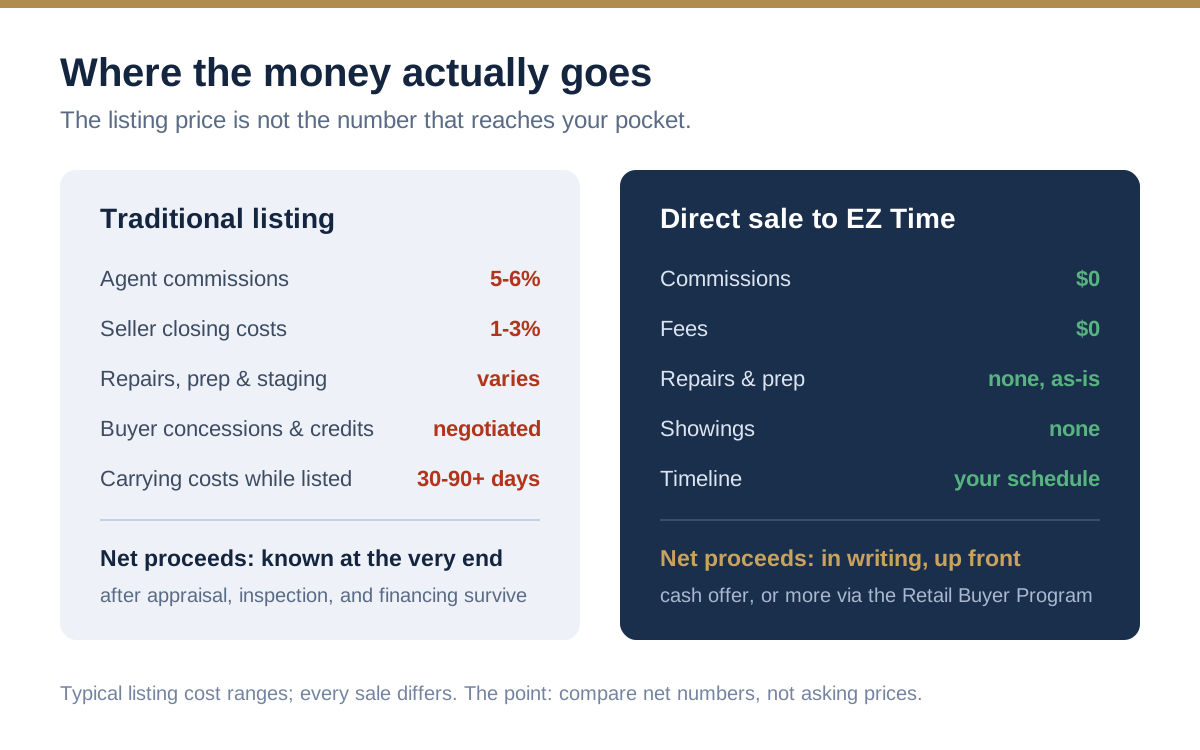
Stack the rest of the local layer on top. The Certificate of Disclosure runs $60 in Cleveland proper. In a point-of-sale suburb, add the inspection fee ($100 to $295 depending on the city) and, far more significantly, either the repair bill for the violation list or the escrow deposit: 125 percent of estimated repairs in Cleveland Heights, 100 percent in South Euclid and Maple Heights, 50 percent in Euclid. Ohio also bills property taxes a year in arrears, so you'll credit the buyer for taxes accrued but not yet billed, with the amount swinging on whether your contract uses short or long proration.
Then the traditional-sale costs: commissions around 5 to 6 percent, title and escrow fees, and whatever the inspection round extracts in repairs or concessions, commonly another 1 to 3 percent. On a direct sale to us the list collapses to the conveyance fee, your payoffs, and the tax proration. The state-level guide itemizes every line, and our as-is page shows how condition gets priced instead of repaired.
Century Homes: What Cleveland Buyers and Inspectors Flag
Most of Cleveland's housing stock predates 1978, and a huge share predates World War II. That age shows up in the same handful of inspection items over and over:
- Knob-and-tube wiring. Common in homes built through the 1930s. It isn't automatically dangerous, but insurers increasingly decline or surcharge policies until it's replaced, which can sink a financed buyer whose lender requires insurability.
- Clay sewer laterals. Houses built before the 1970s typically connect to the main with vitrified clay tile, which cracks and lets tree roots in as it ages. In Cleveland, the lateral is the property owner's responsibility all the way to the main (Cleveland Water Pollution Control), and replacement commonly runs five figures. Point-of-sale suburbs sometimes scope it; retail buyers increasingly test it.
- Lead paint. Anything pre-1978 requires the federal lead disclosure, and in Cleveland proper a pre-1978 rental can't legally operate without Lead-Safe Certification.
- The era's structural tells. Sandstone foundations, 60-amp services, sagging porches on the classic Cleveland double. None of it is exotic here. All of it scares appraisers.
A house carrying two or three of these items rarely survives a financed buyer's inspection round intact. It is, however, exactly the house Cleveland's investor market competes for right now, which is why pricing it honestly as-is often beats renovating it halfway.
The Situations Cleveland Sellers Bring Us Most
The inherited double working through Cuyahoga County Probate Court
The classic file: a Slavic Village or Glenville two-family, titled solely in a parent's name, heirs in three states. Nobody can sign a deed until the Cuyahoga County Probate Court appoints an executor or administrator and issues letters of authority. Once the letters exist, a fiduciary with power of sale under the will, or with the beneficiaries' consent on the court's Form 11.0, can generally sell at private sale for not less than 80 percent of the appraised inventory value without a separate land-sale case. Estates under Ohio's release-from-administration thresholds ($35,000, or $100,000 to a surviving spouse) can skip full administration entirely. Fiduciary sales are also exempt from Ohio's disclosure form. We buy inherited houses contents-included and time closings to the court calendar, and our probate guide maps the sequence.
The pre-1978 rental against the lead-safe clock
Testing, clearance exams, and two-year renewals on a $120,000 double, plus $70 per unit per year in registration, is math a lot of small landlords no longer want. We buy rentals occupied or vacant, with or without current certification, and the compliance stack transfers to us at closing.
The point-of-sale list bigger than the bank account
A Cleveland Heights or Maple Heights inspection produces a violation list; the seller doesn't have the cash to clear it; the ordinance won't record the deed until someone deals with it. The escrow assumption provision is the way through. As the buyer, we assume the violations through the escrow deposit, funded from our side of the closing statement, and the city's list becomes our renovation list. It's a normal part of our closings across the Cleveland area, not an exception.
How a Cleveland Sale Runs, Start to Finish
Cleveland is title-company country. A licensed title agency handles the escrow, the title exam, and the closing; attorneys enter for probate, partition, and foreclosure workouts. The local sequence: confirm your city's point-of-sale status first (in Cleveland Heights and Maple Heights, the certificate legally precedes the purchase agreement), order the Certificate of Disclosure if the house is in Cleveland proper, complete Ohio's disclosure form unless you're exempt, then contract, title work, and closing. At the end, the deed routes through the Cuyahoga County Fiscal Officer, which collects the $4 per $1,000 conveyance fee, and records with the county. Financed buyers typically need 30 to 45 days from contract; cash closes as fast as the title work and any municipal certificate allow, commonly two to three weeks.
One caution for anyone behind on the mortgage: Ohio forecloses only through the courts, typically six to twelve months, and Cuyahoga's docket is not a fast one. That timeline is runway to sell before the sheriff's sale and keep the equity, but the payoff grows every month you wait. And if your house mainly needs cosmetics rather than a gut, ask us about the Retail Buyer Program, which can deliver more than a typical cash offer with the same easy process: we do the work, you skip the commissions and showings.
Wherever the house sits, from Old Brooklyn to the rest of Ohio, the local rules change the checklist, not the outcome. Municipal ordinances and fee schedules change, and this guide is general information, not legal advice; for your specific sale, your title agency or a real estate attorney is the authority.
From the buyers
How EZ Time Home Buyers Can Help in Cleveland
We buy houses in Cleveland as-is, in any condition, on your timeline. You'll get a written cash offer with the math shown line by line, and if that number doesn't fit your situation, the Retail Buyer Program is a second path that typically nets more than a typical cash offer while we do the work. No commissions, no fees, no repairs, either way.
Frequently Asked Questions
Does the City of Cleveland require a point-of-sale inspection?
No. Cleveland proper requires a Certificate of Disclosure on 1-4 unit sales, a $60 document disclosing open violations and legal use (Cleveland Codified Ordinances 367.12), but nobody inspects the house. Point-of-sale inspections are a suburb rule: Cleveland Heights, Euclid, South Euclid, Maple Heights, East Cleveland, and a long list of other Cuyahoga County cities each run their own program with their own fees and escrow requirements. Always confirm with the specific city hall before listing.
My suburb's point-of-sale inspection found violations I can't afford. Can I still sell?
Yes, through escrow assumption. Every major program lets the buyer take on uncorrected violations by depositing repair funds in escrow at closing: at least $1,000 and 125 percent of estimated repairs in Cleveland Heights, 100 percent in South Euclid and Maple Heights, 50 percent in Euclid. We fund that escrow from our side of the closing statement routinely, so the city's repair list becomes ours, not yours.
What is the transfer tax when selling a house in Cuyahoga County?
Cuyahoga County charges Ohio's maximum: $4 per $1,000 of the sale price ($1 state plus $3 county), plus a 50-cent transfer fee per parcel, customarily seller-paid. On Cleveland's $142,000 median sale that's about $568. Add $60 for the Certificate of Disclosure in Cleveland proper, and your suburb's inspection fee if it runs a point-of-sale program.
How do I sell a house that's in probate at the Cuyahoga County Probate Court?
First the court must appoint an executor or administrator and issue letters of authority; no deed is valid without them. With a power of sale in the will, or beneficiary consents filed on the court's Form 11.0, the fiduciary can then sell at private sale for at least 80 percent of the appraised inventory value without a separate land-sale case. Small estates ($35,000, or $100,000 passing to a surviving spouse) may qualify for release from administration instead. Fiduciary sales are exempt from Ohio's disclosure form, and the house sale usually closes months before the estate does.
Related Guides
Ready to see both of your numbers?
Tell us about your property once and get a written cash offer, plus what our Retail Buyer Program could net you instead. No repairs, no fees, no pressure to accept.