
Selling a House in Ohio: Laws, Taxes, and How the Process Actually Works
By Carson Whaley · Updated August 26, 2026 · 11 min read
Ohio requires a state disclosure form that hands your buyer a three-day cancellation right if you deliver it late, forecloses only through the courts on a 6-12 month timeline, and charges a conveyance fee of $1 to $4 per $1,000 at closing. Here's the whole rulebook, written by people who buy houses in all 88 counties.
The Disclosure Form Ohio Requires, and the Escape Hatch It Hands Your Buyer
Most Ohio sellers know the Residential Property Disclosure Form exists. Fewer know it creates a cancellation right.
Ohio law requires sellers of residential property with one to four dwelling units to complete the state's disclosure form and deliver it to the buyer (Ohio Rev. Code 5302.30). The form walks through what you actually know about the house: water supply and sewer, roof, foundation, mechanical systems, water intrusion, hazardous materials, boundary disputes, code violations. It asks for your knowledge, not an inspection. You aren't certifying the house is sound. You're certifying you told the truth about what you know.
Here's the part that bites. If the buyer receives the form after signing the purchase contract, the buyer can rescind the deal, in writing, within three business days of receiving it. That rescission right expires at the earlier of 30 days after you accepted the offer or the closing date (Ohio Rev. Code 5302.30(K)). Deliver the form late, or amend it late with something material, and you've handed your buyer a no-fault exit while your house sat off the market collecting nothing but days. The fix costs zero dollars: complete the form before you list and get it into the buyer's hands before anyone signs.
The exemption list matters just as much as the rule. Court-ordered sales, foreclosure-related transfers, transfers by an executor, administrator, or other fiduciary, new construction, and sales between co-owners generally skip the form entirely (Ohio Rev. Code 5302.30(B)(2)). Selling an inherited house from an estate? You typically don't fill it out. One caution survives every exemption: deliberately concealing a defect you know about is fraud in Ohio no matter what, and "as-is" contract language protects the buyer's inspection posture, not a seller's concealment.
How a Standard Ohio Sale Runs, Start to Finish
Ohio is a title company state. No law requires an attorney for a routine residential sale; licensed title agencies handle the escrow, the title exam, document preparation, and disbursement in every county. Attorneys enter the picture for probate, divorce, partition, and foreclosure workouts, not for the closing table itself.
The sequence looks like this:
- Prepare and price. Comps, condition decisions, and the disclosure form, completed before you list, not scrambled after an offer lands.
- Contract. Offer, counters, acceptance. Ohio contracts commonly carry inspection and financing contingencies, and this is where you elect short or long tax proration (more on that below, it moves real money).
- Inspection round. The buyer's inspector produces a list. You negotiate repairs, credits, or price, or watch the deal die here, which is where roughly a fifth of retail contracts wobble.
- Title work. The title agency searches the chain, flags liens, orders payoffs. Two to four weeks is typical when the title is clean, longer when an old mortgage was never released or an heir never signed off.
- Municipal requirements. In a minority of Ohio cities, a point-of-sale inspection certificate has to exist before transfer. This one ambushes sellers, so it gets its own section.
- Closing. Documents signed, the county auditor collects the conveyance fee, the deed records with the county recorder, and the wire goes out.
Financed buyers typically need 30 to 45 days from contract to keys, paced by the appraisal and underwriting. Cash closes as fast as title work allows, commonly two to three weeks. That second schedule is the one we run at EZ Time across Ohio, and the how-it-works page shows exactly what's inside our offers.
Selling an Inherited Ohio House: Probate, TOD Affidavits, and the Shortcuts
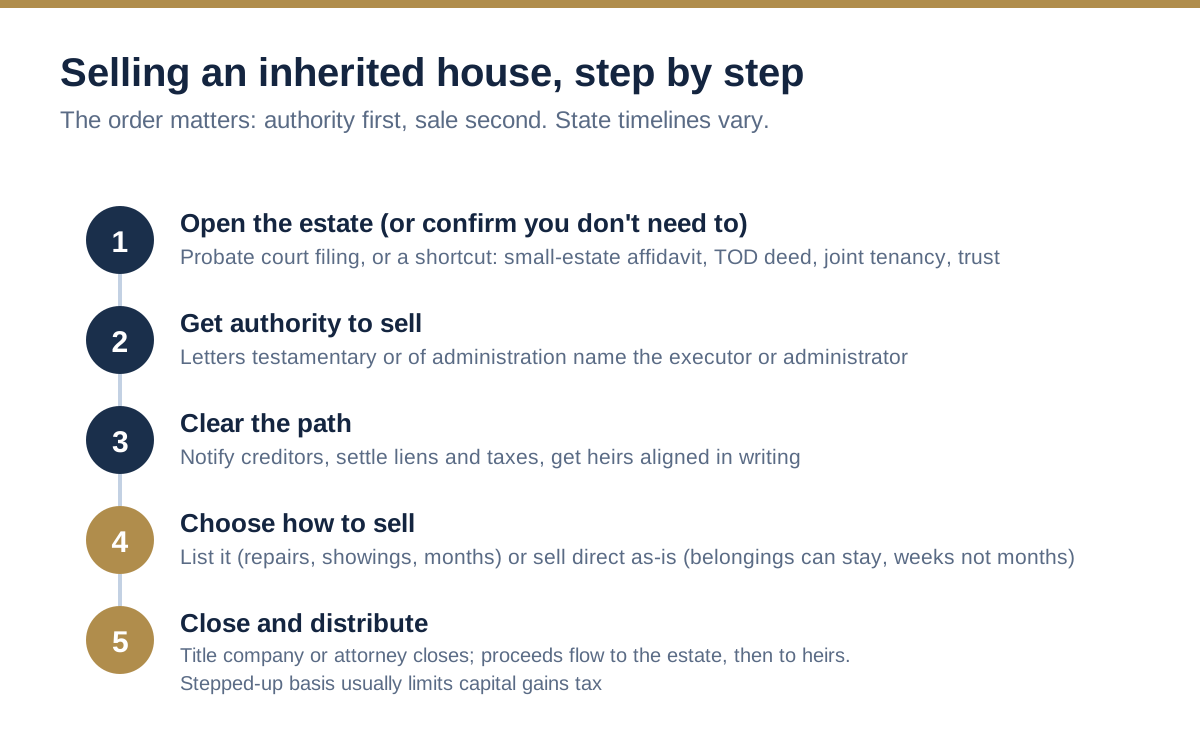
Ohio gives estates more off-ramps than most families realize, and which one applies depends entirely on how the deed was titled the day the owner died.
The house may not need probate at all
Transfer-on-death designation affidavit. Ohio uses a recorded TOD designation affidavit rather than the TOD deed found in other states (Ohio Rev. Code 5302.22). If the owner recorded one before death, the house passes straight to the named beneficiary outside probate: the beneficiary records an affidavit of confirmation with a death certificate at the county recorder, takes title, and can sell immediately. No court, no letters, no waiting on a docket.
Survivorship deeds. A joint-with-survivorship deed or a spouse on the title works the same way in practice: record the death certificate paperwork and the survivor owns the whole thing.
When probate does apply
A house titled solely in the deceased's name goes through the county probate court. Nobody can sign a valid deed until the court appoints an executor or administrator and issues letters of authority, which is the document every title company will ask for first. Ohio offers a release from administration shortcut when the probate estate is worth $35,000 or less, or $100,000 or less when a surviving spouse inherits everything (Ohio Rev. Code 2113.03), plus a summary release for very small estates (Ohio Rev. Code 2113.031). A house usually pushes the estate past $35,000 on its own, so most inherited-house sales run through either the spousal threshold or full administration, which takes roughly six to twelve months, though the house sale itself typically closes months before the estate does.
Two details make estate sales easier in Ohio than sellers expect. First, fiduciary transfers are exempt from the disclosure form, as covered above. Second, the buyer pool for as-is estate property is deep here. We buy inherited houses contents-included, close remotely for scattered heirs, and time the closing to the court calendar instead of fighting it. The inherited house guide covers the tax side, including the stepped-up basis that makes most of these sales nearly tax-free, and the probate walkthrough maps the court sequence step by step.
Facing Foreclosure: Ohio's Judicial Timeline Is Your Runway
Ohio forecloses only through the courts. There's no power-of-sale shortcut here; the lender has to file a lawsuit in the county common pleas court and win it before anything gets sold. That single fact shapes every deadline that follows.
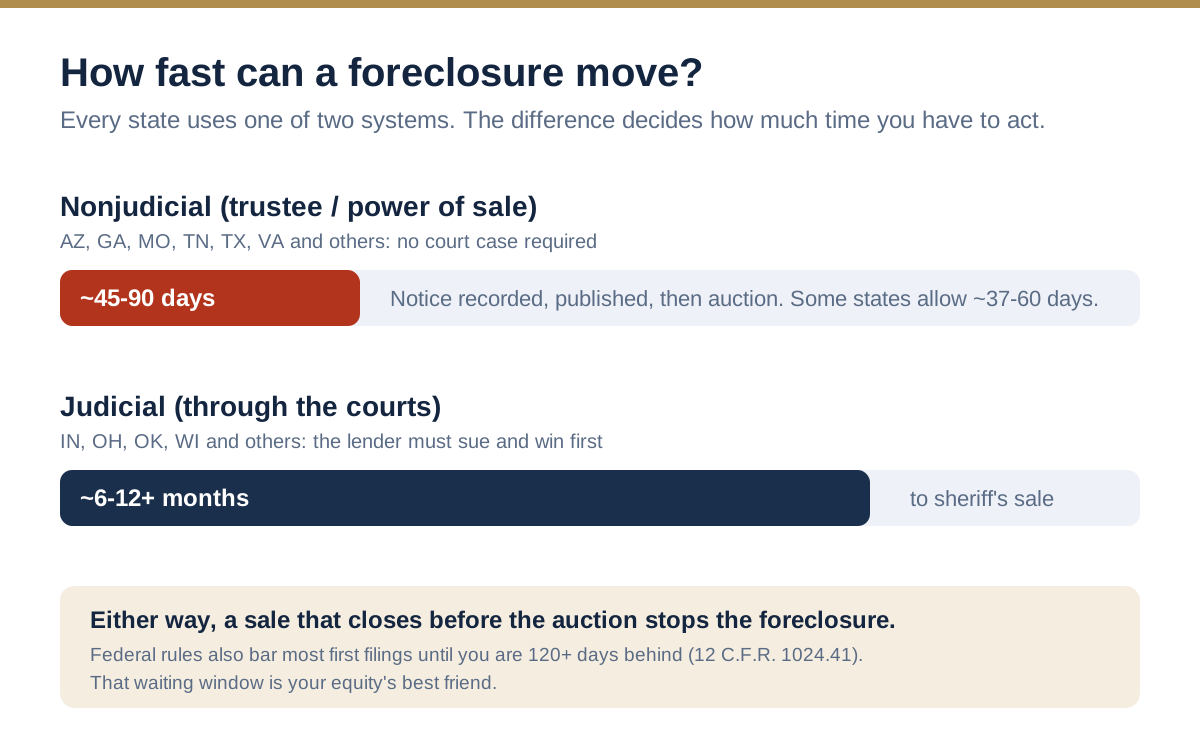
Once you're served with the complaint, you have 28 days to file an answer (Ohio Civ. R. 12). File one, even a simple one, and you're a contested case instead of a default. From first missed payment to sheriff's sale typically runs six to twelve months statewide, and longer in backlogged urban counties. Cuyahoga and Franklin dockets aren't famous for speed.
The sheriff's sale itself has rules worth knowing. The property gets appraised, and the opening bid at the first two auctions can't fall below two-thirds of that appraised value (Ohio Rev. Code 2329.20). If it fails to sell twice, a residential property can then be offered without the minimum-bid floor (Ohio Rev. Code 2329.52). Then comes the piece of Ohio law that surprises everyone: the auction is not the end. You can still redeem the property, meaning pay the full judgment, costs, and interest at 8 percent on the purchase money, at any time until the court confirms the sale (Ohio Rev. Code 2329.33). Confirmation typically lands 30 to 60 days after the auction, and courts can grant a short stay specifically to give an owner time to redeem.
Read that timeline as an asset. Six to twelve months is enough to attempt a loan modification, complete a traditional listing, or close a cash sale two or three times over. A sale that closes before confirmation pays the judgment through the title company, stops the fee clock, and puts whatever equity remains in your pocket instead of the court's ledger. What the timeline is not is a reason to wait: interest, late fees, and the lender's legal costs compound monthly and come out of your side of the ledger. Our foreclosure options guide ranks every path, and the selling before foreclosure walkthrough covers the payoff mechanics deadline by deadline. The short version: every option works better in month two than month eight.
Point-of-Sale Inspection Cities: The Rule That Ambushes Sellers
Ohio has no statewide pre-sale inspection requirement, but a cluster of cities, concentrated in Cuyahoga and Lake counties around Cleveland, run their own point-of-sale (POS) inspection programs. Sell inside one of these city limits and a municipal inspection certificate becomes a condition of transferring the deed.
Cleveland Heights is the textbook example: city ordinance requires a Certificate of Inspection before you even enter a sale agreement, and if violations remain uncorrected at transfer, the buyer or seller must escrow at least $1,000 and 125 percent of the estimated repair cost (Cleveland Heights Codified Ordinances ch. 1329). Euclid runs a similar program with an escrow of 50 percent of estimated repair costs. East Cleveland and a long list of other inner-ring suburbs have their own versions, each with its own fees, escrow math, and certificate expiration dates. Columbus, Cincinnati, and most of the rest of the state have nothing comparable.
For an as-is seller, a POS list can feel like a wall: the city hands you a repair list, you don't have the cash to clear it, and the ordinance won't let the deed record until someone deals with it. The escrow provision is the door through the wall. The violations can be assumed by the buyer through the escrow deposit, which means the city's list becomes the buyer's renovation list, funded from the buyer's side of the closing statement. We buy through POS programs routinely in the Cleveland area, and the assumption paperwork is a normal part of our closings there, not an exception. If your city has a program, say so up front; it changes the checklist, not the outcome. The broader as-is guide explains how condition and compliance items get priced instead of repaired.
What Selling Actually Costs in Ohio
Ohio's government take at closing is modest by national standards, but the line items confuse people because two of them work backwards.
The conveyance fee. The state charges $1 per $1,000 of the sale price (Ohio Rev. Code 319.54(G)(3)), and each county may add a permissive fee of up to $3 more per $1,000 (Ohio Rev. Code 322.02). Combined, that's 0.1 to 0.4 percent, customarily paid by the seller: $250 to $1,000 on a $250,000 sale depending on your county. The auditor collects it when the deed transfers.
Property tax proration, the backwards one. Ohio property taxes are billed a year in arrears, in two semiannual installments, so the bill that arrives in 2026 covers 2025 taxes. That means every seller owes taxes for time already lived in the house that the county hasn't billed yet, and the title company settles the difference as a credit to the buyer at closing. How big that credit is depends on whether your contract calls for "short" or "long" proration, two different formulas that can swing the number by hundreds of dollars. It's a negotiation point almost nobody negotiates. Read the proration clause before you sign, not at the closing table.
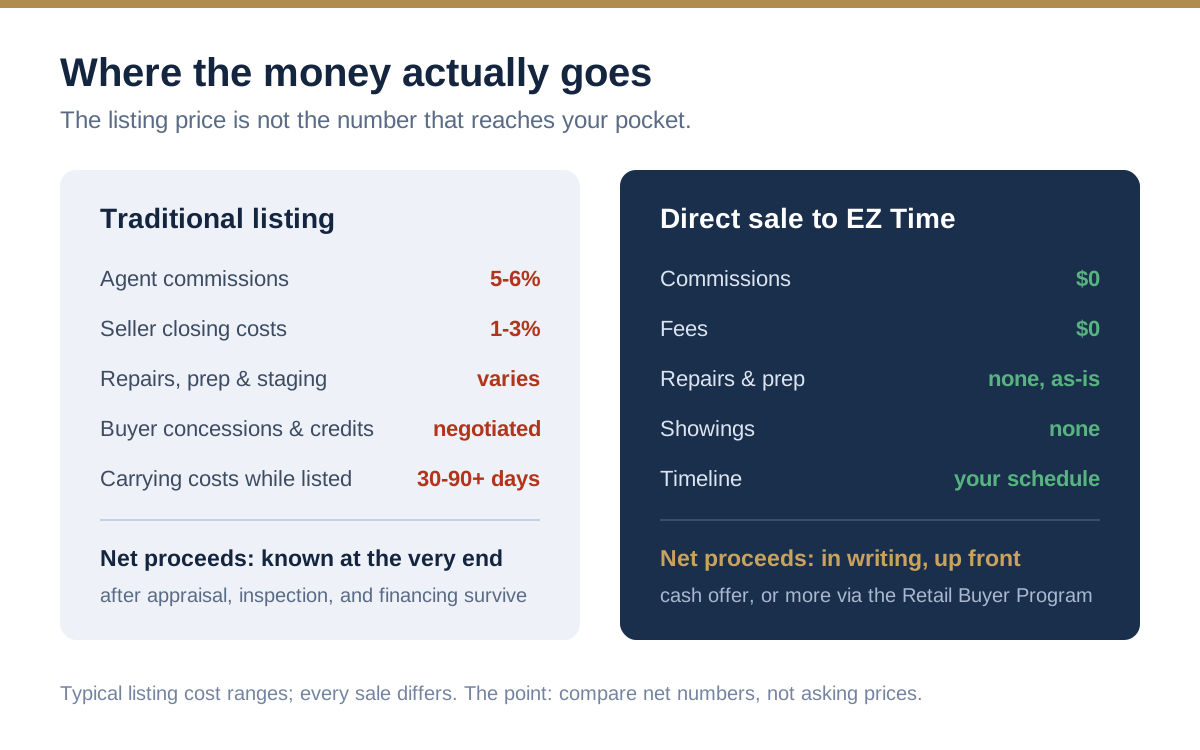
The rest of the list. On a traditional listing: agent commissions in the 5 to 6 percent range, title and escrow fees, deed preparation, any POS compliance costs, plus whatever repairs and buyer concessions the inspection round extracts, commonly another 1 to 3 percent. On a direct sale to us, the list gets shorter: no commission, no repairs, no concessions, no seller-paid standard closing costs, just the conveyance fee, your payoffs, and the tax proration. Our cash offer calculator runs the side-by-side math on your numbers, and for houses in decent shape our Retail Buyer Program prices above a typical cash offer by tying our number to the retail market instead of a flip formula.
Ohio Situations With Their Own Rules
You inherited a house in one city and live in another
The pattern we see weekly: the house is in Cleveland or Dayton, the heirs are in Columbus, Charlotte, and Phoenix. Ohio helps you here. Fiduciary transfers skip the disclosure form, closings can be done remotely with a mobile notary, and a cash sale removes the one thing distance makes miserable, which is managing repairs and showings from three time zones away.
The sheriff's sale is already scheduled
A scheduled auction is a deadline, not a verdict. Ohio's redemption right runs until confirmation (Ohio Rev. Code 2329.33), and confirmation follows the auction by weeks. If real equity exists, a fast closing can still capture it, but the window is measured in days and the payoff figure grows while you think. Call an attorney and a buyer the same afternoon.
The city's POS list costs more than you have
Escrow assumption, covered above, exists for exactly this. The buyer takes the list; you take the proceeds. What kills these deals isn't the ordinance, it's sellers waiting until a retail contract collapses before pricing the direct route.
The house needs more work than the block will repay
Common in legacy neighborhoods from Toledo to Cincinnati: the renovation math doesn't clear because the after-repair value can't carry a full rehab. A retail listing will attrit through inspection after inspection. Pricing it honestly as-is, to a buyer who itemizes the repair budget in writing the way we do, usually nets within shouting distance of the listing path with none of the six-month grind.
The Ohio Seller's Bottom Line
Three rules carry most of the weight. Deliver the disclosure form before the contract, not after, so nobody holds a rescission right over your deal. If foreclosure is in the picture, treat the judicial timeline as runway and use it early, because Ohio gives you more time than almost any state and charges you interest for wasting it. And before you sign anything, know your county's conveyance fee, your city's POS status, and your contract's proration method, the three cost items sellers consistently discover too late.
Ohio statutes and local ordinances change, and this guide is general information, not legal advice. For your specific sale, a real estate attorney or your title agency is the authority.
From the buyers
How EZ Time Home Buyers Can Help in Ohio
We buy houses across Ohio, and everything above is the world we work in every week. If the timelines or repair math in this guide are pushing you toward a direct sale, we'll give you a written cash offer with the math shown line by line: after-repair value, repair budget, our margin. And if the cash number doesn't work for you, our Retail Buyer Program is a second path that typically nets more than a typical cash offer while we handle the work, with no commissions or fees on either path.
Frequently Asked Questions
Is the disclosure form required if I'm selling my Ohio house as-is?
Usually yes. "As-is" changes what you'll repair, not what you must disclose; Ohio Rev. Code 5302.30 requires the Residential Property Disclosure Form for most 1-4 unit sales regardless of condition language. The real exemptions are structural: estate and fiduciary transfers, court-ordered sales, foreclosure-related transfers, and deals between co-owners skip the form. And no exemption ever protects actively concealing a defect you know about.
Can I still sell my house after the sheriff's sale in Ohio?
Until the court confirms the sale, yes, through redemption: Ohio Rev. Code 2329.33 lets you pay the full judgment, costs, and 8 percent interest on the purchase money any time before confirmation, which typically comes 30 to 60 days after the auction. Practically, redemption requires the full payoff at once, so it works through a refinance, family funds, or a sale that closes inside the window. If the house has meaningful equity, move the same week; this window is measured in days.
What taxes and fees do I pay when selling a house in Ohio?
The conveyance fee runs $1 per $1,000 to the state plus up to $3 per $1,000 to your county (Ohio Rev. Code 319.54(G)(3) and 322.02), so $250 to $1,000 on a $250,000 sale, customarily seller-paid. You'll also credit the buyer for accrued property taxes, because Ohio bills taxes a year in arrears in semiannual installments, with the amount depending on whether your contract uses short or long proration. Ohio has no separate state real estate capital gains tax on top of that.
Do I have to go through probate to sell a house I inherited in Ohio?
Only if the deed requires it. A recorded transfer-on-death designation affidavit (Ohio Rev. Code 5302.22) or a survivorship deed passes the house outside probate, and you can sell after recording the confirmation paperwork. A house titled solely in the deceased's name needs probate authority: letters from the county probate court, or a release from administration if the probate estate is $35,000 or less ($100,000 or less when everything goes to a surviving spouse) under Ohio Rev. Code 2113.03. The sale itself usually closes months before the estate wraps up.
Related Guides
Ready to see both of your numbers?
Tell us about your property once and get a written cash offer, plus what our Retail Buyer Program could net you instead. No repairs, no fees, no pressure to accept.