
Selling a House in Phoenix: Local Rules, Real Costs, and What to Expect
By Eric Roebuck · Updated August 26, 2026 · 8 min read
Phoenix is one of the cheapest big cities in America to sell a house in, no transfer tax, no city inspection, a $30 flat recording fee, but the desert writes its own rules about roofs, air conditioners, and timing. Here's the whole local picture, from people who buy Valley houses every month.
What's Actually Different About Selling in Phoenix
Start with the good news, because there's a lot of it. Phoenix has no point-of-sale inspection ordinance. The city will not send an inspector to your house before you sell, there's no resale certificate of occupancy, and no escrow gets held hostage for code repairs the way it does in cities like Cleveland or St. Louis. You can sell a Phoenix house in any condition without asking the city's permission first.
The local layer that does exist is the HOA. Arizona has one of the highest association rates in the country (roughly a third of all homes statewide, and about 65% of Arizona listings carried HOA dues in 2025 per Redfin data reported by Axios in March 2026), and in Phoenix subdivisions built after 1980 an HOA is close to a given. When you sell, the association must produce a resale disclosure packet for the buyer, and state law caps what it can charge: no more than $400 for the documents and transfer services, plus at most a $100 rush fee and a $50 update fee (A.R.S. 33-1806 for planned communities, A.R.S. 33-1260 for condos). Order it the week you go under contract. Slow HOA management companies delay more Phoenix closings than title problems do.
Two more Phoenix-specific facts worth knowing up front. First, recording costs are trivial: the Maricopa County Recorder charges a flat $30 per document (A.R.S. 11-475, flat-fee structure in effect since July 2019), and Arizona's constitution bans transfer taxes outright (Proposition 100, 2008). Second, if the house you're selling is a rental, Arizona law requires it to be registered with the Maricopa County Assessor, and out-of-state owners must name an in-state statutory agent (A.R.S. 33-1902). Unregistered status doesn't block a sale, but cities fine for it, so it's better handled inside the closing than discovered by a code officer.
The Phoenix Market Right Now
The Valley has settled into a slow, negotiable plateau. Per the Phoenix REALTORS July 2026 Maricopa County report, the median sale price was $504,900, up just 1% year over year, homes took a median 73 days to sell, active inventory sat at 14,407 listings, and pending sales were down 35.4% from a year earlier. Months of supply came in at 3.6, technically balanced, but with sellers conceding on repairs and closing costs to get deals done. Zillow's June 2026 data tells the same story from the city side: the typical Phoenix home value is about $410,000, down 2.1% year over year.
Translate that from statistics into experience: a turnkey house in a good school zone still sells fine. A house with a 19-year-old roof underlayment and a dead AC sits, gets low-balled, or both. In 2021 the market forgave condition. In 2026 it prices every flaw, twice. That's the honest backdrop for every decision below.
What Selling Costs in Phoenix, Line by Line
Arizona keeps government costs near zero, so almost everything you pay to sell a Phoenix house goes to private parties, and most of it is avoidable depending on how you sell.
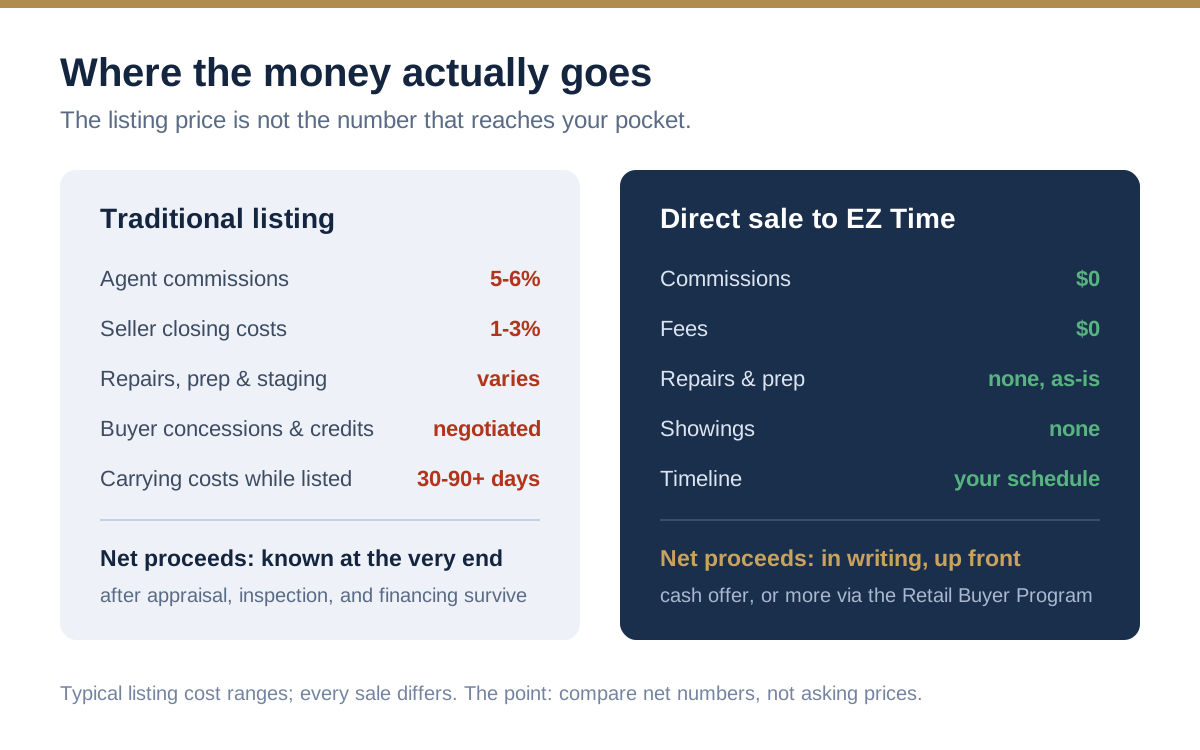
- Commission: 5 to 6% if you list. On the county's $504,900 median, that's $25,000 to $30,000. On a typical $410,000 Phoenix house, $20,500 to $24,600. The largest line on nearly every settlement statement.
- Title and escrow: roughly $1,500 to $3,000. Sellers customarily pay for the owner's title policy in Arizona, and the escrow fee splits 50/50.
- Transfer tax: $0. Constitutionally banned. The only government charge at closing is the Maricopa County Recorder's flat $30 fee.
- Property tax proration: small. Arizona's effective rate runs around 0.4 to 0.5%, taxes are billed in arrears (installments due October 1 and March 1), and escrow simply prorates your ownership days. Hundreds, not thousands.
- HOA resale packet and payoffs. Up to $400 plus the capped rush and update fees, and any unpaid assessments come off your proceeds at closing.
- Concessions and repairs: the real wild card at 73 days on market. Retail buyers in this market routinely ask 1 to 3% in concessions plus inspection-driven repair credits, and in Phoenix those credits cluster around three expensive systems covered in the next section.
A direct sale rewrites the list. When we buy a Phoenix house, there's no commission, we pay standard closing costs, and the price already reflects condition from our own walkthrough, so there's no second negotiation after an inspection. The offer math (after-repair value, minus repairs, minus our margin) goes to you in writing. For houses in solid shape, our Retail Buyer Program can deliver more than a typical cash offer, with the same simple process and a guaranteed floor. Compare either number against a listing net sheet minus commission, concessions, repairs, and three months of carrying costs, and decide with real figures.
The Housing Stock: What Phoenix Buyers Flag First
Desert wear is predictable, which is exactly why Phoenix buyers and inspectors check the same four things on nearly every house.
Tile roof underlayment. The concrete tile on a 1990s or 2000s subdivision roof can last 50 years. The felt underlayment beneath it lasts about 15 to 25 years in Phoenix heat, often 15 to 20 for traditional felt, and replacing it costs five figures on many houses. Buyers' inspectors flag underlayment age relentlessly, so a 1998-built house with its original roof paper is negotiating from behind before the first showing.
HVAC age. Air conditioners in the Valley run eight to ten months a year and typically last 10 to 15 years, frequently less without twice-yearly service. "How old is the AC?" is the first question every Phoenix buyer asks, and a unit past year twelve gets priced like it's already dead.
The pool. Roughly one in three Phoenix homes has one. Pumps, filters, heaters, and surfaces all age on their own schedules, and buyers treat tired pool equipment and worn plaster as line-item deductions.
Termites and the critter questions. Desert subterranean termites are endemic here; pest firms citing university research put the share of Valley homes that see activity at some point near 80%. Arizona doesn't require a termite inspection to sell, but lenders frequently require a state-regulated Wood-Destroying Insect Inspection Report (WDIIR) before funding, so financed buyers bring one. The standard Arizona disclosure form even asks about scorpions. None of this is disqualifying, it's normal desert homeownership, but under Arizona's Hill v. Jones disclosure duty you tell buyers what you actually know, and our Arizona selling guide covers exactly how that duty works.
Older central Phoenix stock adds its own list: 1950s-60s Maryvale and Sunnyslope ranches with original galvanized plumbing, unpermitted additions and casitas, and the federal lead-paint disclosure on anything built before 1978. We buy these as-is constantly; every item above is a number to us, not an objection.
The Selling Situations We See Most in Phoenix
The inherited ranch and Maricopa County probate
Phoenix's snowbird generation left a wave of estates, and Arizona handles them better than almost anywhere. Most estates go through informal probate at the Maricopa County Superior Court's Probate Department: the Probate Registrar (not a judge) processes the application, and personal representatives typically have letters of appointment within a few weeks. One local wrinkle: a non-professional personal representative must complete a court-approved online training program before permanent letters issue, so do that module early. Even better, since late 2025 Arizona's small-estate affidavit covers real property with up to $300,000 in equity measured by assessed value (A.R.S. 14-3971), which captures a large share of older Phoenix housing, heirs record an affidavit six months after death and skip probate entirely. Either way, our inherited house process is built to flex around the legal timeline, contents included.
The out-of-state landlord who's done with the desert
A huge slice of Phoenix rentals belong to owners in California, Washington, and the Midwest, and many discover A.R.S. 33-1902's registration and statutory-agent rules only when a city fine arrives. Selling with tenants in place resolves registration, the lease, the deposit, and the 2 a.m. AC calls in a single remote closing. We buy tenant-occupied Phoenix houses as a routine matter; you never need to fly in.
The equity exit under a 91-day clock
Arizona forecloses fast: once a Notice of Trustee's Sale records, the auction can happen 91 days later, and there's no redemption after the gavel. Most Phoenix owners facing that clock today have real equity, which makes the auction the worst possible way to sell. Ninety-one days is enough to close a cash sale several times over, pay the lender through escrow, and keep the difference. The full statutory timeline is in our Arizona guide, and it's worth reading before the decision window shrinks.
How a Phoenix Closing Actually Runs
Arizona is an escrow state, and Phoenix closings are about as frictionless as American real estate gets. No attorney is required. A title company holds the money, cures title, and records the deed with the Maricopa County Recorder, which accepts e-recording, so deeds record and proceeds wire the same day. On a listed sale, the standard Arizona contract sets the rhythm: earnest money to escrow, seller's disclosure statement due within three days, a 10-day inspection period where the repair negotiation happens, then 30 to 45 days to close if the buyer is financed. A cash sale compresses to whatever the title search takes, often 7 to 14 days, which is the timeline we run on most Phoenix purchases, and the same escrow officers handle both kinds.
If your situation touches probate filings, a trustee's sale, or a title defect, spend an hour with an Arizona attorney; this guide is general information from house buyers, not legal advice. For everything else, selling in Phoenix mostly rewards preparation: know your roof and AC ages, order the HOA packet early, and check any offer, ours included, against the Arizona market numbers above.
From the buyers
How EZ Time Home Buyers Can Help in Phoenix
We buy houses in Phoenix as-is, in any condition, on your timeline. You'll get a written cash offer with the math shown line by line, and if that number doesn't fit your situation, the Retail Buyer Program is a second path that typically nets more than a typical cash offer while we do the work. No commissions, no fees, no repairs, either way.
Frequently Asked Questions
Does the city of Phoenix require an inspection before I sell my house?
No. Phoenix has no point-of-sale inspection ordinance, no resale certificate of occupancy, and no city sign-off of any kind on a home sale. The inspections that happen are private: the buyer's 10-day inspection under the standard Arizona contract, and a Wood-Destroying Insect Inspection Report (WDIIR) if the buyer's lender requires one. Selling as-is to a cash buyer can skip both.
How much can my Phoenix HOA charge for resale documents?
Arizona caps it by statute: no more than $400 total for the resale disclosure packet and related transfer services, plus at most a $100 rush fee and a $50 update fee (A.R.S. 33-1806 for planned communities, A.R.S. 33-1260 for condos). Any unpaid assessments get paid off through escrow at closing. Order the packet as soon as you're under contract, because slow management companies are one of the most common closing delays in Phoenix subdivisions.
How long does probate take in Maricopa County before an inherited house can sell?
For most estates, weeks rather than months. Maricopa County runs informal probate through a Probate Registrar with no court hearing, and letters of appointment commonly issue within a few weeks of filing, after the personal representative completes a required court-approved training program. Once letters issue, the representative can sell the house without waiting for the estate to close. Smaller estates may skip probate entirely: Arizona's affidavit process covers real property with up to $300,000 in equity by assessed value, transferring title to heirs six months after death.
Should I replace my roof underlayment or AC before selling in Phoenix?
Usually not, and the math is why. Tile roof underlayment replacement and a new HVAC system are both five-figure-adjacent projects, and in the current 73-days-on-market Phoenix market there's no guarantee you'll recover the spend rather than simply subsidize the buyer. For a retail listing, an inspector will flag both items and buyers will demand credits either way. For a direct sale, the age of those systems is just a line in the repair math, we buy Phoenix houses with original underlayment and dead compressors routinely, and we show the deduction in writing so you can compare it against the cost of doing the work yourself.
Related Guides
Ready to see both of your numbers?
Tell us about your property once and get a written cash offer, plus what our Retail Buyer Program could net you instead. No repairs, no fees, no pressure to accept.