
Selling a House in Arizona: Laws, Taxes, and How the Process Actually Works
By Eric Roebuck · Updated August 27, 2026 · 11 min read
Arizona is one of the easiest states in the country to sell a house in: no transfer tax (it's constitutionally banned), no attorney requirement, escrow companies handle everything, and even foreclosure runs on a fixed 91-day clock. Here's the whole legal and financial picture, written by people who close Arizona purchases every month.
What Arizona Law Requires You to Disclose
Start with the part that surprises people: Arizona has no statute forcing you to fill out a disclosure form. The duty comes from case law instead. In Hill v. Jones, 151 Ariz. 81 (App. 1986), the Arizona Court of Appeals held that a seller must disclose known facts that materially affect the property's value and that the buyer can't reasonably discover on their own. That case involved termite damage the sellers knew about and stayed quiet on. They lost.
So the rule is simple and personal: disclose what you actually know. The leaking roof, the summer the AC died twice, the neighbor's drainage that floods your side yard every monsoon. You are not required to hire inspectors to hunt for problems you don't know about, and you can't be liable for defects you genuinely never knew existed.
In practice, listed sales run on the Seller's Property Disclosure Statement (SPDS), a multi-page form published by the Arizona Association of REALTORS.
It isn't law, but the standard AAR purchase contract requires you to deliver a completed SPDS to the buyer within three days of contract acceptance, so if you list with an agent you will be filling it out: insurance claims, roof age, plumbing, scorpions, all of it.
Two more items ride along in most files: the federal lead-based paint disclosure for homes built before 1978, and an affidavit of disclosure if you're selling unsubdivided land in an unincorporated area (A.R.S. 33-422).
One warning we give every seller: "as-is" does not erase Hill v. Jones. An as-is clause means the buyer accepts the property's condition; it does not license silence about known material defects. When we buy houses as-is, the honest version of that conversation takes ten minutes, we price the condition from our own walkthrough, and nobody needs the roof to be a secret.
How a Standard Arizona Sale Runs, Start to Finish
Arizona is an escrow state. No attorney is required at closing (though you can hire one), and there's no wet-signing ceremony around a conference table. A neutral title/escrow company holds the money and documents, cures title issues, and records the deed. Here's the sequence on a typical listed sale:
- Prep and list. Cleaning, repairs, photos. Days to months depending on the house.
- Offer and acceptance. The AAR contract sets the calendar: earnest money to escrow (commonly around 1% of price), SPDS due in 3 days, and a 10-day inspection period the buyer can use to cancel or renegotiate.
- Escrow opens. The title company searches the chain of title, orders payoffs, and issues a title commitment.
- Buyer's inspection and appraisal. This is where roughly one in five retail deals dies or gets repriced, usually over repairs.
- Closing. Financed buyers need 30 to 45 days from acceptance. Cash closes as fast as the title work allows, often 7 to 14 days. You sign in front of a notary (mobile and remote signings are routine), the deed records with the county, and escrow wires your proceeds, typically same day as recording.
Statewide, count on 60 to 90 days from listing to funded sale for a retail transaction in the current market, longer if the house needs work, because metro Phoenix inventory has been rising 15 to 20% year over year and buyers have their pick. The direct-sale version of this timeline skips steps 1, 2, and 4: we've closed Arizona houses in under two weeks because escrow was the only thing between handshake and wire.
Selling an Inherited House in Arizona
Arizona handles inherited property better than almost any state we work in, for three reasons.
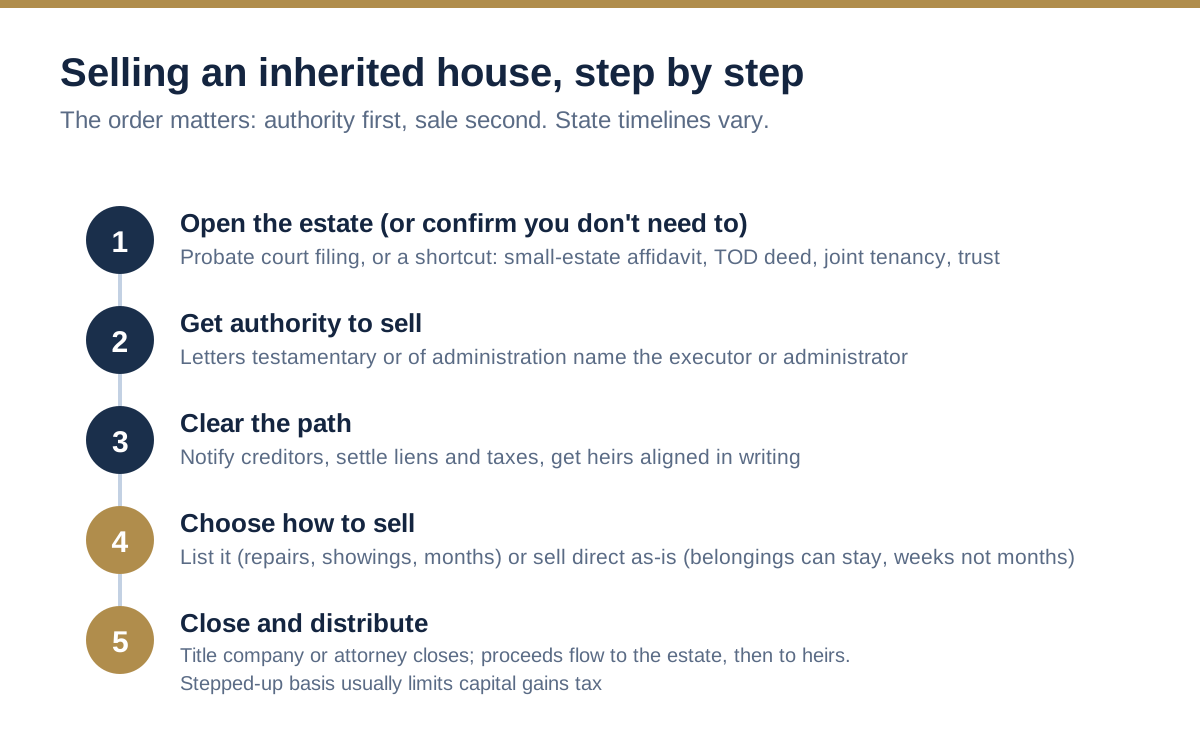
First, it's a Uniform Probate Code state. Most Arizona probates are "informal": filed with the court registrar, no hearings, no judge unless someone objects. The personal representative gets letters of appointment, usually within a few weeks, and can then sell estate property much like a normal owner. Uncontested estates commonly wrap in 6 to 12 months, but here's the part heirs miss: the house sale rarely has to wait for the estate to close. Our probate guide walks through who has authority and when.
Second, the small-estate shortcut got dramatically bigger. Under A.R.S. 14-3971, as amended by House Bill 2116 in 2025 (effective September 26, 2025), real property with up to $300,000 in equity, measured by assessed value net of liens, can transfer to heirs by recorded affidavit six months after death, no probate at all. The old cap was $100,000. Because Arizona assessed values run well below market prices, a large share of older Phoenix, Mesa, and Tucson housing stock now fits under this threshold. Personal property gets a $200,000 cap with a 30-day wait. Check the numbers with a probate attorney; the calculation is equity, not sale price.
Third, Arizona is a community property state. When one spouse dies, the survivor generally takes title to community property with a full stepped-up basis on the entire house, not just half (this is the federal treatment of community property under IRC 1014). Combined with the step-up all heirs get on inherited property, most inherited-house sales in Arizona produce little or no capital gains tax if sold reasonably soon after death. Keep the date-of-death valuation documents.
The practical problem with inherited Arizona houses is rarely the law. It's the 1978 kitchen, the sun-cooked roof, and four heirs in three time zones. That's the exact situation our inherited house purchase process was built for: we make one firm written offer, present it to every heir at once, and let escrow flex around the legal timeline, whether that's informal probate or the six-month affidavit wait.
Selling Under Foreclosure Pressure: The Real Timeline
Arizona forecloses without a courtroom. Nearly all home loans here are secured by deeds of trust, and the lender's trustee sells the house at auction under the statutory power of sale (A.R.S. 33-807). The clock is precise:
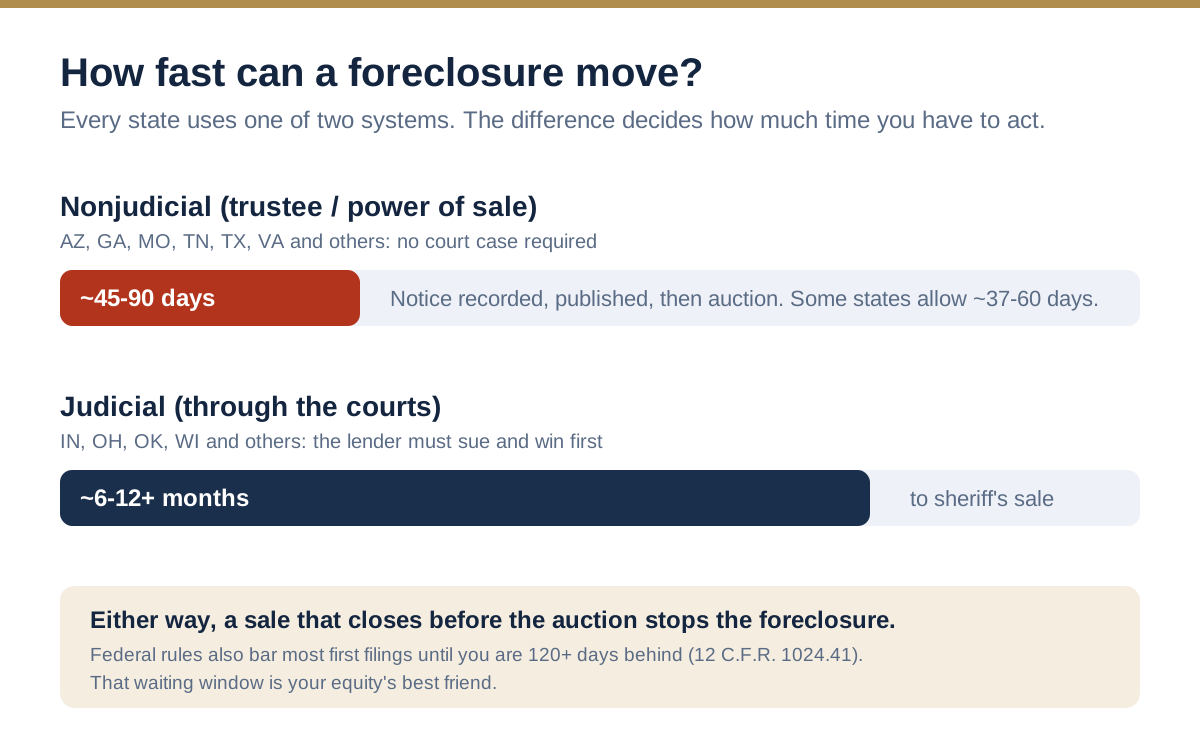
- Day 0: The trustee records a Notice of Trustee's Sale with the county recorder and mails it to you. Under A.R.S. 33-808, the auction date must be at least 91 days after recording.
- Days 1 through ~90: Your decision window. You can reinstate, sell, or negotiate with the servicer. Nothing about the notice stops you from selling the house; you own it until the auction.
- Reinstatement deadline: Under A.R.S. 33-813, you can reinstate the loan, paying only the missed payments plus fees and costs, not the full accelerated balance, until 5:00 p.m. on the last business day before the sale.
- Sale day: The trustee auctions the house. Arizona has no post-sale redemption after a trustee's sale. When the gavel falls, your ownership ends, and any surplus above the debt gets distributed through a claims process.
Two more Arizona-specific facts matter here. The good one: Arizona's anti-deficiency statute (A.R.S. 33-814(G)) generally bars the lender from suing you for the shortfall after a trustee's sale of a property of 2.5 acres or less used as a single one- or two-family dwelling. If you're underwater, the auction usually ends the debt, though it still wrecks your credit and burns any equity.
The sobering one: most Arizona owners in foreclosure today are not underwater. After years of appreciation, the typical distressed Phoenix-area owner has real equity, and a trustee's sale is the single worst way to harvest it. Auction bidders price for profit, and surplus recovery is slow and uncertain.
Ninety-one days is enough time to close a conventional sale once, or a cash sale three times over. We've stopped foreclosures by closing two weeks after the first phone call, paying off the lender through escrow, and wiring the owner the difference.
If you're earlier in the process, our guide on selling before foreclosure maps every exit while you still have all of them.
What Selling Actually Costs in Arizona
Arizona's seller costs are among the lowest in the country, which makes it worth itemizing exactly where the money goes.
- Transfer tax: $0. Arizona voters banned real estate transfer taxes constitutionally in 2008 (Proposition 100, passed with about 77% of the vote, now Article IX, Section 24 of the Arizona Constitution). The only government charge at recording is a flat $30 recording fee (A.R.S. 11-475). Compare that to states charging 1 to 2% of the price and you're keeping thousands by geography alone.
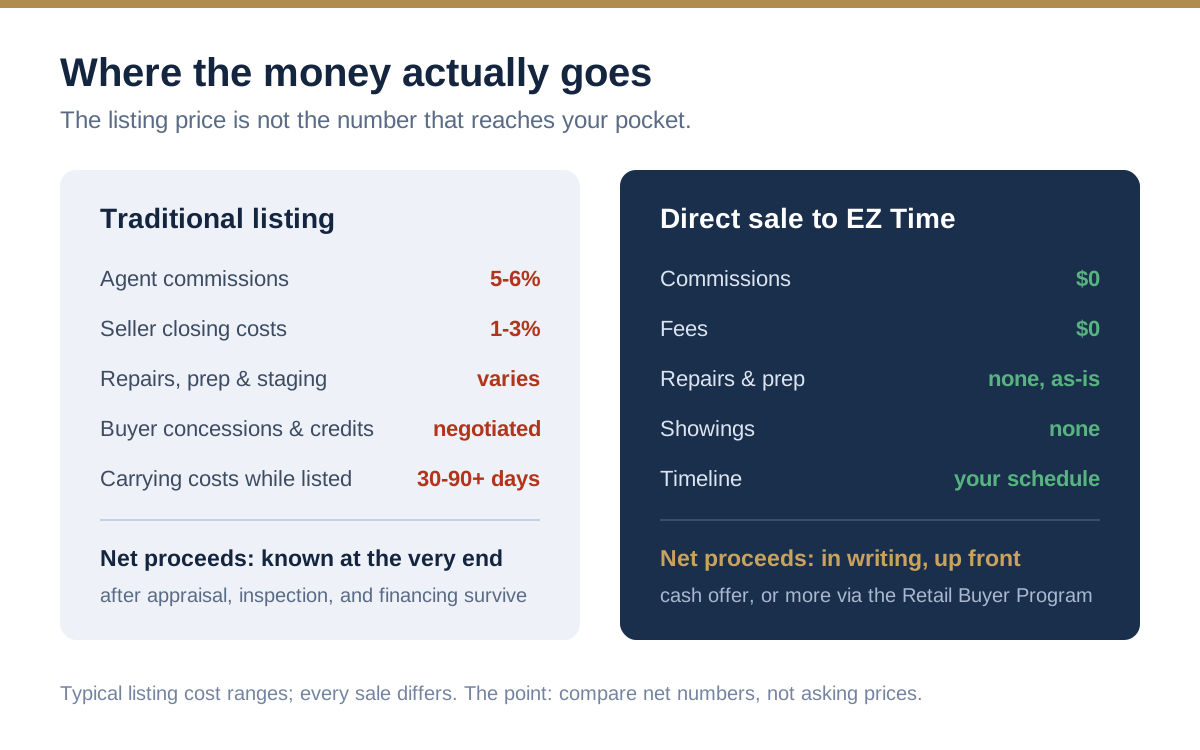
- Commissions: 5 to 6% if you list. On a $410,000 metro Phoenix house (roughly the current average per Zillow and Redfin data), that's $20,500 to $24,600 off the top, the largest single line on most settlement statements.
- Title and escrow: roughly $1,500 to $3,000 combined. The owner's title insurance policy (customarily seller-paid in Arizona) plus the escrow fee, which is usually split 50/50 between buyer and seller.
- Property tax proration: small. Arizona's effective property tax rate runs around 0.4 to 0.5%, among the lowest four states. Taxes are billed in arrears in two installments (due October 1 and March 1), so escrow credits the buyer for your ownership days. On a typical house this is hundreds, not thousands.
- Buyer concessions and repairs: the wild card. In a rising-inventory market, retail buyers routinely extract 1 to 3% in concessions plus inspection-driven repair credits. Budget for it if the house isn't turnkey.
- HOA transfer costs, if applicable: covered below, capped by statute.
A direct sale rewrites that list. When we buy, there's no commission, we pay standard closing costs, there are no repair credits because the price already reflects condition from our walkthrough, and there's no concession round because there's no financed buyer.
Our offer is built from the after-repair value, minus repairs, minus our margin, all shown in writing. It will be less than a perfect retail outcome on a perfect house; on a worn house it frequently nets within a few percent of listing once you subtract commissions, repairs, concessions, and months of carrying costs.
And for houses in solid shape, our Retail Buyer Program can beat a typical cash offer by marketing the property to our network of end buyers while you keep a guaranteed floor, more than the standard investor number, with the math shown in writing so you can verify it.
Run your own numbers with the cash offer calculator and check them against a listing agent's net sheet.
Capital gains: the federal and Arizona picture
If the house was your primary residence for two of the last five years, IRC Section 121 excludes up to $250,000 of gain ($500,000 married filing jointly) from federal tax. Most Arizona homeowners owe nothing on a primary-residence sale.
Above the exclusion, or on rentals and second homes, federal long-term capital gains rates of 0, 15, or 20% apply, plus depreciation recapture on rentals. Arizona then taxes the gain as ordinary income at its flat 2.5% rate, softened by a 25% subtraction for long-term capital gains (A.R.S.
43-1022), which as of January 1, 2026 applies to all long-term gains regardless of when you acquired the asset, putting the effective Arizona rate near 1.875% (Arizona Department of Revenue). Inherited property, remember, usually has a stepped-up basis, so "gain" is measured from date-of-death value, not what your parents paid in 1989.
Arizona Scenarios That Change the Playbook
You're in an HOA (statistically, you probably are)
Roughly a third of Arizona homes sit in an association, and the share is far higher in newer Phoenix suburbs. When you sell, the buyer gets a resale disclosure packet, and Arizona caps what the HOA can charge for it: no more than $400 total for the resale documents and related transfer services, plus at most a $100 rush fee and a $50 update fee (A.R.S.
33-1806 for planned communities; A.R.S. 33-1260 for condos). Order the packet early. Unpaid assessments become escrow payoffs, and an HOA lien surfacing in the title search is a fixable, common event, not a deal killer.
You own a rental, especially from out of state
Every Arizona residential rental must be registered with the county assessor, and out-of-state owners must designate an in-state statutory agent (A.R.S. 33-1902). Cities stack fines on unregistered rentals. If you're a remote landlord whose Maricopa County paperwork has drifted, selling with tenants in place resolves registration, agent, lease, and deposit obligations at a single closing; the lease transfers to the buyer by law.
The house is in Phoenix, Mesa, or Tucson and needs real work
Sun and time are hard on Arizona housing stock: 20-year shingle roofs that actually last 15, HVAC systems that die in July, original interiors from the Eisenhower through Carter administrations. Retail buyers in today's plateaued market skip these houses or bid brutally.
This is the core of what we buy in Phoenix, Mesa, and Tucson: as-is, contents included if you want, with the repair math on paper.
You live out of state (snowbird estates, relocations)
Arizona closings don't require your presence. Escrow companies handle mail-away and remote notarization routinely, and we close with out-of-state sellers, often heirs of snowbird parents, as a standard practice. One item for non-residents: on some sales, escrow may apply state and federal withholding rules for out-of-state or foreign sellers (FIRPTA federally); the escrow officer flags this early, and it's a prepayment, not an extra tax.
A note on all of the above: we buy houses for a living, we are not attorneys or CPAs, and this guide is general information rather than legal or tax advice. For probate filings, foreclosure defense, or an unusual title problem, spend the few hundred dollars on an hour with an Arizona professional. It's the cheapest insurance in this business.
If the simpler path fits, we're here: a written, itemized cash offer on any Arizona house, any condition, on your timeline, with escrow doing exactly what Arizona escrow does best.
From the buyers
How EZ Time Home Buyers Can Help in Arizona
We buy houses across Arizona, and everything above is the world we work in every week. If the timelines or repair math in this guide are pushing you toward a direct sale, we'll give you a written cash offer with the math shown line by line: after-repair value, repair budget, our margin. And if the cash number doesn't work for you, our Retail Buyer Program is a second path that typically nets more than a typical cash offer while we handle the work, with no commissions or fees on either path.
Frequently Asked Questions
Do I need a lawyer to sell a house in Arizona?
No. Arizona is an escrow state: a licensed title/escrow company handles the closing, the deed, and the money, and no attorney is required by law. That said, we tell people to hire one anyway in three situations: an active probate, a foreclosure with junior liens or an HOA lawsuit attached, or a title defect the escrow officer can't cure with routine paperwork. An hour of Arizona real estate attorney time typically costs $250 to $450 and can save the whole deal.
Does Arizona have a real estate transfer tax?
No, and it can't create one without amending the constitution. Proposition 100, passed by about 77% of voters in 2008, added Article IX, Section 24 to the Arizona Constitution, prohibiting any new tax or fee on the sale or transfer of real property. The only government charge when your deed records is a flat $30 recording fee (A.R.S. 11-475). Your settlement statement will show payoffs, prorated property taxes, and title/escrow fees, but no percentage-based tax line.
How long does foreclosure take in Arizona?
The legal minimum is 91 days from the recording of the Notice of Trustee's Sale to the auction (A.R.S. 33-808), and in practice most sales happen at or shortly after that mark, sometimes later if the trustee postpones. You can reinstate the loan by paying just the arrears plus fees until 5:00 p.m. the last business day before the sale (A.R.S. 33-813), and you can sell the house any time before the auction. What you cannot do is undo the sale afterward: Arizona has no post-sale redemption for trustee's sales, so the 91-day window is the whole game.
Can I sell an inherited house before probate closes in Arizona?
Usually yes. Once the court issues letters of appointment, which in Arizona's informal probate process often takes only a few weeks, the personal representative can generally sell estate real property without waiting for the estate to close, and the proceeds flow into the estate account for later distribution. Smaller estates may skip probate entirely: under A.R.S. 14-3971 as amended in 2025, real property with up to $300,000 in equity (assessed value net of liens) can pass to heirs by affidavit six months after death, and the heirs then sell as owners. We regularly write firm offers that stay open while either path plays out.
Related Guides
Ready to see both of your numbers?
Tell us about your property once and get a written cash offer, plus what our Retail Buyer Program could net you instead. No repairs, no fees, no pressure to accept.