
The Arizona Foreclosure Process: Timeline, Your Rights, and Ways Out
By Carson Whaley · Updated August 26, 2026 · 8 min read
Arizona forecloses without a courtroom: once the trustee records a Notice of Trustee's Sale, the auction can happen just 91 days later (A.R.S. 33-808), and there is no getting the house back afterward. The full clock from your first missed payment is closer to seven months, and every day of it is usable. Here's the whole process, stage by stage, with what you can still do at each one.
The Arizona Foreclosure Timeline, Stage by Stage
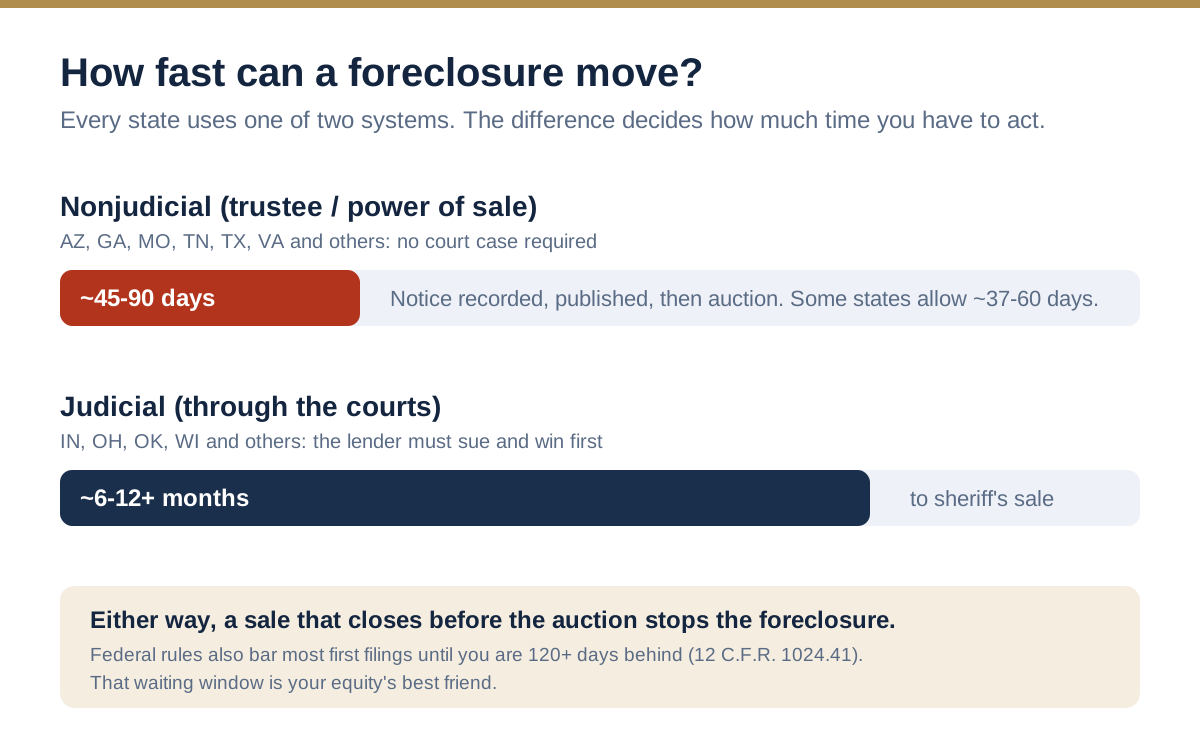
Nearly every Arizona home loan is secured by a deed of trust, not a mortgage in the courtroom sense. That distinction is the whole story: a deed of trust lets the lender's trustee sell the house at auction under a statutory power of sale (A.R.S. 33-807), no lawsuit, no judge, no jury. It's fast, it's mechanical, and the dates are knowable in advance. Here's the sequence.
Months 1 Through 4: Delinquency, Not Foreclosure
After a missed payment, you'll get late fees, then calls and letters from the servicer. Federal law builds in a long runway here: under 12 C.F.R. 1024.41(f), the servicer generally cannot make the first foreclosure filing until you are more than 120 days delinquent. Those four months are pure option time, and the people who come out of this with money in hand are the ones who use them.
Day 0: The Notice of Trustee's Sale
The trustee records the notice with the county recorder, setting the auction date. Under A.R.S. 33-808, that date must be at least 91 days after recording. The notice also gets mailed to you within five business days (A.R.S. 33-809), published in a newspaper, and posted at the property. This recorded notice is public, which is why your mailbox fills with investor letters the same week.
Days 1 Through 90: The Decision Window
Nothing about the notice changes who owns the house. You do, until the gavel falls. You can reinstate, negotiate, or sell it during this entire window.
Sale Day: Auction, Trustee's Deed, No Redemption
The auction is a public sale, usually at or near the county courthouse. Bidders other than the lender must post a $10,000 deposit to participate (A.R.S. 33-810), and the winner pays the balance by 5:00 p.m. the next business day. The lender opens with a credit bid, essentially bidding its own debt. If nobody outbids it, the lender takes the house. The trustee's deed then conveys title (A.R.S. 33-811), and Arizona has no post-sale redemption after a trustee's sale. There is no confirmation hearing, no waiting period, no undo.
Add it up: roughly 120 days of delinquency plus 91 days of notice means the realistic minimum from first missed payment to auction is about seven months, and trustees can and do postpone sales, sometimes repeatedly. But plan against the minimum, not the postponements.
Your Rights at Each Stage
Arizona gives homeowners fewer procedural off-ramps than judicial states (there's no court case to answer and no settlement conference requirement), but the rights it does give are strong and specific.
The right to loss mitigation review. If you submit a complete loss mitigation application to your servicer more than 37 days before the sale, federal rules generally require the servicer to review it before conducting the sale (12 C.F.R. 1024.41). Apply early and keep proof of everything you send.
The right to reinstate. This is the big one. Under A.R.S. 33-813, you can reinstate the loan by paying only the missed payments plus allowable fees and costs, not the full accelerated balance, at any time until 5:00 p.m. on the last business day before the sale. A $280,000 loan with $14,000 in arrears is cured for $14,000 plus costs, and the foreclosure simply ends.
The right to sell. You own the house until the auction. A sale that closes even one day before the trustee's sale pays off the lender in full through escrow and stops everything.
Protection from deficiency judgments. Arizona's anti-deficiency statute (A.R.S. 33-814(G)) generally bars the lender from suing you for any shortfall after a trustee's sale of a property of 2.5 acres or less used as a single one-family or two-family dwelling. For most homeowners, the auction ends the debt even if the bid doesn't cover it. Where a deficiency claim is possible, the lender must file suit within 90 days of the sale or the debt is treated as fully satisfied (A.R.S. 33-814(A), (D)).
The right to surplus funds. If the auction brings more than the debt, the excess goes through a claims process under A.R.S. 33-812, with junior lienholders paid before you. Real money does get returned this way, but slowly, on the court's schedule, months later.
What you don't have: any right of redemption after the sale, and any judge reviewing whether the sale price was fair. The 91 days are the whole game.
Every Real Way Out
Every exit from an Arizona foreclosure falls into one of six doors, and all six are open on day one. They close one by one as the sale date approaches.
- Catch up. If the arrears are manageable, reinstatement under A.R.S. 33-813 is the cleanest fix. Get an exact reinstatement quote from the trustee in writing; the number grows monthly with fees.
- Loan modification. The servicer reworks the loan, often moving the arrears to the back of the term. Realistic if your income has recovered; slow and paperwork-heavy if it hasn't.
- Forbearance or a repayment plan. A pause or a catch-up schedule. These help with temporary setbacks, a job gap or a medical event, not a permanent income drop.
- Bankruptcy. Filing triggers an automatic stay that immediately halts the trustee's sale, and a Chapter 13 plan can spread the arrears over years, at real cost to your credit and with attorney fees attached.
- Deed in lieu of foreclosure. You hand the lender the keys and walk away without an auction on your record. It's an orderly surrender, and that's the problem: you surrender every dollar of equity along with the keys.
- Sell before the sale. The only exit where the equity leaves with you. Our guide to selling before foreclosure walks through this door in detail.

Which door is right depends on one honest question: can you actually afford this house going forward? If yes, fight for reinstatement or modification. If no, then forbearance just delays the same cliff, and the real choice is between the exits, ranked by how much of your money you keep.
The Equity Math: Selling vs. Letting It Go
Here's the part that matters most in 2026: most Arizona homeowners in foreclosure are not underwater. After years of appreciation, the typical distressed owner in metro Phoenix or Tucson has six figures of equity, and a trustee's sale is the single worst way to harvest it.
Think through what actually happens at auction. The lender credit-bids its debt, say $240,000 on a house worth $400,000. Third-party bidders only go higher if there's profit in it for them, and they're bidding cash, sight unseen inside, with payment due by 5:00 p.m. the next business day. So they bid the way you'd expect: well below market, pricing in risk, repairs, and their margin. If the winning bid is $310,000, your $160,000 of equity just became a $70,000 surplus claim, filed under A.R.S. 33-812, paid after junior liens, months from now. The difference evaporated into the mechanism.
Now run the same house through a sale you control. Even a discounted as-is sale at $360,000 pays off the $240,000, pays no commissions if it's a direct sale, and wires you the difference at closing, before the auction ever happens. We've stopped Arizona foreclosures exactly this way: cash offer in writing, escrow opened the same week, lender paid off through title, owner's equity wired at recording. On houses in good condition, our Retail Buyer Program can bring more than a typical cash offer, with the same fast, simple process, which matters when the calendar is the whole problem.
And if you're underwater rather than equity-rich, the math inverts: the anti-deficiency statute means letting the trustee's sale happen may genuinely be the least-bad outcome for your finances, though your credit takes the full foreclosure hit. Anyone who tells you selling is always the answer is selling something. Run your numbers first: current payoff, arrears, realistic value, in that order.
Using the 91 Days Well
The owners who lose the most in Arizona foreclosures aren't the ones with the worst finances. They're the ones who spent days 1 through 60 hoping and days 61 through 91 panicking. A better calendar:
Week 1: Read the recorded notice and confirm the sale date. Request a payoff statement and a reinstatement quote in writing. Get a realistic value on the house, not the Zestimate, so you know whether you're protecting equity or walking from debt.
Weeks 2 through 4: If you're keeping the house, submit the complete loss mitigation application now, while the 37-day federal review window is comfortably open. If you're selling, get offers now; every week of delay adds fees to the payoff and subtracts negotiating room.
By day 45: Commit to a path. A conventional listed sale needs most of the remaining clock to close, and a financed buyer's timeline failing in week 10 leaves you nothing. A cash closing needs 7 to 14 days once escrow opens, which means even day 70 is workable, but choosing at day 85 is gambling.
The last week: Reinstatement is still legally possible until 5:00 p.m. the last business day before the sale (A.R.S. 33-813), and trustees do postpone sales when a payoff is in escrow. But nothing about this process rewards arriving at the deadline.
Statewide, the same playbook applies whether the house is in Mesa, Glendale, or anywhere else we buy in Arizona; the statutes don't change by county, only the recorder's office does. And a necessary caveat: we buy houses, we don't practice law. This guide is general information, not legal advice, and a HUD-approved housing counselor (free) or an Arizona foreclosure attorney can tell you exactly where you stand before the clock decides for you.
From the buyers
How EZ Time Home Buyers Can Help Before Foreclosure
A sale that closes before the auction pays off the loan, stops the foreclosure, and puts your remaining equity in your pocket instead of losing it at the courthouse. We close in as little as 2-3 weeks, coordinate payoff directly with your lender through a licensed title company, and show you the math in writing before you commit to anything. No fees, and no pressure: if keeping the house is possible, we'll say so.
Frequently Asked Questions
How long does the foreclosure process take in Arizona?
Measured from the first missed payment, the realistic minimum is about seven months: federal rules generally bar the first foreclosure filing until you're more than 120 days delinquent (12 C.F.R. 1024.41(f)), and once the Notice of Trustee's Sale is recorded, the auction must be at least 91 days out (A.R.S. 33-808). Many foreclosures run longer because trustees postpone sales, but Arizona is still one of the fastest foreclosure states in the country because no court case is required.
Can I stop a trustee's sale in Arizona?
Yes, up until the deadline. You can reinstate the loan by paying just the missed payments plus fees, not the full balance, until 5:00 p.m. on the last business day before the sale (A.R.S. 33-813). You can also sell the house any time before the auction, since you own it until the gavel falls; a closing that pays off the lender through escrow ends the foreclosure. A bankruptcy filing triggers an automatic stay that halts the sale immediately. What you cannot do is reverse the sale afterward: Arizona has no post-sale redemption for trustee's sales.
Will I owe the bank money after an Arizona foreclosure?
Usually not. Arizona's anti-deficiency statute (A.R.S. 33-814(G)) generally prevents the lender from suing you for the shortfall after a trustee's sale of a property of 2.5 acres or less used as a single one-family or two-family dwelling, so for most homeowners the auction extinguishes the debt even when the bid falls short. Where a deficiency action is allowed, the lender must file it within 90 days of the sale or the debt is deemed fully satisfied (A.R.S. 33-814(A), (D)). Second mortgages and HELOCs can complicate the picture, so have an attorney review your specific loans.
What happens to my equity if my Arizona house sells at auction?
Any amount bid above the total debt becomes excess proceeds, distributed through a claims process under A.R.S. 33-812, with junior lienholders paid before you see anything. The deeper problem is that auctions rarely bid anywhere near market value: buyers pay cash, can't inspect the interior, and must close by the next business day, so they bid with a heavy discount built in. An owner with real equity almost always keeps far more by selling before the sale date, even at an as-is price, because the payoff happens through escrow and the remaining equity wires directly to them at closing.
Related Guides
Ready to see both of your numbers?
Tell us about your property once and get a written cash offer, plus what our Retail Buyer Program could net you instead. No repairs, no fees, no pressure to accept.