
The Georgia Foreclosure Process: Timeline, Your Rights, and Ways Out
By Eric Roebuck · Updated August 27, 2026 · 8 min read
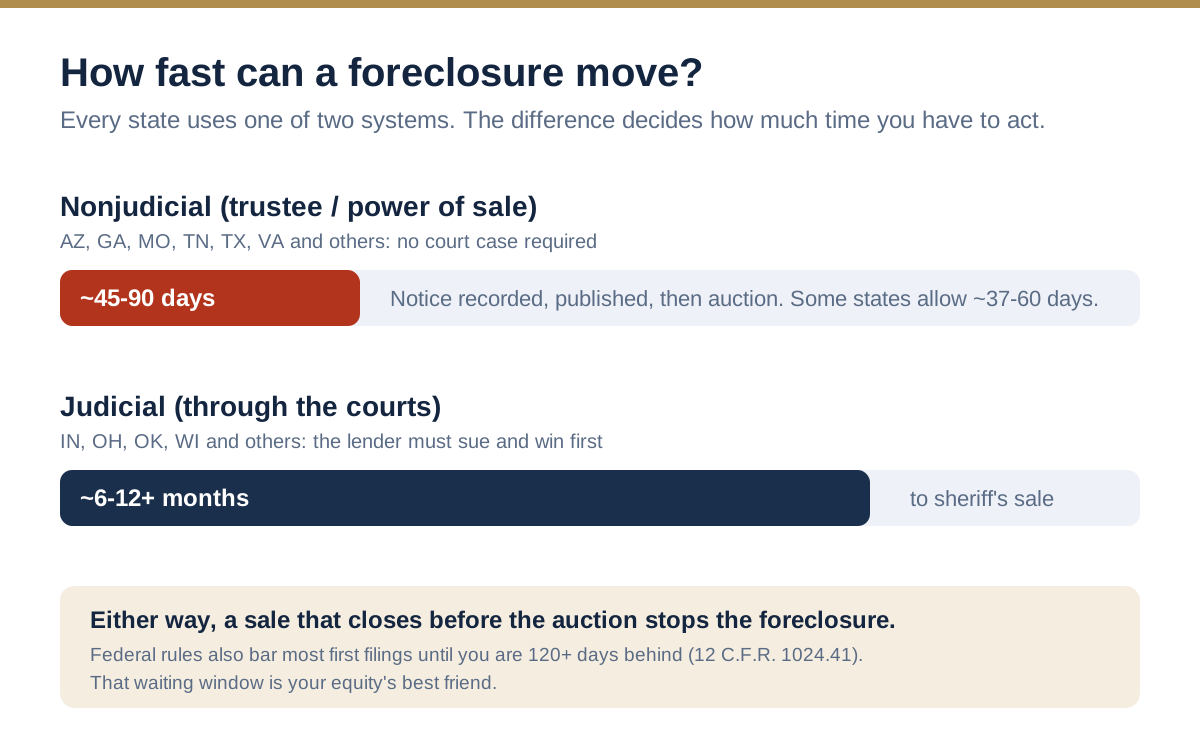
Georgia runs the fastest foreclosure clock in the country: once the lender mails the sale notice required by O.C.G.A. 44-14-162.2, the courthouse-steps auction can happen in as little as 37 days, and there is no right of redemption afterward. A federal rule does add a cushion up front, since the process can't formally start until you're more than 120 days behind. Here is every stage, every right you hold at each one, and every real way out.
Why Georgia Foreclosures Move So Fast
Georgia is a nonjudicial, power-of-sale state. When you bought your house, you almost certainly signed a security deed rather than a mortgage, and buried in it is a clause that lets the lender sell the house at public auction if the loan defaults, without filing a lawsuit, without a judge, without a court date. No complaint, no answer, no hearing. The entire legal process is a mailed notice, four newspaper ads, and a crier on the courthouse steps.
That structure is why homeowners who moved here from judicial states get blindsided. In New York or Florida, foreclosure means a court case that grinds on for a year or more. In Georgia, the formal process is measured in weeks. Understanding exactly where you are on the timeline is the difference between having options and having none.
The Timeline, Stage by Stage
From the first missed payment to the auction, a typical Georgia foreclosure runs five to seven months, but almost all of that cushion sits at the front, before the formal process begins. Once the notice goes out, the clock sprints.
Stage 1: Missed Payments and the Federal 120-Day Floor
After a missed payment comes a grace period, usually 15 days, then late fees and collection calls. Federal servicing rules prohibit the servicer from making the first official foreclosure filing or notice until you are more than 120 days delinquent (12 C.F.R. 1024.41(f)). Those four months are your quiet window: nothing public has happened, every option is still open, and the people who come out whole are almost always the ones who acted here.
Stage 2: Demand and Acceleration
Your security deed typically requires the lender to send a default letter giving you roughly 30 days to cure before accelerating the loan, meaning the entire balance comes due, not just the missed payments. This letter is contractual, not statutory, but nearly every standard security deed contains it.
Stage 3: The 30-Day Sale Notice
This is Georgia's one hard statutory requirement. The lender must send written notice of the sale no later than 30 days before the sale date, by registered or certified mail or overnight delivery, to the property address or your last known address (O.C.G.A. 44-14-162.2).
The notice must identify the entity with full authority to negotiate, amend, and modify the loan's terms, with a name, address, and phone number. If you get this letter, the sale date inside it is real. Calendar it.
Stage 4: Four Weeks of Advertising
The sale must be advertised once a week for four consecutive weeks in the county's legal organ newspaper, following the same rules as sheriff's sales (O.C.G.A. 44-14-162, 9-13-140 through 9-13-142). The ad runs with your name and the property's legal description. This usually overlaps the 30-day notice period rather than adding to it.
Stage 5: The First-Tuesday Auction
Sales happen on the first Tuesday of the month between 10 a.m. and 4 p.m. at the county courthouse, at public outcry (O.C.G.A. 9-13-161); if the first Tuesday lands on January 1 or July 4, it slides to Wednesday. Add the pieces up and the minimum from notice to gavel is about 37 days. Two months is common. When the crier finishes, ownership transfers, and Georgia gives you no statutory right of redemption after a foreclosure sale. There is no buying it back.
After the sale. You become a tenant at sufferance in your own former house, and the new owner can pursue dispossessory (eviction) proceedings through magistrate court. Any surplus above the debt and costs belongs to you, but see the deficiency rules below for the other direction.
Your Rights at Each Stage
The right to pay off the loan, up to the sale. You can stop the foreclosure at any point before the auction by paying the full amount owed, which after acceleration means the entire balance plus fees and costs. Refinancing or a completed sale of the house accomplishes the same thing.
Reinstatement: contractual, not statutory. Georgia law gives no general statutory right to reinstate, that is, to catch up the arrears and continue the loan as before. But the standard Fannie Mae/Freddie Mac security deed used in most Georgia loans grants a contractual reinstatement right, commonly exercisable until at least five days before the sale. Pull out your security deed and read the reinstatement paragraph, because that contract term is the closest thing Georgia borrowers have to a cure deadline.
Loss mitigation review. If you submit a complete loss mitigation application more than 37 days before the sale, federal rules require the servicer to review it and generally bar the servicer from moving to sale while a timely first application is pending (12 C.F.R. 1024.41). This is the anti-dual-tracking rule, and it's the reason to submit paperwork completely and early rather than piecemeal.
Deficiency protection through confirmation. If the auction brings less than you owe, the lender can only pursue you for the shortfall if it reports the sale to a superior court judge within 30 days and gets the sale confirmed, which requires the court to find the property brought its true market value (O.C.G.A. 44-14-161). Many lenders skip confirmation on residential loans, so most Georgia homeowners never face a deficiency suit. But that's a probability, not a guarantee, and it does nothing to recover your lost equity.
Georgia has no settlement conference or mandatory mediation program, no judicial check before the sale, and no post-sale redemption. Every protection you have lives in the federal servicing rules, your security deed's own terms, and the notice statute. If the lender botched the notice, a wrongful foreclosure claim exists, but that's a lawsuit after the fact, not a shield before it.
Every Real Way Out
We buy houses from Georgians in foreclosure every month, and we'll tell you what we tell them: selling is one option, not the only one. Here's the honest menu.
Catch up or reinstate. If the shortfall is a few months of payments and your income has recovered, ask the servicer for a repayment plan or exercise the contractual reinstatement right. Cheapest fix by far.
Loan modification. The servicer reworks the loan's rate, term, or balance to make the payment sustainable. Real, but slow: apply early, because a modification review started after the sale notice arrives is racing a 37-day clock.
Forbearance. A documented pause or reduction in payments for a temporary hardship, with the missed amounts resolved later. Works when the problem is temporary. It only postpones the math if the problem isn't.
Bankruptcy. Filing triggers an automatic stay that halts the sale immediately, and a Chapter 13 plan can stretch arrears over three to five years, at the cost of a long credit event and a court-supervised budget.
Deed in lieu. You hand the lender the keys and the deed, they cancel the debt. It avoids the auction, but it surrenders every dollar of equity, so it only makes sense when there's no equity to protect.
Sell before the sale. A completed closing pays off the loan, ends the foreclosure entirely, and puts your equity in your pocket instead of leaving it on the courthouse steps. The rest of this guide is about when that's the right call, and our stop foreclosure guide covers the keep-the-house routes in more depth.
The Equity Math Nobody Runs Until Too Late
Here's what actually happens at a first-Tuesday auction. The lender opens with a credit bid, typically the debt plus fees, because it can bid its own note without cash. Third-party bidders must pay cash essentially on the spot, so they bid like wholesalers, deep below market, or not at all. Auction prices routinely land far under what a negotiated sale would bring.
Run the numbers on a $250,000 house with a $160,000 payoff. Sold before the auction, even at a discount for speed and condition, the loan clears and tens of thousands come back to you at closing.
At auction, if the house brings only the credit bid, your $90,000 of equity vanishes in one gavel stroke, and no confirmation statute brings it back. The foreclosure also rides your credit report for seven years, against roughly two for most short sales.
Losing a house with equity at auction is the single most expensive outcome available, and it's the default outcome if you do nothing.

What a Fast Sale Actually Looks Like Against This Clock
A listed sale needs prep, marketing, a buyer's 7 to 14 day due diligence window, and a 30 to 45 day financed closing. Against a 37 to 60 day foreclosure runway, that math usually fails unless the notice just arrived and the house shows well.
A direct sale is built for this clock. We walk the house once, put a written offer in front of you the same day with the numbers shown, and close in two to three weeks when title is clean, through a licensed Georgia closing attorney as state law requires.
The payoff goes straight from the attorney to your lender, the foreclosure dies at funding, and the balance wires to you. If your house is in good condition, our Retail Buyer Program typically nets more than a typical cash offer with the same short timeline.
And if your timeline is genuinely too tight, we'll say so on that first call, because a contract that can't close before the auction helps nobody.
We work this exact situation across Georgia, from Atlanta to Columbus and Augusta, where first-Tuesday crowds gather at every county courthouse.
The timing mechanics are laid out in can I sell my house before foreclosure.
What to Do the Week the Notice Arrives
Treat the 30-day notice as a project plan, not a death sentence. First, confirm the sale date and calendar it, then count backward: any solution must fund before that Tuesday.
Second, call the entity listed in the notice, they are legally required to have authority to modify the loan, and ask for your reinstatement figure and payoff figure in writing. Third, pull your security deed and read the reinstatement paragraph so you know your contractual deadline.
Fourth, decide which path fits your real situation: keep the house if the payment is sustainable, sell it if the house has equity and the payment isn't.
Fifth, if selling, start now, because a payoff already sitting in a closing attorney's escrow is the strongest argument anyone can make for postponing a sale, and postponement requests need to land well before sale week. Whatever you choose, choose it in week one. Georgia's clock does not offer a week two that looks any better.
Our full Georgia selling guide covers what happens at the closing table once you're under contract.
This guide is general information about Georgia foreclosure law, not legal advice. For advice on your specific loan or sale, talk to a Georgia-licensed attorney or a HUD-approved housing counselor.
From the buyers
How EZ Time Home Buyers Can Help Before Foreclosure
A sale that closes before the auction pays off the loan, stops the foreclosure, and puts your remaining equity in your pocket instead of losing it at the courthouse. We close in as little as 2-3 weeks, coordinate payoff directly with your lender through a licensed title company, and show you the math in writing before you commit to anything. No fees, and no pressure: if keeping the house is possible, we'll say so.
Frequently Asked Questions
How long does the foreclosure process take in Georgia?
Formally, it's the fastest in the country: the lender sends a sale notice at least 30 days before the auction (O.C.G.A. 44-14-162.2), advertises four consecutive weeks in the county legal organ, and sells on the first Tuesday of the month, a minimum of about 37 days from notice to gavel. Counting from the first missed payment, the realistic total is five to seven months, because federal rules bar the first foreclosure step until you're more than 120 days delinquent (12 C.F.R. 1024.41). Nearly all of your usable time sits in that front window.
Can I stop a Georgia foreclosure after I get the 30-day notice?
Yes, several ways. You can pay the full accelerated balance any time before the sale, exercise a contractual reinstatement right if your security deed grants one (the standard Fannie/Freddie deed allows it until at least five days before the sale), file bankruptcy to trigger the automatic stay, or close a sale of the house before the auction date, which pays off the loan and ends the foreclosure entirely. A complete loss mitigation application submitted more than 37 days before the sale also generally pauses the sale while it's reviewed. What you cannot do is wait: 37 days leaves no room for a plan B.
Can I get my house back after a Georgia foreclosure sale?
No. Georgia provides no statutory right of redemption after a nonjudicial foreclosure sale; once the auction concludes on the courthouse steps, ownership transfers and the previous owner becomes a tenant at sufferance facing dispossessory proceedings. Don't confuse this with Georgia tax sales, where a 12-month redemption period does exist. For a mortgage foreclosure, every option has to be exercised before the first-Tuesday sale, which is why the 30-day notice is effectively your final deadline.
Will I still owe money if my Georgia house sells at auction for less than I owe?
Only if the lender jumps through a specific hoop: it must report the sale to a superior court judge within 30 days and get the sale confirmed, including a finding that the property brought its true market value (O.C.G.A. 44-14-161). Without confirmation, no deficiency judgment is allowed, and many lenders skip it on residential loans. That protects you from a lawsuit, but not from losing your equity: any value above the debt that an auction fails to capture is simply gone, which is the strongest financial argument for selling before the sale instead.
Related Guides
Ready to see both of your numbers?
Tell us about your property once and get a written cash offer, plus what our Retail Buyer Program could net you instead. No repairs, no fees, no pressure to accept.