
Selling an Inherited House in Georgia: Probate, Taxes, and Your Options
By Carson Whaley · Updated August 26, 2026 · 9 min read
Georgia gives heirs more ways to sell an inherited house than almost any state: standard probate with letters issuing in roughly 2 to 6 months, a No Administration Necessary order when the heirs all agree, and a year's support award that can move the home to a surviving spouse ahead of most creditors. There is no Georgia estate or inheritance tax, and stepped-up basis usually erases most of the capital gain. Here's the whole path, from the probate court to the closing table.

First, How Title Actually Passes When Someone Dies in Georgia
Georgia has one of the more precise vesting rules in the country, and it explains why a sole heir still can't just sign a deed. When someone dies without a will, title to their real estate vests immediately in the heirs at law, but that title is subject to divestment: if the probate court appoints an administrator, title moves to the administrator for the benefit of heirs and creditors, and it only returns to the heirs when the administrator formally assents (O.C.G.A. 53-2-7). When there is a will, the named beneficiaries take the house through the executor, and the executor's assent is what perfects their title (O.C.G.A. 53-8-15). Either way, a title company examining an estate sale wants to see court authority or a court order before it insures the deal.
Some Georgia houses skip probate entirely. Property held jointly with right of survivorship passes to the surviving co-owner by recording a death certificate. A house in a living trust sells on the trustee's signature. And since July 1, 2024, Georgia recognizes transfer-on-death deeds (O.C.G.A. 44-17-1 through 44-17-7): if the owner recorded one, the named beneficiary takes title outside probate, but must record an acceptance affidavit with the death certificate within nine months of the death or the house falls back into the estate (O.C.G.A. 44-17-6). Check the deed record before assuming you need probate at all.
Everything below assumes the common case: the house was titled solely in the deceased's name, and some form of probate stands between you and a sale.
The Probate Paths, From Standard to Shortcut
Georgia probate runs through the probate court of the county where the deceased lived, and the state offers more routes to a signed deed than most heirs expect. Which one fits depends on whether there's a will, whether the heirs agree, and whether the estate owes money.
Standard Probate With a Will
The will is offered for probate, almost always in solemn form, meaning every heir gets notice and the order becomes binding quickly. Common form probate skips the notice but stays contestable for four years, which is why title companies dislike it. Once the court issues letters testamentary, the executor can sign a contract and a deed. Expect roughly 2 to 6 months from filing to letters depending on the county docket and whether anyone objects, and most Georgia wills grant the executor power of sale so no separate hearing on the sale itself is needed.
Administration Without a Will
No will means the same court and the same letters (called letters of administration), with the administrator selected by the heirs' agreement or the court. The administrator may need heir consent or court permission for certain powers, which the estate's attorney sorts out at the petition stage.
The No Administration Necessary Order
This is Georgia's signature shortcut. When the owner died without a will, all heirs agree on the division, and creditors are paid or on board, any heir can petition under O.C.G.A. 53-2-40 for an order declaring that no administration is necessary. The order (entered under O.C.G.A. 53-2-41) passes title straight to the heirs without anyone being appointed. For an unencumbered family house with cooperative siblings, this is often the fastest and cheapest route to a closing, though every heir then signs the deed.
Year's Support for a Surviving Spouse
A surviving spouse or minor children can petition under O.C.G.A. 53-3-1 for twelve months' support from the estate, and Georgia probate courts can and do award the family home itself. Property set aside as year's support is preferred ahead of nearly all other claims, so this route can transfer title and clear junior debts in one order. If you're a surviving spouse looking at an estate with more bills than cash, ask a probate attorney about year's support before anything else.
The sale itself does not wait for the estate to fully close. Once authority exists, the house can go under contract and close, with proceeds held in the estate account until distribution. The mechanics of who signs and when court approval matters are covered in our probate sale guide, and the broader rules of any Georgia closing are in our Georgia selling guide.
The Tax Picture Is Better Than Most Heirs Fear
Start with the good news, because there's a lot of it.
Georgia has no estate tax and no inheritance tax. The state's estate tax was eliminated for deaths on or after July 1, 2014 (O.C.G.A. 48-12-1), and Georgia has never taxed heirs on what they receive. Nothing is owed to the state simply because you inherited the house.
Federal estate tax is irrelevant for almost everyone. The federal exemption is $15 million per person in 2026. Unless the total estate approaches that, no federal estate tax return is even due.
Stepped-up basis does the heavy lifting. Under federal law, your cost basis in the house resets to its fair market value on the date of death. Sell for $260,000 a few months after inheriting a house worth $255,000 at death, and your taxable gain is roughly $5,000, not the difference from what your parents paid in 1987. This is why getting a date-of-death appraisal or a written valuation matters so much: it documents the basis. Keep every valuation record the estate produces.
Two Georgia-specific wrinkles. If you live outside Georgia, the buyer must withhold 3% of the price at closing under O.C.G.A. 48-7-128, but you can sign an affidavit of seller's gain (Form IT-AFF2) so the withholding applies only to actual gain, which for a stepped-up inherited house is often close to zero. And the transfer tax barely registers: about 0.1% of the price (O.C.G.A. 48-6-1), which is $250 on a $250,000 sale. The closing attorney handles both.
When There's More Than One Heir
One signer is simpler than four. While the house sits in the estate, the personal representative alone signs the contract and deed, which is why most estates that intend to sell do it before distributing the property. Once the house is deeded out to three siblings, every sibling signs, every sibling's judgments and tax liens attach to the title search, and every disagreement acquires deed-level stakes.
When heirs want different things, the workable options run in this order. A buyout: one heir purchases the others' shares at an agreed value, often using a small mortgage or the estate's cash. A negotiated sale with the proceeds split, which is what most families land on. And, as a genuine last resort, a partition action. Georgia was an early adopter of the Uniform Partition of Heirs Property Act (O.C.G.A. 44-6-180 through 44-6-189.1), which protects inherited cotenants better than old-style partition: the court orders an independent appraisal, gives the other heirs a chance to buy out the heir who filed, and prefers a supervised open-market sale over a courthouse auction. Those protections are real, but a partition case still burns a year and five figures in fees. Almost any negotiated outcome beats it.
Our observation from years of estate purchases: most heir standoffs are about information, not money. Send every offer and every document to every heir at the same time. We present offers on group calls for exactly this reason, one conversation, every question answered in front of everyone.
The House Itself: Belongings, Insurance, and an Empty Building
The legal process gets the attention, but the physical house creates most of the stress, especially when the heirs live elsewhere.

Belongings. Clearing a parent's house of forty years of possessions is the job nobody budgets for. Take the documents, photos, and anything with real or sentimental value, then decide honestly whether an estate sale is worth the weeks it takes. When we buy, heirs take what they want and leave the rest, furniture, garage, attic, all of it. That single term saves out-of-state families more grief than any price negotiation.
Insurance. Homeowner policies restrict or void coverage on vacancy, commonly after 30 to 60 days, and the owner's death itself can complicate the policy. Call the insurer early and ask for an estate or vacant-property endorsement. An uninsured vacant house is the estate's single biggest liability.
Security and upkeep. An obviously empty house draws break-ins, code citations, and in some Georgia cities, formal consequences: Atlanta runs a vacant property registry with fines, and Macon-Bibb applies a blight tax that multiplies the property tax on cited houses, details on our Macon page. Mow the yard, keep a lamp on a timer, and have a neighbor collect the flyers.
Your Selling Options, Compared Honestly
Georgia simplifies one thing for executors that trips up heirs in other states: there is no mandatory seller disclosure form to fill out or be exempted from. The state runs on caveat emptor with a duty to disclose latent defects you actually know about. An executor who never lived in the house typically knows little, and the law only requires disclosing what you know. Say what you know, hide nothing, and you're covered.
Listing With a Real Estate Agent
Listing is right for a house in genuinely good condition when the estate can wait. Plan on preparing and clearing the house first, a 7 to 14 day due diligence window during which the buyer can walk for any reason, financed closings of 30 to 45 days, and commissions commonly 5 to 6%. A dated house shows its age against renovated comps, and inspection renegotiation hits estates hardest because no one at the table can answer questions about the roof's history.
Selling As-Is to a Direct Buyer
We buy Georgia estate houses in any condition, contents included, and we put the offer in writing with the after-repair value, the itemized repair budget, and our margin shown. We can hold that firm offer while probate runs, so the estate closes within weeks of letters issuing. If the house is in decent shape, ask about our Retail Buyer Program, which typically nets more than a typical cash offer with the same simple process. Either way there are no commissions, we cover standard closing costs, and the closing lands on the estate's date, not a lender's.
Whichever path you choose, a licensed Georgia attorney must conduct the closing (O.C.G.A. 15-19-50). For an estate that's a feature, not a cost: a professional verifies the letters, clears the title, and wires each heir their share per the estate's instructions. Distant heirs sign by mail or remotely through the attorney's office, which is how we close for families across Georgia, from Savannah to the Atlanta suburbs, with one walkthrough and one signer.
A Practical Order of Operations
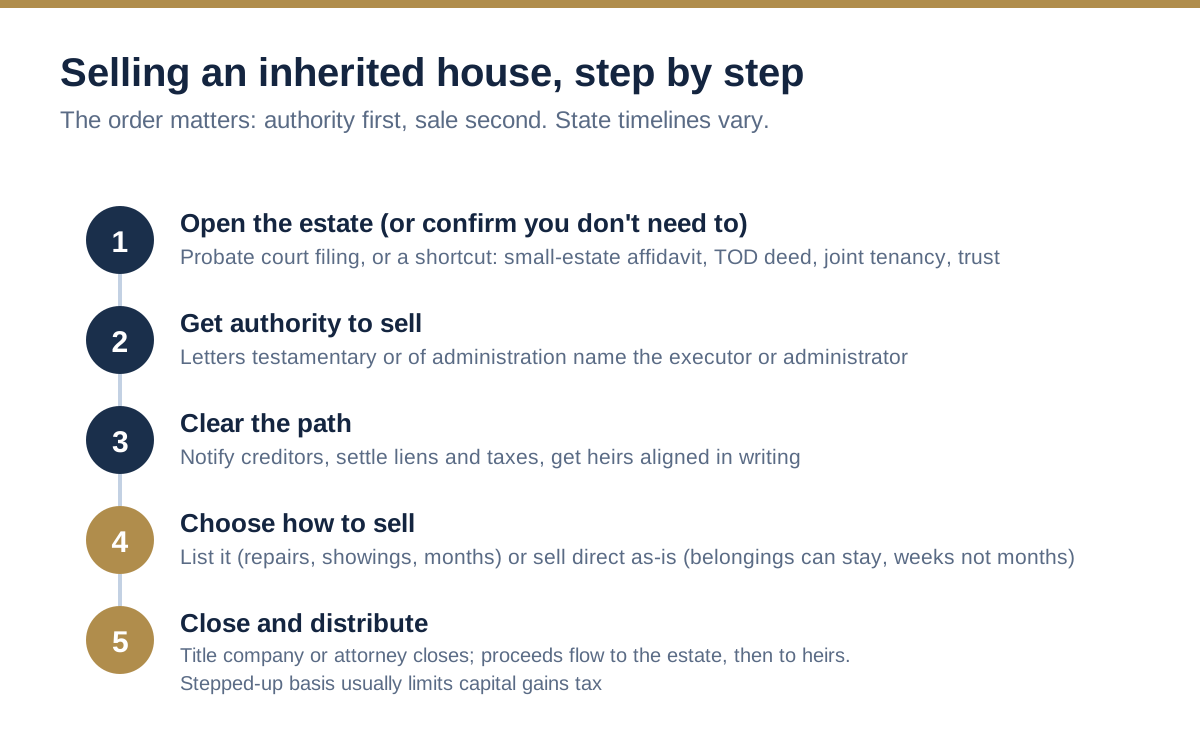
If you've just inherited a Georgia house, this sequence prevents most of the expensive mistakes. First, secure and insure the property this week, before anything legal happens. Second, check the deed record for survivorship language or a transfer-on-death deed before assuming probate is required. Third, sit down with a probate attorney and pick the right path: solemn form probate, administration, No Administration Necessary, or year's support. Fourth, get a date-of-death valuation in writing to lock in the stepped-up basis. Fifth, get every heir the same information at the same time. Then, and only then, decide how to sell. The deeper tax mechanics are in our inherited house guide.
This guide is general information about Georgia law, not legal or tax advice. For your specific estate, talk to a Georgia probate attorney or CPA.
From the buyers
How EZ Time Home Buyers Can Help With an Inherited House
We work with executors, heirs, and families in probate all the time, including houses full of belongings and houses three states away from everyone who inherited them. We buy as-is, work around court timelines, and put every offer in writing with the math shown. If the family wants more than a cash number, the Retail Buyer Program handles the work while typically netting more than a typical cash offer, with no commissions or fees.
Frequently Asked Questions
Do all heirs have to agree before we can sell an inherited house in Georgia?
It depends on the path. While the house is in the estate, the executor or administrator signs alone once letters issue, though a smart representative keeps every heir informed. A No Administration Necessary order (O.C.G.A. 53-2-40) requires all heirs to agree up front, and afterward every heir signs the deed. If the house has already been distributed into the heirs' names, every owner must sign. When one heir refuses, Georgia's Uniform Partition of Heirs Property Act (O.C.G.A. 44-6-180) governs the court fight, but a negotiated buyout is almost always cheaper and faster.
Does Georgia have an inheritance tax or estate tax?
No to both. Georgia's estate tax ended for deaths on or after July 1, 2014 (O.C.G.A. 48-12-1), and the state has never had an inheritance tax on what heirs receive. Federal estate tax only touches estates above $15 million per person in 2026. What matters for most heirs is stepped-up basis: your cost basis resets to the home's value at the date of death, so selling soon after inheriting usually produces little or no taxable capital gain.
How long does Georgia probate take before the house can be sold?
Letters testamentary or letters of administration typically issue 2 to 6 months after filing, depending on the county and whether anyone objects, and the sale can close as soon as authority exists; it does not wait for the estate to fully wrap up. Georgia's shortcuts can move faster: a No Administration Necessary order when heirs agree and debts are handled, or a year's support award (O.C.G.A. 53-3-1) moving the home to a surviving spouse. We can put a firm written offer in place while any of these run, so the estate closes within weeks of the order.
Do we have to withhold taxes at closing if the heirs live outside Georgia?
Georgia requires the buyer to withhold 3% of the purchase price when the seller is a nonresident (O.C.G.A. 48-7-128), and that catches out-of-state heirs selling a distributed house. Two softeners: sales under $20,000 are exempt, and you can sign an affidavit of seller's gain (Form IT-AFF2) so the 3% applies only to your actual gain, which is usually tiny on an inherited house thanks to stepped-up basis. The closing attorney prepares the paperwork; just flag heir residency early.
Related Guides
Ready to see both of your numbers?
Tell us about your property once and get a written cash offer, plus what our Retail Buyer Program could net you instead. No repairs, no fees, no pressure to accept.