
The Oklahoma Foreclosure Process: Timeline, Your Rights, and Ways Out
By Carson Whaley · Updated August 26, 2026 · 8 min read
An Oklahoma foreclosure cannot even be filed until you are more than 120 days behind (12 C.F.R. 1024.41), and once filed, the mostly judicial process typically runs 4 to 12 months to a confirmed sheriff's sale. That is real time, and Oklahoma law hands you more rights inside it than almost any neighboring state. Here is the whole map, stage by stage.
Judicial by Default, Judicial by Demand
Oklahoma is a judicial foreclosure state in practice: the overwhelming majority of foreclosures here are lawsuits, filed in the district court of the county where the house sits, decided by a judge, and finished at a sheriff's sale the court must confirm.
Oklahoma technically allows a faster non-judicial route under the Oklahoma Power of Sale Mortgage Foreclosure Act, but the legislature armed homeowners against it. If the property is your homestead, you can force the case into court: send the lender written notice by certified mail, at least ten days before the scheduled sale, stating that the property is your homestead and that you elect judicial foreclosure, and record a copy with the county clerk (46 O.S. 43). The lender must then start over with a lawsuit. Even when a lender does proceed by power of sale, it must first mail a notice of intent by certified mail and give you 35 days to cure the default and reinstate the mortgage (46 O.S. 44).
The practical upshot: in Oklahoma, you almost always get the slow, supervised version of foreclosure, with a judge in the loop. Use the time it buys you deliberately, because every month of it adds interest, attorney fees, and court costs to your payoff.
The Timeline, Stage by Stage
Here is the sequence most Oklahoma homeowners actually experience, with the legal floor under each step.
Months 1 to 4: Missed Payments, No Filing Allowed
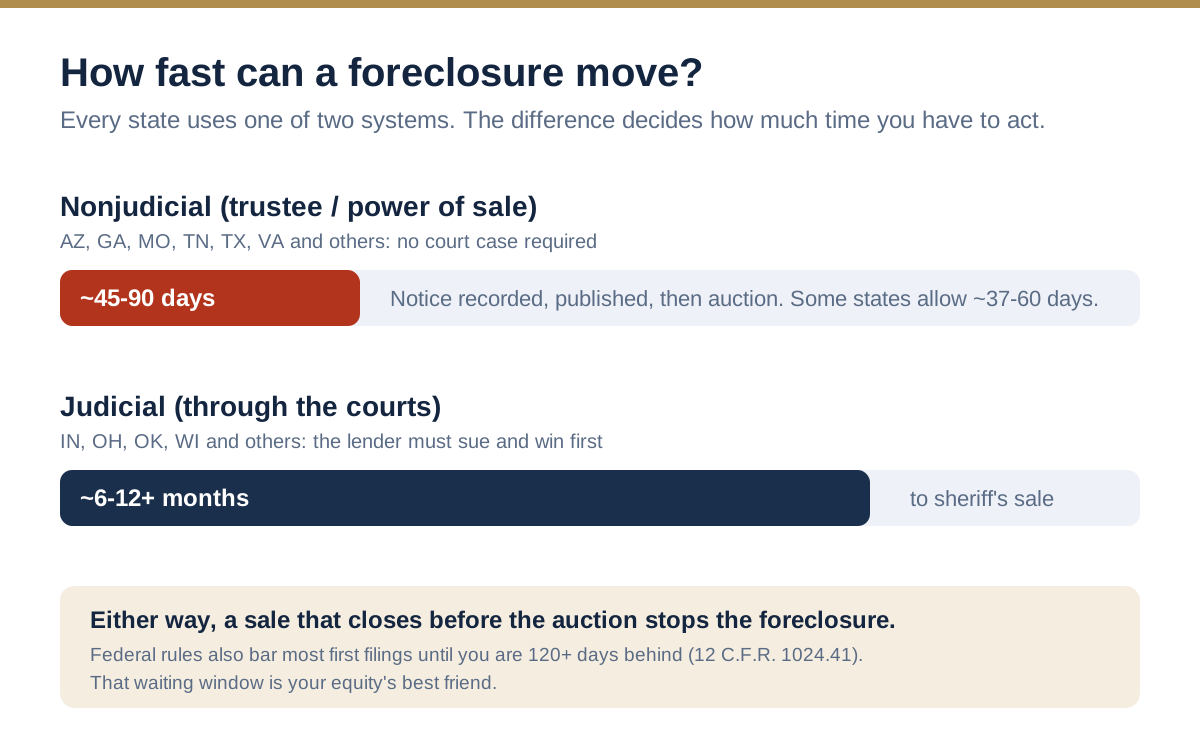
After the first missed payment come late fees and collection calls, and your servicer is required to reach out about loss mitigation options. Federal law prohibits the first foreclosure filing until you are more than 120 days delinquent (12 C.F.R. 1024.41). Most standard mortgages also require a breach letter giving you at least 30 days to cure before acceleration. Nothing about your house is decided in this window, but it is the cheapest window you will ever have to fix the problem.
Filing, Service, and Your 20 Days to Answer
The lender files a petition in district court and you are served. You have 20 days after service to file an answer (12 O.S. 2012). File one. Homeowners who answer, even simply, often gain weeks to months of additional time and preserve defenses; homeowners who ignore the suit hand the lender a default judgment on the fastest possible track.
Judgment and the Six-Month Appraisement Rule
If there is no viable defense, the court enters judgment for the loan balance plus interest, fees, and costs, and orders the property sold. If your mortgage waived appraisement, the sale cannot happen until six months after judgment (12 O.S. 686). If appraisement was not waived, the sale process starts sooner but includes a valuation safeguard.
Appraisement, Notice, and the Sheriff's Sale
The sheriff has the property valued by three appraisers (12 O.S. 759). Notice of the sale must be mailed to you at least ten days ahead, and published in a county newspaper for two consecutive weeks, with the sale held no sooner than 30 days after the first publication (12 O.S. 764).
At the auction itself, the property cannot sell for less than two-thirds of its appraised value (12 O.S. 762). The lender typically bids its judgment amount as a credit bid, and at most Oklahoma sales, the lender is the only bidder.
Confirmation: The Point of No Return
The sale is not final until the court confirms it at a hearing. This is a real checkpoint, not a rubber stamp; irregularities in notice or sale mechanics get raised here. After confirmation, the sheriff's deed issues and the new owner can seek possession.
Add it up and Oklahoma practitioners put the typical contested-or-not case at 4 to 12 months from filing to confirmation, on top of the 120-plus days of delinquency before filing.
Your Rights at Every Stage
The right to reinstate. In a power-of-sale foreclosure, Oklahoma statute gives you 35 days from the notice of intent to cure the default and reinstate (46 O.S. 44). In a judicial case, reinstatement rights come from your mortgage contract, and standard mortgage forms allow you to reinstate by catching up the arrears, not the full balance, up to specified points in the case. Ask your servicer for a reinstatement quote in writing; it is usually a far smaller number than the payoff.
The right to redeem. Until the court confirms the sheriff's sale, you can redeem the property by paying the full amount due plus costs and fees (42 O.S. 18-20). Oklahoma has no post-confirmation redemption period, so confirmation is the true point of no return. A sale or refinance that closes before confirmation exercises this right in the most practical way possible.
Protection from lowball auctions. The two-thirds-of-appraised-value floor (12 O.S. 762) prevents the worst auction outcomes, but read that number honestly: on a $210,000 appraisal, a $140,000 sale clears the bar, and the floor does nothing to recover your lost equity above it.
Deficiency limits. If the sale brings less than the judgment, the lender can pursue the shortfall only by motion filed at confirmation or within 90 days after the sale, and the court must credit you the higher of the sale price or the property's fair market value (12 O.S. 686). If the lender misses the 90-day window, the debt is treated as satisfied. In a power-of-sale foreclosure that you did not convert to judicial, no deficiency is allowed at all on the mortgage debt (46 O.S. 43).
Loss mitigation review. Submit a complete loss mitigation application more than 37 days before the sale and your servicer must evaluate it before foreclosing, and generally cannot run the sale while a complete application is under review (12 C.F.R. 1024.41).
Every Real Way Out
There are exactly six, and the honest version of each fits in a paragraph.
Catch up. Reinstatement, paying the missed payments plus fees, is the cleanest exit if the hardship was temporary. Family help, a 401(k) loan, or sale of another asset can fund it. Get the quote in writing first; it expires and grows.
Modify the loan. A modification rolls the arrears into a restructured loan, sometimes with a lower rate or extended term. It suits homeowners whose income has recovered. Applications are free through your servicer; anyone charging upfront fees to "negotiate" for you is a red flag.
Forbearance. A temporary pause or reduction in payments, with the missed amounts handled later. It is a bridge for a short hardship, not a fix for a payment you can no longer afford at all.
Bankruptcy. Filing triggers an automatic stay that immediately halts the foreclosure (11 U.S.C. 362), and a Chapter 13 plan can spread the arrears over three to five years; it is a serious step with long credit consequences and belongs in a conversation with a bankruptcy attorney, not a blog.
Deed in lieu. You hand the lender the deed and walk away, usually only after a sale attempt has failed, and ideally with a written waiver of any deficiency. It surrenders whatever equity you have, which is why it belongs near the bottom of the list for anyone with equity.
Sell before the sale. If you have equity, this is the option that converts the crisis into a check. You can sell at any point up to confirmation, the mortgage gets paid from proceeds at closing, the foreclosure case is dismissed, and the credit damage stops accruing. Our guide to selling before foreclosure walks the mechanics, and the stop-foreclosure page compares all six options side by side, including the ones that keep you in the house.

The Equity Math of Selling vs. Letting It Go
Run the numbers on a real case. Say your Tulsa house would appraise at $210,000 and you owe $130,000 including arrears. Let it go to sheriff's sale and the lender credit-bids its judgment; if the hammer falls at the two-thirds floor of $140,000, the sale covers the debt and costs and leaves you a sliver of surplus at best, against $80,000 of equity you actually had. Every month the case runs, interest and fees move that line further against you.
Now sell before confirmation instead. A market listing captures the most price if the house shows well and the calendar allows a 30 to 45 day financed closing plus marketing time, which is realistic in month two of a lawsuit and reckless in month eight. A direct sale compresses the whole thing: when we buy at EZ Time Home Buyers, we order the payoff and title work on day one, there is no financing contingency to collapse the week before a sale date, and two to three weeks to close is typical once the abstract clears. We have closed ahead of sheriff's sale dates in Oklahoma City, Tulsa, and Lawton, and the sequence is always the same: written offer, payoff ordered, court dates calendared, closed with the case dismissed.
For houses with more equity and more runway, our Retail Buyer Program is worth a look: we prepare and market the house to retail buyers ourselves, which typically brings more than a typical cash offer with the same easy process. The right choice depends on one variable more than any other, and that is how many months stand between today and your confirmation hearing. More detail on Oklahoma closings, including the abstract system that sets the pace, is in our Oklahoma selling guide.
What to Do This Week
Open every envelope from the servicer and the court, because each one contains a deadline. If you were just served, calendar day 20 and file an answer (12 O.S. 2012). Call your servicer, ask for a written reinstatement quote and a loss mitigation application, and call a HUD-approved housing counselor, which is free. Then get a real number for what your house would bring today, from an agent, from us, or both, so every decision after this one is made against actual dollars instead of fear. The homeowners who leave Oklahoma foreclosures with money in hand are the ones who acted during the lawsuit, not the week before the sale.
This article is general information about Oklahoma foreclosure law, not legal advice. Deadlines are unforgiving and facts differ; talk to an Oklahoma attorney about your specific case.
From the buyers
How EZ Time Home Buyers Can Help Before Foreclosure
A sale that closes before the auction pays off the loan, stops the foreclosure, and puts your remaining equity in your pocket instead of losing it at the courthouse. We close in as little as 2-3 weeks, coordinate payoff directly with your lender through a licensed title company, and show you the math in writing before you commit to anything. No fees, and no pressure: if keeping the house is possible, we'll say so.
Frequently Asked Questions
How long does foreclosure take in Oklahoma?
Longer than most states. Federal rules bar the filing until you are more than 120 days delinquent (12 C.F.R. 1024.41), and Oklahoma's mostly judicial process then typically runs 4 to 12 months from filing to a confirmed sheriff's sale. If your mortgage waived appraisement, the sale cannot occur until six months after judgment (12 O.S. 686). Filing an answer within your 20 days generally extends the timeline further.
Can I stop an Oklahoma foreclosure by catching up on payments?
Often, yes. In a power-of-sale foreclosure, statute gives you 35 days from the notice of intent to cure the default and reinstate (46 O.S. 44). In a judicial case, standard mortgage contracts let you reinstate by paying the arrears and fees, not the full balance, up to points specified in the loan documents. Separately, you can redeem outright by paying the full amount due any time before the court confirms the sale (42 O.S. 18-20).
Can the lender come after me for money after the foreclosure sale in Oklahoma?
Only within strict limits. The lender must ask the court for a deficiency by motion at confirmation or within 90 days after the sale, and the court credits you the higher of the sale price or the home's fair market value (12 O.S. 686). If no timely motion is filed, the debt is treated as satisfied. In a completed power-of-sale foreclosure, Oklahoma bars a deficiency on the mortgage debt entirely (46 O.S. 43).
Is it too late to sell my house once the foreclosure lawsuit is filed in Oklahoma?
No. You keep the right to redeem, and therefore to sell, until the court confirms the sheriff's sale (42 O.S. 18-20), and Oklahoma's judicial timeline typically leaves 4 to 12 months after filing. At closing, the mortgage and case costs are paid from proceeds and the suit is dismissed. The catch is that interest and attorney fees grow the payoff every month, so each month you wait transfers equity from you to the lender.
Related Guides
Ready to see both of your numbers?
Tell us about your property once and get a written cash offer, plus what our Retail Buyer Program could net you instead. No repairs, no fees, no pressure to accept.