
Selling an Inherited House in Oklahoma: Probate, Taxes, and Your Options
By Eric Roebuck · Updated August 26, 2026 · 9 min read
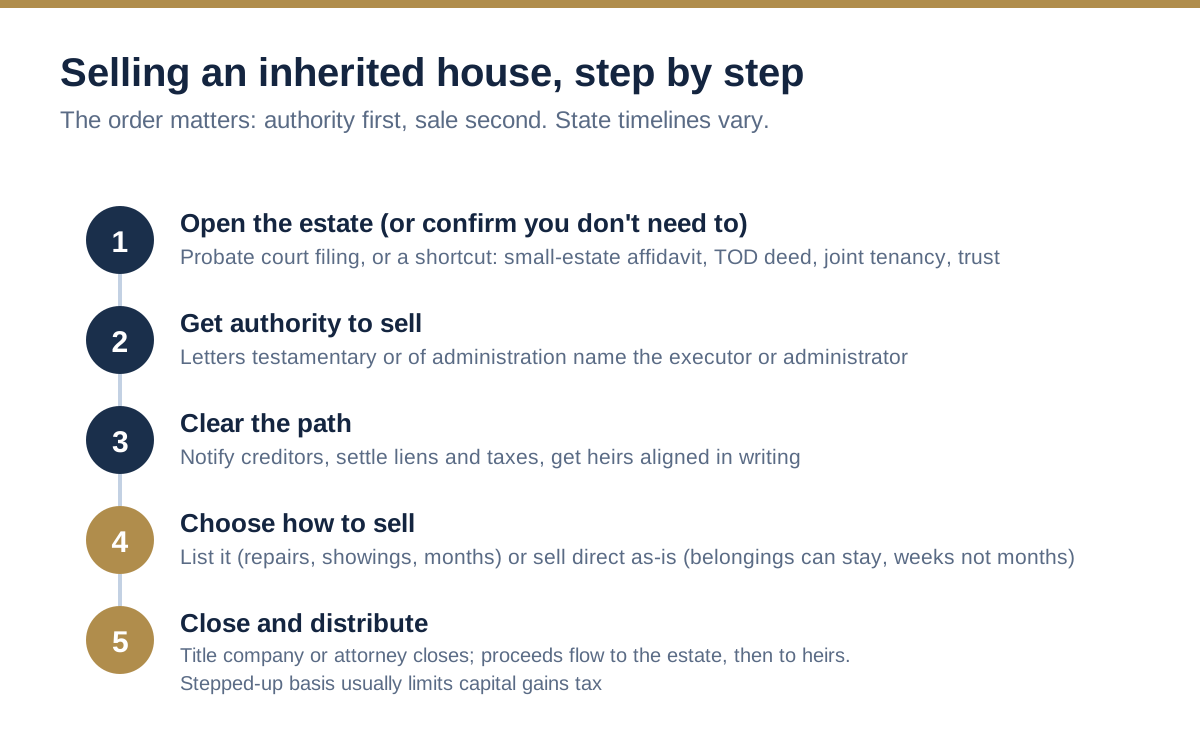
Oklahoma charges heirs no estate or inheritance tax, its summary administration wraps probate in roughly 60 to 90 days for estates of $200,000 or less (58 O.S. 245), and the stepped-up basis erases most of the income tax on a sale. Here is how an inherited Oklahoma house actually gets from a parent's name to sold, step by step.

What Legally Happens to the House When the Owner Dies
The moment an Oklahoma owner dies, the right to the property is presumed to vest in the heirs or devisees (84 O.S. 175). That sounds like you own it. Practically, you don't control it yet. Nobody can sign a valid deed until the legal path for that particular house plays out, and which path applies depends entirely on how the house was titled.
The house skips probate in three common situations. If it was held in joint tenancy with right of survivorship, the surviving co-owner takes full title by recording a death certificate and survivorship affidavit. If it was held in a living trust, the trustee can sell under the trust's terms. And if the owner recorded a transfer-on-death deed under Oklahoma's Nontestamentary Transfer of Property Act (58 O.S. 1251-1258), the named beneficiary takes title outside probate.
That last path carries a trap that catches Oklahoma families constantly: the TOD beneficiary must record an affidavit accepting the transfer, with a death certificate attached, within nine months of the owner's death (58 O.S. 1252). Miss the window and the property falls back into the estate, and you're in probate after all. If you're inside that nine months right now, recording the affidavit is the single most valuable errand on your list.
The house goes through probate when it was titled solely in the deceased's name, or as tenants in common, will or no will. A will names who inherits and who serves as personal representative; it does not skip the courthouse. Probate is filed in the district court of the county where the decedent lived (58 O.S. 5), and until that court issues letters testamentary or letters of administration, no heir, not even an only child, can convey the house.
The Probate Paths: Full Administration or the Oklahoma Shortcut
Oklahoma probate has a reputation for being slow, and regular administration earns it: 6 to 12 months is the realistic range from petition to final decree, longer if the will is contested or heirs are hard to locate. But the state built a genuine shortcut into Title 58, and a large share of Oklahoma estates qualify for it.
Summary Administration: The 60-to-90-Day Shortcut
Summary administration (58 O.S. 245) is available when any one of three things is true: the total value of the estate is $200,000 or less, the decedent has been dead more than five years, or the decedent was living out of state at death. It compresses the sequence into a single combined hearing and typically resolves in roughly 60 to 90 days. Given that Oklahoma City's median home price sits around $270,000 and much of the state sits below it, the $200,000 estate threshold covers an enormous number of inherited houses here, especially where the house is the estate's main asset and carries a mortgage that reduces the math.
Regular Administration From Petition to Decree
Regular administration follows the classic arc: petition, appointment of the personal representative, notice to creditors, inventory and appraisement, payment of debts, then distribution. The sale usually does not wait for the finish line. Once the representative holds letters, the house can be listed, put under contract, and closed while the rest of the estate winds down, with proceeds landing in the estate account for distribution later. Our probate sale walkthrough covers authority and court sequence in detail.
Locking In an Offer Before Letters Issue
One timing move worth knowing: a buyer can evaluate the house and issue a firm written offer before the letters issue, contingent on appointment. We do this for Oklahoma estates routinely, which means the estate can sign the day the judge does instead of starting the clock afterward.
Taxes: Oklahoma Is About as Gentle as It Gets
Start with the good news, because there's a lot of it.
No Oklahoma estate tax, no inheritance tax. Oklahoma repealed its estate tax for deaths on or after January 1, 2010, and it has never imposed an inheritance tax on recipients. Whatever you inherit, the State of Oklahoma takes no death-tax cut of it.
Federal estate tax is irrelevant for almost everyone. The federal exemption stands at $15 million per person in 2026. Unless the estate is far into eight figures, no federal estate tax return liability exists.
The stepped-up basis does the heavy lifting on income tax. When you inherit, your cost basis resets to the fair market value on the date of death (26 U.S.C. 1014). Say your mother paid $60,000 for the house in 1989 and it was worth $230,000 when she passed. Your basis is $230,000. Sell for $235,000 and your taxable gain is $5,000, not $175,000. Sell reasonably soon after death and the gain often rounds to zero. This is why a date-of-death appraisal or a broker's valuation is a document worth paying for and keeping forever.
Even the transfer tax gives estates a break. Oklahoma's documentary stamp tax is already among the lowest in the country at $0.75 per $500 of price, and an executor's deed made under the terms of a will is exempt from documentary stamps entirely (68 O.S. 3201 et seq.).
The carrying costs are the taxes that actually bite. Property taxes, insurance, utilities, and mowing don't pause for probate. On a typical Oklahoma house that's several hundred dollars a month, every month the estate stays open, which is a quiet argument for the summary route and a decisive sale.
When Several Heirs Inherit One House
One house, three siblings, three zip codes, three opinions. This is the normal case, not the exception, and the law gives it a clean framework even when the family dynamics aren't.
The buyout. One heir keeps the house and pays the others their shares, usually at a value set by an appraisal everyone agrees on in advance. If the buying heir needs financing, lenders handle estate buyouts routinely once letters have issued.
The joint sale. Everyone agrees to sell and split. If the sale runs through the estate, the personal representative signs alone, which is one of the strongest arguments for selling before distribution: distribute the house first and every heir must sign the deed, every heir's judgments and liens attach to the title, and every disagreement gets deed-level stakes.
Partition, the last resort. If co-owners truly cannot agree after the house has been distributed, any owner can file a partition action in district court and force a sale, with proceeds split by ownership share. It works, but it is slow, it is public, attorney fees come off the top, and it converts siblings into opposing parties. In our experience, most standoffs are really about information rather than money. Sharing every offer and every document with every heir at the same time resolves more disputes than lawyers do; we present offers to all heirs on one call for exactly this reason.
The House Itself: Belongings, Insurance, and the Abstract
While the legal process runs, the physical house needs three kinds of attention.

The belongings. Clearing forty years of a life out of a house is the hardest part of most inheritances, and it's the part that stalls sales for months. Set a realistic deadline, take the keepsakes, and give yourself permission not to hand-sort every box. If the house sells as-is to a direct buyer, the contents can usually convey with it: take what matters, leave the rest, and let as-is really mean as-is.
The insurance. Homeowner's policies can restrict or lapse on the owner's death and again on vacancy, sometimes in as little as 30 to 60 days. Call the insurer early, tell them the truth, and ask for a vacant or estate endorsement. An uninsured vacant house is the single biggest financial risk an Oklahoma estate carries, particularly in hail season.
The abstract. This one is pure Oklahoma. Nearly every sale here requires the abstract of title to be updated by a licensed abstractor before closing, and inherited houses are exactly the properties whose abstracts have gone missing: check the safe deposit box, the lender, and the title company from the original purchase. A routine update runs a few hundred dollars; a lost abstract must be rebuilt, which costs more and adds weeks. Starting the search the week you decide to sell is free and saves more closing delays than anything else on this list. Our Oklahoma selling guide covers the abstract system in full.
Your Selling Options, Compared Honestly
Oklahoma gives estate sellers an unusually light paperwork burden. A personal representative who never occupied the property is exempt from the residential disclosure form on a court-related transfer (60 O.S. 838), and an heir who never lived in the house and knows of no defects can sign the short disclaimer statement instead of the full disclosure (60 O.S. 833). Either way, anything you actually know about, you must disclose. The forms just stop asking about a house you never lived in.
Listing With a Real Estate Agent
Listing the house makes sense when it's in genuinely marketable condition and the estate can afford the calendar: expect agent commissions around 5 to 6 percent, buyer-requested repairs, showings on a house you may live hours from, and a 30 to 45 day financed closing after you find the buyer. For an updated house in a strong pocket of Oklahoma City or Tulsa, the math can work well.
Selling As-Is to a Direct Buyer
Selling as-is to a direct buyer trades some price for certainty and speed, which is often exactly what an estate with monthly carrying costs and multiple heirs needs. No repairs, no showings, contents handled, no financing contingency to fail after a court hearing, and a closing that flexes around the probate calendar. When we buy for EZ Time Home Buyers, we put the whole calculation in writing, order title work immediately, and build a lost abstract into the schedule as a routine matter rather than a crisis.
The Middle Path: Our Retail Buyer Program
A middle path exists for houses that don't need a cash buyer: our Retail Buyer Program, where we prepare and market the house to retail buyers ourselves. It typically nets more than a typical cash offer while keeping the same easy process, which suits estates whose house is in good shape but whose heirs are scattered across Broken Arrow, Dallas, and Denver with no appetite for managing a listing.
The honest comparison comes down to condition and clock. A dated house plus a long-distance executor plus monthly carrying costs usually favors the direct route; a turnkey house with patient heirs usually favors the market. Run both numbers before choosing either.
Before You Decide Anything, Do These Five Things
First, confirm how the house was titled, because it determines everything: joint tenancy, trust, or TOD deed means no probate, and a TOD deed means a nine-month affidavit deadline that starts now. Second, ask the estate's attorney whether summary administration fits; at $200,000 or under, it can cut months off the timeline (58 O.S. 245). Third, get a date-of-death valuation in writing to lock in the stepped-up basis. Fourth, call the insurance company before the house has been empty a month. Fifth, find the abstract, or start the hunt. Every one of those costs little or nothing this week, and each one prevents a specific, expensive stall later. The full tax and process detail lives in our inherited house guide.
This article is general information about Oklahoma law, not legal or tax advice. Statutes change and estates differ; confirm your situation with an Oklahoma probate attorney or CPA.
From the buyers
How EZ Time Home Buyers Can Help With an Inherited House
We work with executors, heirs, and families in probate all the time, including houses full of belongings and houses three states away from everyone who inherited them. We buy as-is, work around court timelines, and put every offer in writing with the math shown. If the family wants more than a cash number, the Retail Buyer Program handles the work while typically netting more than a typical cash offer, with no commissions or fees.
Frequently Asked Questions
Do I have to pay inheritance tax on a house I inherit in Oklahoma?
No. Oklahoma has no inheritance tax, and its estate tax was repealed for deaths on or after January 1, 2010. The federal estate tax only reaches estates above the $15 million per-person exemption in 2026. For income tax, your basis steps up to the home's date-of-death value (26 U.S.C. 1014), so if you sell soon after inheriting, the taxable gain is usually small or zero.
How long does it take to sell an inherited house in Oklahoma?
It depends on the probate path. If the house passed by joint tenancy, a trust, or a properly accepted transfer-on-death deed, you can sell as soon as the paperwork records, often within weeks. Summary administration for estates of $200,000 or less (58 O.S. 245) typically takes 60 to 90 days to produce authority to sell. Regular probate runs 6 to 12 months, though the house itself can usually be sold mid-process once the court issues letters.
What happens if the transfer-on-death deed beneficiary misses the nine-month deadline?
The shortcut fails. Oklahoma law requires the TOD beneficiary to record an acceptance affidavit with a death certificate within nine months of the owner's death, or the property reverts to the estate (58 O.S. 1252), meaning probate is required despite the deed. The fallback is often summary administration if the estate is $200,000 or less, which restores authority to sell in roughly 60 to 90 days.
Do I have to fill out Oklahoma's seller disclosure form for an inherited house I never lived in?
Usually not the full form. A personal representative who never occupied the property is exempt on court-related estate transfers (60 O.S. 838), and an heir selling a house they never occupied, with no actual knowledge of defects, can sign the one-page disclaimer statement instead (60 O.S. 833). The rule that never goes away: any defect you actually know about must be disclosed regardless of which document you use.
Related Guides
Ready to see both of your numbers?
Tell us about your property once and get a written cash offer, plus what our Retail Buyer Program could net you instead. No repairs, no fees, no pressure to accept.