
The Tennessee Foreclosure Process: Timeline, Your Rights, and Ways Out
By Eric Roebuck · Updated August 26, 2026 · 9 min read
Tennessee runs one of the fastest foreclosure clocks in America: once a lender starts, a nonjudicial foreclosure can reach the auction block in roughly 45 to 60 days, and the sale is effectively final because the two-year redemption right is almost always waived in the deed of trust. Your real protection is the front end, where federal rules bar the first foreclosure step until you're more than 120 days behind (12 C.F.R. 1024.41). Here's the whole process, stage by stage, and every real way out of it.

Why Tennessee Foreclosures Move So Fast
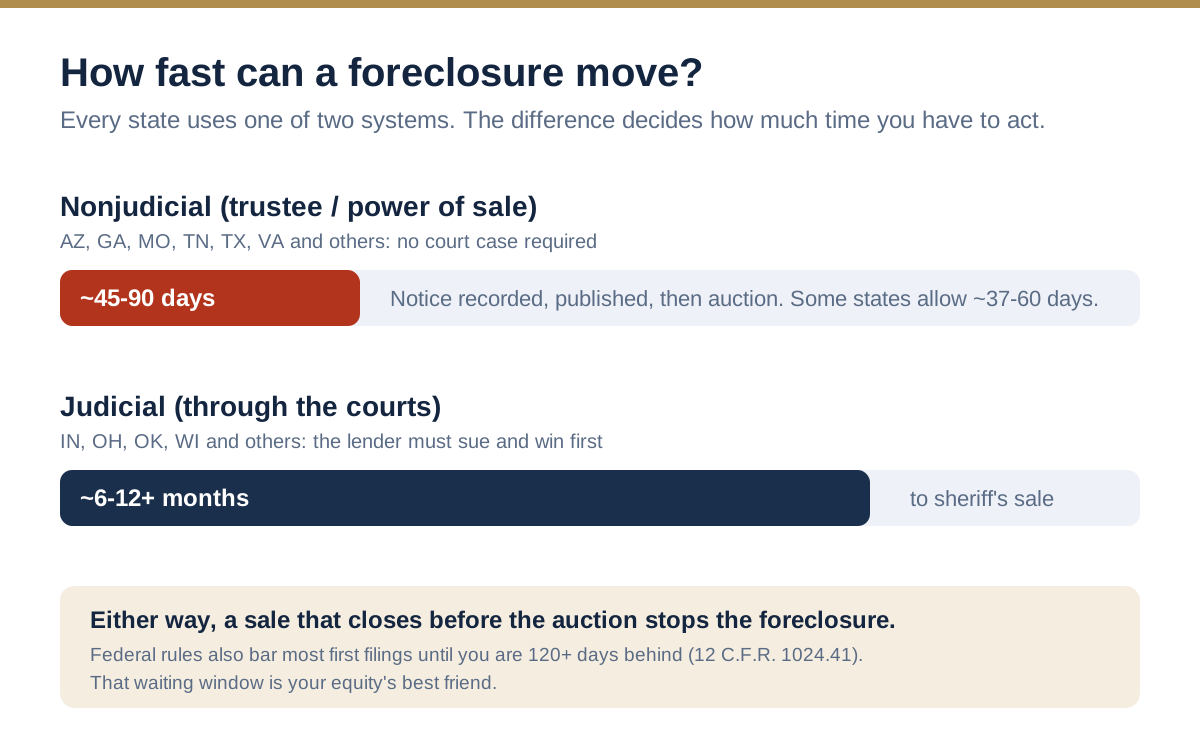
Nearly every Tennessee home loan is secured by a deed of trust containing a power-of-sale clause. That clause lets the lender's trustee sell the house without filing a lawsuit, which makes Tennessee a nonjudicial foreclosure state: no complaint, no judge, no months of docket time. The statutory requirements are thin, mostly notice and publication under Tenn. Code Ann. 35-5-101, and once those are satisfied the trustee can auction the property.
Compare that to a judicial state like Ohio or Florida, where a foreclosure lawsuit grinds through court for six to twelve months or more. Tennessee's version commonly finishes in 45 to 60 days from the first notice. If you take one thing from this guide, take this: in Tennessee, waiting to see what happens is itself a decision, and it's the worst one available.
The Timeline, Stage by Stage
Here's the full sequence from the first missed payment to a trustee's deed, with where each rule comes from.
Days 1 to 30: Delinquency Begins
Miss a payment and you enter the grace period, usually 15 days, then a late fee lands. The loan is delinquent but nothing dramatic happens yet. Federal servicing rules require the servicer to reach out with live contact attempts by day 36 and send written loss mitigation information by day 45 (12 C.F.R. 1024.39 and 1024.40).
Days 30 to 120: The Federal Floor
Federal law prohibits the servicer from making the first official foreclosure filing until you are more than 120 days delinquent (12 C.F.R. 1024.41). This is your guaranteed runway, roughly four months from the first missed payment, and it exists precisely so you can apply for help or arrange a sale. Somewhere in this window the lender sends a demand or acceleration letter declaring the full balance due if you don't cure by a stated date. Most deeds of trust require 30 days' notice before acceleration.
The Notice of Sale: Where the State Clock Starts
After acceleration, the trustee (or a substitute trustee the lender appoints) schedules the auction and publishes notice of the sale three times in a newspaper of general circulation in the county, with the first publication at least 20 days before the sale date, and mails a copy to the borrower on or before that first publication (Tenn. Code Ann. 35-5-101). That 20-day minimum is why the whole state-law phase can compress into six to eight weeks in practice.
Sale Day at the Courthouse
The auction happens at the county courthouse or another advertised location. The lender opens with a credit bid (more on that below), third parties can bid it up, and the high bidder gets a trustee's deed. There is no court confirmation step in a Tennessee nonjudicial foreclosure; the gavel is the end of it. If the sale brings more than the debt plus costs, the surplus belongs to you, though in our experience meaningful surpluses at auction are rare for reasons the equity math section explains.
After the Sale: The Waived Redemption Right
Tennessee law nominally provides a two-year right of redemption after a foreclosure sale, but only if the deed of trust didn't waive it, and virtually every institutional deed of trust waives it with express language (Tenn. Code Ann. 66-8-101). Assume yours did; your closing package almost certainly says so. Once the new owner records the deed, the former owner is an occupant without title, and a detainer (eviction) action follows if you're still in the house.
Total elapsed time from first missed payment to a stranger owning your home: commonly five to six months. That number should shape every choice you make.
Your Rights at Each Stage
The process is fast, but you're not without leverage. These are the rights that actually matter in Tennessee:
The right to a loss mitigation review. If you submit a complete loss mitigation application more than 37 days before the scheduled sale, the servicer generally cannot conduct the sale while the application is pending, and it must review you for all available options (12 C.F.R. 1024.41). This federal dual-tracking protection is the strongest brake available on Tennessee's fast clock. Use it early; a complete application submitted late in the process protects far less.
The right to reinstate. Tennessee statute doesn't grant a reinstatement right, but your contract almost certainly does. The standard Fannie Mae/Freddie Mac deed of trust used across Tennessee gives the borrower the right to reinstate the loan, meaning pay the missed payments, late fees, and the lender's costs rather than the full accelerated balance, up until five days before the sale. Ask the servicer for a written reinstatement quote; they must tell you the number.
Limited deficiency exposure, but not zero. If the auction brings less than you owe, the lender can sue for the difference within two years of the sale (Tenn. Code Ann. 35-5-117). The statute presumes the sale price equaled fair market value, and you can defeat a deficiency claim only by proving the property sold for materially less than fair market value. Translation: a low auction price doesn't automatically protect you, and a deficiency judgment is a real possibility on top of losing the house.
What Tennessee doesn't give you: no judicial oversight of the sale, no mandatory settlement conference or mediation program, and, for nearly everyone, no post-sale redemption. States like New York build in a court-supervised negotiation; Tennessee builds in speed. Plan accordingly.
Every Real Way Out
We talk to Tennessee homeowners at every stage of this process, and these are the options that genuinely exist, in roughly the order they stay available:
Catch up (reinstate). If the shortfall is temporary, a reinstatement quote plus a family loan, 401(k) loan, or tax refund is the cheapest exit. The loan simply resumes.
Loan modification. The servicer reworks the loan, moving arrears to the back end, extending the term, or adjusting the rate. Realistic when your income has recovered; a paper chase when it hasn't. Apply through the loss mitigation process above, and apply complete: partial applications earn none of the federal protections.
Forbearance or repayment plan. A pause or a temporary payment bump to spread the arrears. Useful for a short, documented hardship like a medical event or a gap between jobs.
Bankruptcy. Filing triggers an automatic stay that immediately halts the sale, and a Chapter 13 plan can spread arrears over three to five years, but it's a serious legal step that deserves a bankruptcy attorney's advice, not a blog's.
Deed in lieu of foreclosure. You hand the lender the keys and the deed; the lender skips the auction. It avoids the foreclosure sale itself, but you surrender every dollar of equity, and lenders often refuse if there are junior liens. Get any deficiency waiver in writing.
Sell before the sale. A completed sale at any point before the gavel pays off the loan through the title company, stops the foreclosure entirely, and puts your remaining equity in your pocket. This is the only option on the list that both ends the debt and preserves equity, which is why we cover it last and in detail below. The legality question people worry about has a clean answer: yes, you can sell right up to the sale date, as we lay out in Can I Sell My House Before Foreclosure?
The Equity Math of Letting It Go
Here's the part of foreclosure nobody explains until it's too late: the auction is designed to clear the debt, not to get you a fair price.

At the sale, the lender bids its own debt as a credit bid, paying with the balance owed rather than cash. Third-party bidders are buying a house sight unseen, with no inspection, no disclosures, cash due fast, and title risk, so when they bid at all, they bid deep discounts. The most common outcome is that nobody outbids the lender's credit bid, the lender takes the house, and the sale price equals the debt. Your equity above the debt simply evaporates at the courthouse steps.
Run the numbers on a real example. Say the house would fetch $220,000 sold normally and the payoff with arrears and fees is $150,000. Sell before the auction, even at a discounted as-is price of $195,000, and roughly $45,000 lands in your pocket after the payoff. Let it go to auction and the likely outcome is the lender's credit bid near $150,000: your $70,000 of equity becomes $0, your credit takes the foreclosure hit anyway, and under Tenn. Code Ann. 35-5-117 you could still face a deficiency suit if the numbers ran the other way. We have never seen an auction outcome that beat a competent pre-sale sale for the homeowner.
What a Fast Sale Looks Like Against This Clock
A conventional listing struggles inside Tennessee's window. Average Tennessee listings take two to three months to close after going under contract and marketing time, and buyers with financing bring appraisal and inspection contingencies that can crater a deal in week five, when you no longer have a week five to spare.
A direct sale is built for exactly this clock. When we buy, there are no repairs, no showings, and no financing contingency; we make a written offer within a day or two of the walkthrough, and the title company can close in two to three weeks. Just as important: lenders and trustees routinely postpone a scheduled sale when they're shown a signed purchase contract with a real closing date and an earnest money deposit, because a payoff beats an auction for them too. A letter saying you plan to sell moves nothing; a contract moves sale dates. If your timeline is longer, meaning the notice hasn't been published yet and you have measurable equity, ask us about our Retail Buyer Program, where we market the house to our retail buyer network and you net more than a typical cash offer with the same easy process.
We do this across the state, in Nashville, Memphis, Chattanooga, and everywhere between; the Tennessee hub covers our whole footprint, and our Tennessee selling guide covers the broader state rules. For the full menu of foreclosure alternatives in one place, start with our stop foreclosure guide.
If You're Behind Right Now, Do These Things This Week
- Open every letter from the servicer and write down two dates: how many days delinquent you are, and any sale date. The 120-day federal floor and the 20-day publication minimum tell you how much runway remains.
- Call the servicer and request a reinstatement quote and a loss mitigation application. Submitting a complete application more than 37 days before a sale pauses it.
- Get a free foreclosure-prevention counselor through a HUD-approved agency; they're the one party in this process with no financial stake.
- Price your sale option now, not later. Know your payoff, know your house's realistic as-is value, and know the difference, because that difference is what the auction takes from you.
- Whatever you choose, choose before the first publication. Every option on this page is stronger with 90 days of runway than with 19.
This guide is general information about Tennessee foreclosure law, not legal advice. Deadlines are unforgiving here, so for your specific situation, talk to a Tennessee foreclosure attorney or a HUD-approved housing counselor now.
From the buyers
How EZ Time Home Buyers Can Help Before Foreclosure
A sale that closes before the auction pays off the loan, stops the foreclosure, and puts your remaining equity in your pocket instead of losing it at the courthouse. We close in as little as 2-3 weeks, coordinate payoff directly with your lender through a licensed title company, and show you the math in writing before you commit to anything. No fees, and no pressure: if keeping the house is possible, we'll say so.
Frequently Asked Questions
How long does the foreclosure process take in Tennessee?
Once the lender initiates, commonly 45 to 60 days. Tennessee foreclosures are nonjudicial: the trustee publishes notice three times in a county newspaper with the first publication at least 20 days before the sale, and mails the borrower a copy (Tenn. Code Ann. 35-5-101). Your total runway is longer because federal rules bar the first foreclosure step until you're more than 120 days delinquent (12 C.F.R. 1024.41), so from the first missed payment to the auction is usually five to six months.
Can I get my house back after a Tennessee foreclosure sale?
Almost never. Tennessee law provides a two-year right of redemption after the sale only if the deed of trust didn't waive it (Tenn. Code Ann. 66-8-101), and virtually every institutional deed of trust contains an express waiver. There's also no court confirmation step after a nonjudicial sale. Practically speaking, the auction is final, which is why every real option, including selling, has to happen before the gavel.
Can the lender come after me for money after the foreclosure in Tennessee?
Yes. If the sale brings less than the debt plus costs, the lender can sue for a deficiency judgment within two years of the sale (Tenn. Code Ann. 35-5-117). Tennessee law presumes the auction price equaled fair market value, and the borrower can only defeat the claim by proving the property sold for materially less than fair market value, which courts have required to be a dramatic gap. So a low auction price can leave you without the house and still owing money.
How late can I sell my house to stop a foreclosure in Tennessee?
Legally, right up until the auction happens: a closing that pays off the loan at any point before the sale stops the foreclosure and preserves your remaining equity. Practically, you need enough time for a title company to close, which is two to three weeks on a cash sale. Trustees and lenders also routinely postpone a scheduled sale when shown a signed contract with a firm closing date, so a real contract can buy the time a listing can't.
Related Guides
Ready to see both of your numbers?
Tell us about your property once and get a written cash offer, plus what our Retail Buyer Program could net you instead. No repairs, no fees, no pressure to accept.