
Selling an Inherited House in Tennessee: Probate, Taxes, and Your Options
By Carson Whaley · Updated August 26, 2026 · 9 min read
Tennessee makes inheriting a house simpler than almost any other state: title vests in the heirs immediately at death (Tenn. Code Ann. 31-2-103), the state's inheritance tax was fully repealed for deaths in 2016 and after, and the stepped-up basis usually wipes out most of the capital gains. The paperwork between you and a closing is real but manageable, and this guide walks through all of it.

What Happens to the House the Moment the Owner Dies
Tennessee's core rule surprises most families, in a good way. Real property here vests in the heirs or devisees immediately at death (Tenn. Code Ann. 31-2-103). The house does not sit in legal limbo waiting for a judge. If there's a will, title passes to the people named in it; if there isn't, it passes to the heirs under Tennessee's intestacy statutes. The personal representative keeps a right to pull the house back into the estate if debts require selling it, but absent that, the ownership question is answered on day one.
Some houses skip the court entirely. If the property was held in a living trust, the trustee sells under the trust document. If it was owned jointly with right of survivorship, or by spouses as tenants by the entirety, the survivor owns it outright after recording a death certificate. One caution for people who read national articles: Tennessee does not authorize transfer-on-death deeds for real estate, so if you saw that shortcut mentioned somewhere, it doesn't apply here.
Everything else, meaning a house titled solely in the deceased's name or as tenants in common, runs through the process below. For the general court mechanics in any state, our probate sale guide is the companion read; this article covers what Tennessee does differently.
The Probate Paths, and the Shortcut That Doesn't Cover the House
Vesting answers who owns the house. It does not by itself satisfy a title company, which needs recorded paperwork proving the chain of title before it will insure your buyer. Tennessee gives you several routes to that paperwork, and picking the right one is where an hour with a probate attorney pays for itself.
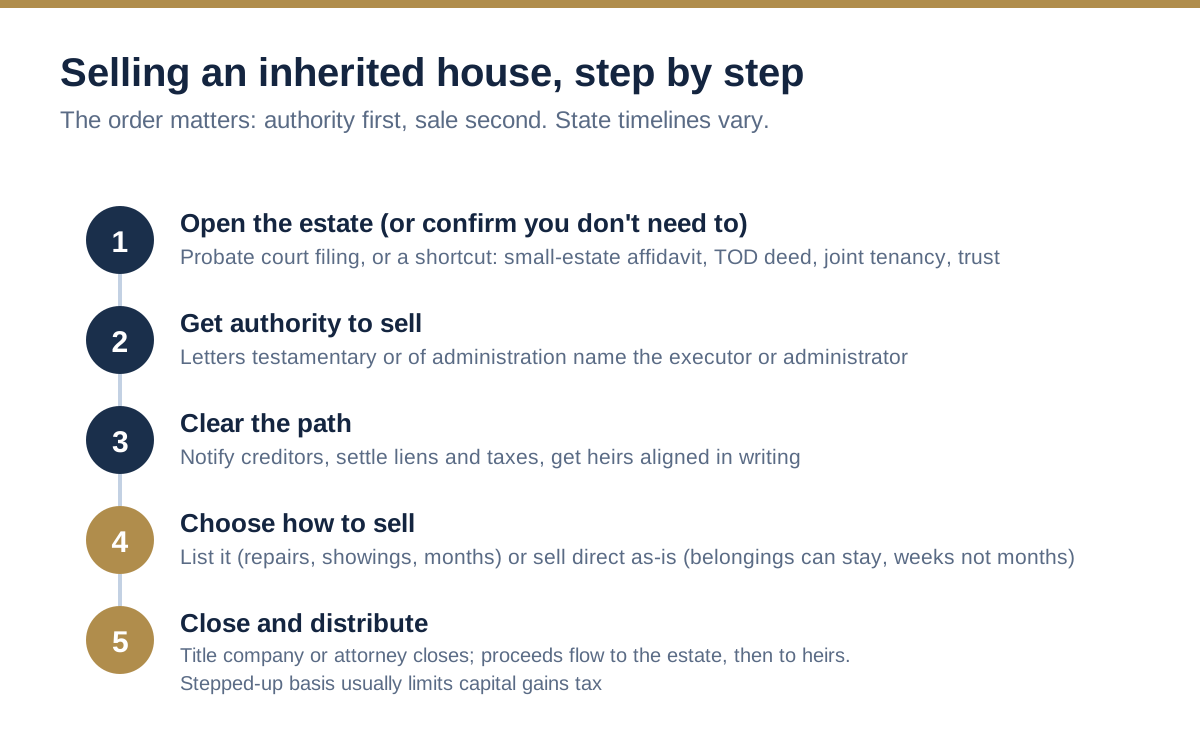
Full Administration
This is the standard route when the estate has debts, disputes, or assets beyond the house. You petition the court, which issues letters testamentary (with a will) or letters of administration (without one), typically two to eight weeks after filing. In most Tennessee counties that court is the chancery court, where the clerk and master handles probate (Tenn. Code Ann. 16-16-201); Davidson and Shelby counties have dedicated probate courts. Once appointed, the personal representative publishes notice to creditors, who then have four months from first publication to file claims, and Tennessee cuts off virtually all creditor claims one year after death regardless. Most straightforward estates wrap in six to twelve months, but here's the part that matters for you: the house sale almost never has to wait for the estate to close.
Muniment of Title
This is Tennessee's quiet shortcut for the most common situation of all: a will, a house, and not much else. The court admits the will as a muniment (evidence) of title without appointing anyone or opening an administration. No letters, no creditor publication, dramatically less cost and time. If the only probate asset is real estate and there's a valid will, ask about this one first.
The Affidavit of Heirship
When there's no will and no need for administration, title companies commonly insure heir sales based on a sworn affidavit from someone who knew the family and can recite who the legal heirs are. It's a title-industry solution rather than a court proceeding, and in Tennessee it moves a lot of inherited houses.
Why the Small Estates Act Won't Move the House
Tennessee's small estate procedure applies only to personal property worth $50,000 or less (Tenn. Code Ann. 30-4-102). It transfers bank accounts and vehicles. It does not transfer real estate at any value, so the $50,000 figure you may have read about is irrelevant to the house.
Taxes: Tennessee Is About as Gentle as It Gets
Three layers of tax could theoretically touch an inherited house. In Tennessee, all three usually amount to nothing.
State inheritance and estate tax: gone. Tennessee phased out its inheritance tax and eliminated it entirely for deaths on or after January 1, 2016 (Tenn. Code Ann. 67-8-318). There is no Tennessee estate tax either, and the state's last income tax, the Hall tax on interest and dividends, was fully repealed effective January 1, 2021. Heirs owe the state of Tennessee nothing on the inheritance itself and nothing on the sale proceeds.
Federal estate tax: irrelevant for almost everyone. The federal exemption sits in the millions of dollars per person, so only a small fraction of estates nationwide file at all. Unless the estate's attorney flags it, this is not your problem.
Capital gains: mostly erased by the stepped-up basis. Federal law resets an inherited property's cost basis to its fair market value on the date of death. If mom's house was worth $280,000 when she passed and you sell it for $290,000, your taxable gain is $10,000, not the $230,000 she would have recognized. This is why getting a date-of-death appraisal or a solid valuation record early is worth the couple hundred dollars: it documents the basis that shelters the sale.
At closing, Tennessee's realty transfer tax of $0.37 per $100 of price applies (Tenn. Code Ann. 67-4-409), and by custom the buyer pays it. When we buy a house, we follow that custom.
When Several Heirs Inherit One House
One house cannot be split three ways with a saw, and Tennessee's vesting rule means multiple heirs become co-owners automatically. The workable outcomes, roughly in order of preference:
Everyone sells together. The clean path. One sale, proceeds divided by inheritance share, everyone signs. If the estate is under administration, the personal representative can often sell as the single signer, which is one reason many families sell from the estate rather than deeding the house out first.
One heir buys the others out. Common when a sibling wants to keep the homeplace. Get a real appraisal, not a guess, and paper the buyout properly with a deed and, if needed, a small mortgage.
Rent it jointly. Works until it doesn't. Co-owned rentals strain family relationships faster than almost anything we see, because one heir always ends up doing the work.
Partition, the last resort. Any co-owner can petition a Tennessee court for partition or sale for partition (Tenn. Code Ann. 29-27-101). Nobody can be forced to co-own real estate forever. And Tennessee adopted the Uniform Partition of Heirs Property Act (Tenn. Code Ann. 29-27-301 et seq.), which adds protections when the co-owners are family: the court gets the property appraised, the heirs who want to keep it receive a first right to buy out the heir who filed, and the court must prefer a physical division or open-market sale over a courthouse auction. Those protections are genuinely valuable, but a partition case still burns a year and thousands in fees. In our experience most standoffs are really information problems, so share every document and every offer with every heir at the same time. We routinely present our offers on a group call for exactly this reason.
The House Itself: Contents, Insurance, and the Waiting Months
While the legal work runs, the physical house is quietly becoming the estate's biggest liability.

The belongings. Emptying a parent's home of forty years routinely takes families a whole summer of weekends, and it stalls more inherited-house sales than any statute does. Sort the irreplaceable things (photos, documents, jewelry), then decide honestly whether the rest is worth your labor. An estate sale service takes 30 to 50 percent of proceeds; a cleanout crew charges $1,000 to $5,000. Or skip the entire project: we buy houses with contents in place, take what you want and leave the rest. Our inherited house page explains how that works.
The insurance. Call the decedent's homeowner's insurer within the first couple of weeks. Policies can limit or deny coverage once the named insured has died or the house sits vacant, typically after 30 to 60 days empty. Ask for a vacant or estate endorsement. An uninsured vacant house with a burst pipe can erase more value than every other decision in this article combined.
The carrying costs. Property taxes (Tennessee's effective rate near 0.46% is mercifully low), utilities, yard work, and any mortgage payments continue every month. A house that takes a year to sell at a slightly higher price often nets less than one sold in a month.
Your Selling Options, Compared Honestly
Tennessee stacks the deck in favor of selling an inherited house as-is, because the disclosure law largely steps aside. A sale by an estate fiduciary is exempt from the standard disclosure form (Tenn. Code Ann. 66-5-209), and separately, any seller who hasn't lived in the property during the three years before closing is exempt too, which describes nearly every heir. You furnish a short exemption notification instead. None of that permits hiding a defect you know about; it just means you aren't warranting a house you never lived in.
Listing With a Real Estate Agent
Listing with an agent makes sense when the house is in genuinely good condition and nobody is in a hurry. Expect commissions near 5 to 6 percent, buyer repair demands after inspection (lenders balk at old roofs and dated systems), and two to four months of carrying costs from listing to closing. For a dated house, add the renovation question: spending $40,000 the estate may not have, to chase a retail price no one can guarantee.
Selling Directly to a Cash Buyer
Selling directly to us trades some top-end price for certainty and zero labor: no repairs, no cleanout, no showings, a written offer with the numbers itemized, and a closing in two to three weeks once your paperwork route (letters, muniment, or affidavit) is set. Every heir sees the same offer at the same time, and out-of-state heirs sign remotely through the title company. If the house is in decent shape and the estate has some runway, ask us about our Retail Buyer Program, where we market the house to our retail buyer network and the estate nets more than a typical cash offer, with the same easy process.
We buy inherited houses across the state, from Nashville and Memphis to Knoxville, and the Tennessee hub has the full picture of how we work here, including the broader state rules covered in our selling a house in Tennessee guide.
A Sensible Order of Operations
If you inherited a Tennessee house this month, here's the sequence we'd follow ourselves:
- Secure the house and call the insurer this week; ask for a vacant or estate endorsement.
- Find the will, if any, and spend one hour with a probate attorney to pick your route: full administration, muniment of title, or affidavit of heirship.
- Get a date-of-death valuation to lock in the stepped-up basis.
- Talk with your co-heirs early and share everything in writing with everyone at once.
- Price your real options side by side: renovated listing net, as-is listing net, and a direct offer, each minus its months of carrying costs.
Do those five things and you'll be ahead of ninety percent of the families who call us.
This guide is general information about Tennessee law, not legal or tax advice. For your specific estate, a Tennessee probate attorney or CPA is the authority.
From the buyers
How EZ Time Home Buyers Can Help With an Inherited House
We work with executors, heirs, and families in probate all the time, including houses full of belongings and houses three states away from everyone who inherited them. We buy as-is, work around court timelines, and put every offer in writing with the math shown. If the family wants more than a cash number, the Retail Buyer Program handles the work while typically netting more than a typical cash offer, with no commissions or fees.
Frequently Asked Questions
Do I have to go through probate to sell an inherited house in Tennessee?
Not always in the full sense. Tennessee real estate vests in the heirs or devisees immediately at death (Tenn. Code Ann. 31-2-103), so ownership passes automatically. What you need is paperwork a title company will insure: a will admitted to probate (sometimes as a simple muniment of title with no administration), an affidavit of heirship when there's no will, or a full administration when debts or disputes require it. Note that Tennessee's small estate procedure covers personal property only, up to $50,000 (Tenn. Code Ann. 30-4-102), and never transfers the house.
Does Tennessee have an inheritance tax on a house I inherit?
No. Tennessee's inheritance tax was phased out and does not apply to deaths on or after January 1, 2016 (Tenn. Code Ann. 67-8-318), and the state has no estate tax. Tennessee also has no income tax on sale proceeds since the Hall tax was fully repealed in 2021. Federally, the stepped-up basis resets the house's cost basis to its date-of-death value, so most heirs owe little or no capital gains tax when they sell.
What if one heir wants to sell the inherited house and another refuses?
No Tennessee co-owner can be forced to stay a co-owner forever. Any heir can file for partition or sale for partition (Tenn. Code Ann. 29-27-101), and because Tennessee adopted the Uniform Partition of Heirs Property Act (Tenn. Code Ann. 29-27-301 et seq.), the court must have the property appraised, give the heirs who want to keep it a first chance to buy out the filing heir, and prefer an open-market sale over a courthouse auction. It works, but it typically burns a year and real legal fees, so a negotiated buyout or joint sale is almost always the better outcome.
Do heirs have to fill out a seller disclosure form in Tennessee?
Usually not. Tenn. Code Ann. 66-5-209 exempts sales by a fiduciary administering a decedent's estate from the disclosure form, and separately exempts any seller who has not lived in the property during the three years before closing, which covers nearly every heir. Exempt sellers give the buyer a short exemption notification instead. The exemption doesn't allow concealing a known defect, but it means you aren't warranting the condition of a house you never lived in.
Related Guides
Ready to see both of your numbers?
Tell us about your property once and get a written cash offer, plus what our Retail Buyer Program could net you instead. No repairs, no fees, no pressure to accept.