
Selling an Inherited House in Ohio: Probate, Taxes, and Your Options
By Carson Whaley · Updated August 26, 2026 · 8 min read
Ohio charges heirs no estate or inheritance tax, the stepped-up basis erases most capital gains, and a recorded TOD affidavit can skip probate entirely. When the house does need probate, plan on six to twelve months for the estate, though the sale itself usually closes months earlier.

What Happens to the House the Moment the Owner Dies
Ohio answers the first question faster than most heirs expect. Title to real estate here passes at the moment of death: to the surviving co-owner, to a named beneficiary, or to the heirs and devisees, subject to the estate's administration. The house is never ownerless. What the deed says on the day of death decides everything that follows.
Three doors, and every inherited Ohio house walks through one of them:
A survivorship deed. If the deed was joint with right of survivorship, or a spouse held title with the deceased, the survivor takes the whole property automatically (Ohio Rev. Code 5302.17). Record the death certificate paperwork with the county recorder and the survivor can sell like any other owner. No probate.
A transfer-on-death designation affidavit. Ohio uses a recorded TOD designation affidavit instead of the TOD deed other states use (Ohio Rev. Code 5302.22). If the owner recorded one before death, the named beneficiary files an affidavit of confirmation with a death certificate at the recorder's office, takes title outside probate, and can sell immediately. Pull the deed records before you assume anything; plenty of families discover a TOD affidavit they never knew existed, and plenty assume one exists when it doesn't.
The deceased's name alone. Sole ownership, or a tenants-in-common share, goes through the probate division of the county Court of Common Pleas. That's the path the rest of this guide walks.
The Probate Paths, From Shortcut to Full Administration
Probate exists to move title cleanly and pay the estate's debts, and Ohio offers more than one route through it. Nobody, not even a sole heir, can sign a valid deed on an estate house until a court says who holds the pen.
Release From Administration: The $35,000 Shortcut
Ohio waives full probate when the probate estate is worth $35,000 or less, or $100,000 or less when a surviving spouse inherits everything (Ohio Rev. Code 2113.03). A house usually blows past the $35,000 line on its own, so in practice this shortcut mostly serves surviving spouses. There's also a summary release for very small estates (Ohio Rev. Code 2113.031), which rarely fits a house at all.
Full Administration and Letters of Authority
For everything else, someone files with the probate court, the court appoints an executor (with a will) or administrator (without one), and issues letters of authority. That document is the first thing every title company asks for. Appointment typically takes a few weeks to a couple of months depending on the county docket. Creditors then get six months from the date of death to present claims (Ohio Rev. Code 2117.06), and the full estate commonly wraps in six to twelve months.
Here's the part that changes the mood in the room: the house sale doesn't have to wait for the estate to close. Once authority exists, the sale can proceed, proceeds go into the estate account, and heirs receive distributions when the estate wraps up.
Power of Sale, Heir Consents, and Land Sale Actions
How much freedom the fiduciary has depends on the paperwork. If the will grants a power of sale, the executor can generally sell without a separate court proceeding. Without one, Ohio law still allows a sale if the surviving spouse and all heirs or devisees file written consents with the probate court, and the price hits at least 80 percent of the appraised value in the approved inventory (Ohio Rev. Code 2127.011). If neither applies, the fiduciary files a land sale action under Ohio Rev. Code Chapter 2127, which adds a court proceeding and several weeks. Buyers who work estate purchases regularly, us included, build the court calendar into the contract instead of fighting it.
Taxes: Mostly Better News Than Heirs Expect
The tax picture on an inherited Ohio house is the best news in this whole guide, and almost nobody believes it until they see the math.
Ohio has no estate tax and no inheritance tax. The state repealed its estate tax for deaths on or after January 1, 2013 (it died with House Bill 153), and Ohio has never levied an inheritance tax on the person receiving property. Nothing is owed to Columbus because you inherited.
The federal estate tax won't touch most families either. The federal exemption is $15 million per person in 2026, so only a small fraction of estates ever file, let alone pay.
The stepped-up basis does the heavy lifting. Under federal law (26 U.S.C. 1014), your cost basis in the house resets to its fair market value on the date of death. Say your mother paid $60,000 for the house in 1989 and it was worth $230,000 when she passed. Your basis is $230,000, not $60,000. Sell for $235,000 a few months later and your taxable gain is roughly $5,000, minus selling costs, often zero. This is why a date-of-death appraisal or valuation is worth keeping forever: it's the document that makes the sale nearly tax-free. Gains above the stepped-up basis are taxed as capital gains federally and flow through Ohio's income tax, but for a house sold within a year or so of death, there's usually little gain to tax.
Two closing-table items still apply like any Ohio sale: the conveyance fee of $1 per $1,000 to the state plus up to $3 per $1,000 to the county (Ohio Rev. Code 319.54(G)(3) and 322.02), and the property tax proration credit, because Ohio bills property taxes a year in arrears. Our full Ohio selling guide breaks both down.
When Several Heirs Own One House
One house, three siblings, three zip codes, three opinions. This is the normal case, not the hard one, and Ohio gives it workable mechanics.
If one heir wants to keep the house, a buyout priced off a neutral appraisal is the clean route: the estate distributes the house to that heir, or the heir purchases the others' shares, often financed with a regular mortgage. If everyone wants to sell, selling from the estate keeps one signer, the fiduciary, and one clean transaction. Distribute the house into multiple names first and every heir must sign the deed, every heir's title issues ride along, and every disagreement gains deed-level stakes.
When heirs genuinely deadlock, Ohio's last resort is a partition action under Ohio Rev. Code Chapter 5307: any co-owner can force a sale through the common pleas court, with the proceeds split by ownership share. Partition works, but it burns months and attorney fees that come out of everyone's inheritance. In our experience most standoffs are information problems wearing a money costume. Share every offer, every payoff figure, and every document with every heir at the same time; we present offers on group calls for exactly this reason, and the probate walkthrough covers the family dynamics in more depth.
The House Itself: Belongings, Insurance, and an Empty Building
While the legal process runs, a physical house sits somewhere in Ohio filling with risk.

The belongings. Forty years of possessions is the task that stalls more estate sales than any court does. Pull the documents (deed, insurance, tax records, valuations), let heirs claim keepsakes, and resist the urge to renovate before anyone has authority; improvements made without letters can spark reimbursement fights later. We buy inherited houses contents-included, so clearing every closet is optional, not a prerequisite.
The insurance. Homeowner's policies can lapse or restrict coverage when the owner dies or the house sits vacant. Call the insurer within the first two weeks and ask for an estate or vacant endorsement. An uninsured vacant house is the estate's single biggest liability: one burst pipe in a January cold snap can erase more value than any negotiation ever will.
The building. Change the locks, keep the utilities on, and check it weekly, especially through an Ohio winter. And if the house sits in one of the Cleveland-area suburbs that run point-of-sale inspection programs, Cleveland Heights and Euclid among them, a municipal inspection certificate becomes a condition of transfer, with repair escrows if violations remain (Cleveland Heights Codified Ordinances ch. 1329). Estates rarely have cash for a city repair list; the escrow-assumption route, where the buyer takes the list, is how those sales close, and we handle it routinely around Cleveland.
Your Selling Options, Honestly Compared
Start with a rule that surprises most executors: estate sales usually skip Ohio's disclosure form. Transfers by an executor, administrator, or other fiduciary are exempt from the Residential Property Disclosure Form (Ohio Rev. Code 5302.30(B)(2)). That's logical, you can't disclose what you never lived in, and it removes a chunk of paperwork and liability. It never excuses concealing a defect you actually know about; that stays fraud in Ohio.
Listing With a Real Estate Agent
Listing with an agent makes sense when the house is updated, the heirs are patient, and someone local can manage showings, repairs, and an inspection negotiation. Expect a financed buyer to need 30 to 45 days from contract to close, after however long the listing takes, and expect the inspection round to extract repairs or credits on a dated house.
Selling As-Is to a Direct Buyer
A direct as-is sale trades some price for certainty and zero preparation: no repairs, no showings, contents included, a closing timed to the letters of authority, and remote signing for heirs scattered from Columbus to California. For estate houses in solid shape, our Retail Buyer Program prices above a typical cash offer with the same easy process, which closes most of the gap that makes families hesitate. The inherited house guide walks through how we calculate offers, and our Ohio page covers everywhere we buy, from Dayton to the lake.
The honest comparison isn't sticker price against sticker price. It's the net after commissions, repairs, months of taxes, insurance, and utilities on a vacant house, and the value of the estate closing this season instead of next.
The Order of Operations That Protects the Estate
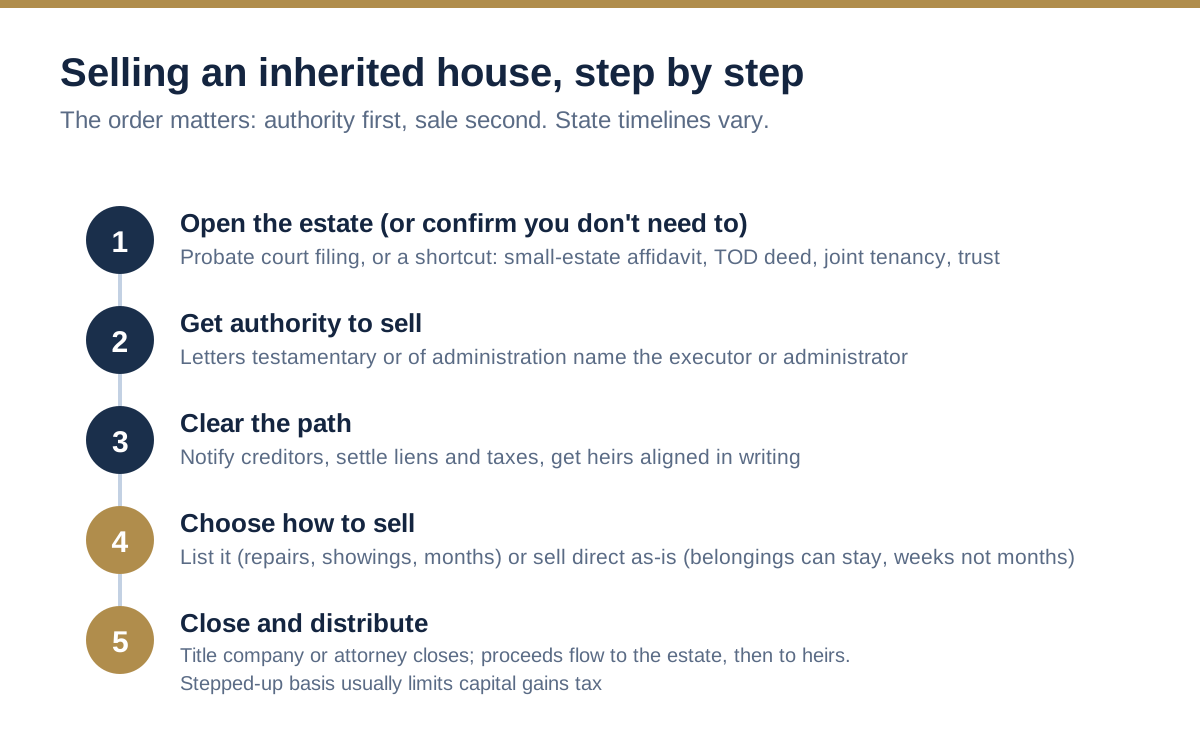
Do these in sequence and the Ohio process mostly runs itself. Pull the deed at the county recorder first; it tells you whether you even need probate. Call the insurance company second. Open the estate and get letters before signing anything, though negotiating a contract contingent on appointment is fair game. Get a date-of-death valuation and keep it with the estate records; it sets the tax basis. Then choose the selling route based on the house's condition and the heirs' patience, not on which option sounds best in the abstract. Six months from now, the family will remember whether the process felt fair far longer than they'll remember any single number on the closing statement.
Ohio probate and tax rules change, and every estate is different. This guide is general information, not legal advice; the estate's attorney is the authority on your specific situation.
From the buyers
How EZ Time Home Buyers Can Help With an Inherited House
We work with executors, heirs, and families in probate all the time, including houses full of belongings and houses three states away from everyone who inherited them. We buy as-is, work around court timelines, and put every offer in writing with the math shown. If the family wants more than a cash number, the Retail Buyer Program handles the work while typically netting more than a typical cash offer, with no commissions or fees.
Frequently Asked Questions
Do I pay inheritance tax on a house I inherit in Ohio?
No. Ohio repealed its estate tax for deaths on or after January 1, 2013, and the state has no inheritance tax at all. The federal estate tax only reaches estates above $15 million per person in 2026. What matters for you is the stepped-up basis: your cost basis resets to the home's date-of-death value under 26 U.S.C. 1014, so selling soon after inheriting usually produces little or no taxable capital gain.
How long does Ohio probate take before I can sell the house?
Getting an executor or administrator appointed typically takes a few weeks to a couple of months, and the sale can proceed once letters of authority issue; you don't wait for the estate to close. Creditors have six months from the death to present claims (Ohio Rev. Code 2117.06), and full administration commonly runs six to twelve months, but the house sale itself usually closes months before that. A recorded TOD designation affidavit (Ohio Rev. Code 5302.22) or a survivorship deed skips probate entirely.
Can the executor sell an Ohio estate house without every heir agreeing?
It depends on the paperwork. If the will grants a power of sale, the executor can generally sell without a separate proceeding. Without one, Ohio Rev. Code 2127.011 lets the fiduciary sell if the surviving spouse and all heirs or devisees file written consents with the probate court and the price is at least 80 percent of the appraised inventory value. If consent can't be gathered, the fiduciary files a land sale action under Ohio Rev. Code Chapter 2127 and the court approves the sale.
Do I have to complete Ohio's disclosure form when selling an inherited house?
Usually not. Transfers by an executor, administrator, or other fiduciary are exempt from Ohio's Residential Property Disclosure Form (Ohio Rev. Code 5302.30(B)(2)), which makes sense because you never lived in the house. If the property was first distributed to you and you're selling as the new owner after living there, the exemption may not fit, and no exemption ever protects deliberately concealing a defect you know about.
Related Guides
Ready to see both of your numbers?
Tell us about your property once and get a written cash offer, plus what our Retail Buyer Program could net you instead. No repairs, no fees, no pressure to accept.