
Selling a House in Virginia Beach: Local Costs, Rules, and What to Expect
By Carson Whaley · Updated August 27, 2026 · 8 min read
Virginia Beach sells houses fast, about 23 days on average, but the city has quirks that catch sellers off guard: a buyer pool where nearly half the mortgages are VA loans with strict appraisal standards, a second grantor-side tax most of Virginia never pays, and flood insurance that is quietly repricing whole neighborhoods. Here is what actually matters when you sell here, with the numbers.
The Two Things That Make Virginia Beach Different
Start with the two local facts that shape every sale in this city.
First, Virginia Beach does not require any city inspection to sell a house. No point-of-sale ordinance, no pre-sale certificate, no occupancy sign-off.
The only municipal inspection regime is the rental Certificate of Compliance program, which covers rental dwellings in 109 designated inspection block groups and carries a $50 per-unit inspection fee (City of Virginia Beach, Housing & Neighborhood Preservation).
If you live in your house, you can sell it tomorrow without a city inspector ever walking through it. If you rent it out inside one of those districts, the inspection follows the property, and we come back to that below.
Second, the buyer pool here is unlike anywhere else in the country. As of March 2026, roughly 43 percent of mortgaged home purchases in the Virginia Beach area were VA loans, the highest share in the nation. That is genuinely good news if your house is move-in ready: VA buyers are plentiful and can buy with nothing down.
It is a real problem if your house is rough. Every VA loan triggers a VA appraisal, and the VA's minimum property requirements have teeth: peeling paint on a pre-1978 house must be scraped and repainted before closing, the roof needs remaining life and no active leaks, and the systems have to be safe and functional.
A dated-but-sound ranch passes. A house with a spongy roof, water stains, and flaking 1962 paint loses close to half the financed buyers in this market before the sign goes in the yard.
That is the specific math behind an as-is cash sale in Virginia Beach, and it is why so many of the houses we buy here are ones a VA appraiser would send back with a conditions list.
The Market Right Now: Fast, Steady, and Military-Anchored
The headline numbers are strong. Virginia Beach's median sale price sits around $415,000, up 5.1 percent year over year, with homes going under contract in roughly 23 days in a market Redfin rates very competitive (Redfin, May 2026). Under those numbers is the steadiest demand floor in Virginia: NAS Oceana employs more than 10,000 people, Joint Expeditionary Base Little Creek-Fort Story about 13,000, and every set of orders that moves a family out moves another family in.
A 23-day market cuts both ways. Clean houses sell quickly at full price. Houses with condition problems sit, because the buyers waving contingencies at the pretty listings are the same ones whose lenders will not touch a project. Our written offers are anchored to current after-repair values, which is exactly what 5.1 percent annual growth keeps pushing up. The full neighborhood-level picture is on our Virginia Beach page.
What Selling Costs in Virginia Beach
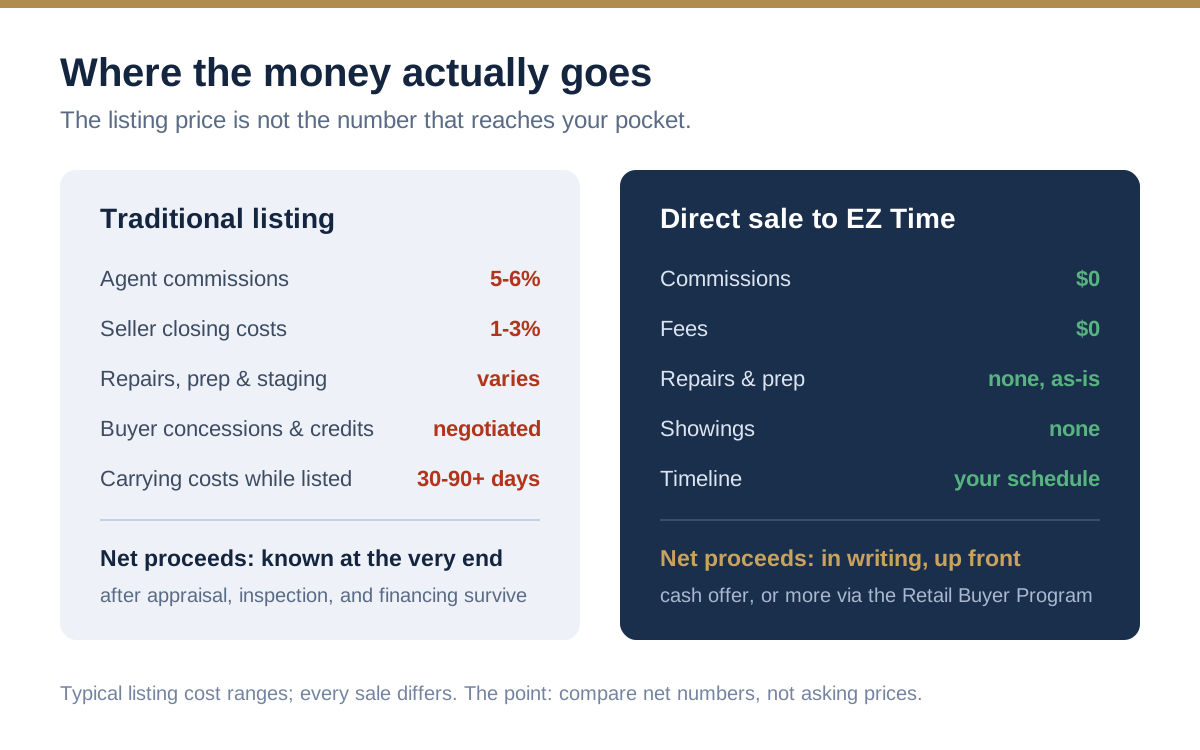
The biggest line item is the same one as everywhere: agent commissions. List with an agent and plan on 5 to 6 percent of the price in total commissions, which is $20,750 to $24,900 on a median $415,000 Virginia Beach sale, before repairs, concessions, or a single month of carrying costs.
The government's cut is where Virginia Beach differs from most of Virginia, because sellers here pay two transfer charges, not one:
- The state grantor's tax: $0.50 per $500 of price, about 0.1 percent, split between the state and the city (Va. Code 58.1-802). That is $415 on a $415,000 sale.
- The Hampton Roads regional transportation improvement fee: $0.06 per $100, paid by the seller on deeds recorded in the Hampton Roads transportation district, with the money going to the Regional Transit Fund (Va. Code 58.1-802.5). That is another $249 on the same sale. Do not let older articles confuse you here: the region's first add-on grantor tax (the old Va. Code 58.1-802.2) was repealed in 2018, but the General Assembly enacted this replacement in 2020, and it applies in Virginia Beach today.
Together that is about $664 in seller-side transfer charges on a median sale, roughly 0.16 percent. Still cheap by national standards, just not the bare 0.1 percent sellers pay in Richmond. The larger recordation tax, $0.25 per $100, is customarily the buyer's cost.
Beyond taxes: settlement agent fees, attorney deed preparation (one of the few lawyer-only steps in a Virginia closing), lien payoffs and release recordings, and prorated real estate taxes.
Virginia's Wet Settlement Act requires your proceeds to be disbursed within two business days of settlement (Va. Code 55.1-903), so at least the finish line is quick.
Our guide to selling a house in Virginia walks through the statewide rules, including the buyer-beware disclosure regime that makes as-is sales such a natural fit here.
When we buy, the cost list collapses: no commissions, no repairs, no concessions, and we cover standard closing costs. A typical settlement statement on our side of a Virginia Beach sale shows the two transfer charges, any payoff, and your proceeds.
What Buyers Flag in Virginia Beach Houses
Virginia Beach built out fast in the postwar decades, and the housing stock shows it. Aragona Village is 1950s and 60s brick ranches, one of the first planned subdivisions in old Princess Anne County.
The Kempsville corridor is 1960s and 70s tract housing built for military and government families, much of it still in original-owner condition. These houses are structurally honest and endlessly renovatable, which is why investors like us keep buying them.
But financed buyers and their appraisers flag the same things over and over: pre-1978 paint (a VA appraisal trigger the moment it peels), roofs at the end of their service life, and original kitchens and baths that photograph poorly against the renovated comp next door.
Then there is the water. Virginia Beach's coastal geography puts a meaningful share of its housing in FEMA flood zones, and Hampton Roads holds roughly three-quarters of Virginia's FEMA repetitive-loss properties (WHRO, October 2024).
Virginia's disclosure law asks very little of sellers, but flood history on a repetitive-loss home is the exception: that must be disclosed. Meanwhile FEMA's Risk Rating 2.0 keeps stepping premiums toward full actuarial rates, capped at 18 percent per year, which means the flood-zone discount compounds annually.
The city's improved Community Rating System standing, Class 7 as of August 2025, earns policyholders a 15 percent NFIP discount, which softens the trend without reversing it. Any financed buyer in a mapped flood zone will be required by their lender to carry flood insurance, so every premium increase quietly shrinks your buyer pool.
A cash buyer has no lender in the transaction, which is why flood-zone and flood-history houses are one of the most common purchases we make in this city.
The Sales We See Most in Virginia Beach
PCS orders with a report date
Military orders do not negotiate, and between Oceana, Little Creek-Fort Story, and Naval Station Norfolk across the water, thousands of Hampton Roads households get them every season.
A 23-day average to contract sounds fast until you add a financed buyer's 30-to-45-day escrow and the possibility of a VA appraisal conditions list with your household goods pickup already scheduled.
We close in two to three weeks on the date you pick, the closing moves if the detachment date moves, and plenty of our sellers sign from the next duty station.

The original-owner estate ranch
The families who bought Aragona and Kempsville new are aging out of them, and their children, often living out of state, inherit 60-year-old ranches full of belongings.
Virginia makes the legal side easier than most states: there is no separate probate court, and the Clerk of the Virginia Beach Circuit Court handles probate and executor qualification by appointment at the Judicial Center at 2401 Courthouse Drive (call 757-385-8831, and bring the original will, a death certificate, and a list of assets with estimated values).
Probate tax runs $1 in state tax plus 33 cents in local tax per $1,000 of estate value. We buy inherited houses contents-included, coordinate with the clerk's paperwork and the estate's attorney, and close remotely when the heirs are scattered.
The rental caught by a Certificate of Compliance inspection
If your rental sits in one of the city's 109 designated inspection block groups, Code Enforcement can require a Certificate of Compliance inspection ($50 per unit) before it is rented, and an aging Bayside or Kempsville rental can fail its way into a renovation budget. Selling as-is to us converts that inspection list into our renovation list: tenants in place or vacant, compliance becomes our problem at closing.
How a Closing Actually Runs Here
Virginia lets either an attorney or a registered title company conduct residential settlements, and by statute the buyer chooses the settlement agent (Va. Code 55.1-1006). The deed itself must be prepared by an attorney.
At closing, the settlement agent collects both the grantor's tax and the regional transportation improvement fee, records the deed with the Virginia Beach Circuit Court Clerk at 2401 Courthouse Drive, and disburses your proceeds within two business days under the Wet Settlement Act.
On a financed sale, expect 30 to 45 days from ratified contract to settlement, plus however long the listing takes. A cash sale compresses to whatever title work requires, which for us is usually two to three weeks.
And if your house is in good shape and your goal is maximum proceeds without the listing process, ask about our Retail Buyer Program: it gets you more than a typical cash offer while staying just as easy, with your proceeds agreed in writing up front.
Statutes, fees, and FEMA maps change, and every sale differs. This guide is general information, not legal or tax advice; a Virginia attorney or your settlement agent is the authority on your transaction.
From the buyers
How EZ Time Home Buyers Can Help in Virginia Beach
We buy houses in Virginia Beach as-is, in any condition, on your timeline. You'll get a written cash offer with the math shown line by line, and if that number doesn't fit your situation, the Retail Buyer Program is a second path that typically nets more than a typical cash offer while we do the work. No commissions, no fees, no repairs, either way.
Frequently Asked Questions
What transfer taxes do I pay when selling a house in Virginia Beach?
Two seller-side charges. The state grantor's tax is $0.50 per $500 of price (Va. Code 58.1-802), and Virginia Beach deeds also carry the Hampton Roads regional transportation improvement fee of $0.06 per $100 (Va. Code 58.1-802.5), enacted in 2020 after the region's earlier grantor tax was repealed. On a $415,000 sale that totals about $664. The larger $0.25-per-$100 recordation tax is customarily paid by the buyer.
Can I sell a Virginia Beach house that would not pass a VA appraisal?
Yes, but expect the financed market to be thin. Roughly 43 percent of mortgaged purchases in the Virginia Beach area were VA loans as of March 2026, the highest share in the country, and VA minimum property requirements block closings over things like peeling pre-1978 paint, active roof leaks, and unsafe systems. A cash sale has no appraisal conditions at all: we buy as-is, price the repairs once in a written offer, and close in two to three weeks.
How does probate work in Virginia Beach when I inherit a house?
There is no separate probate court. The Clerk of the Virginia Beach Circuit Court handles probate and executor qualification by appointment at 2401 Courthouse Drive (757-385-8831). Bring the original will, a death certificate, and a list of estate assets with estimated values; probate tax is $1 state plus 33 cents local per $1,000 of estate value. Under Virginia law, real estate generally vests in the heirs or devisees at death, so a house sale often does not have to wait for full estate administration.
Does Virginia Beach require an inspection before I can sell my house?
No. Virginia Beach has no point-of-sale or pre-sale inspection ordinance, so an owner-occupied home can sell with no city involvement at all. The city's only inspection program is the rental Certificate of Compliance, which applies to rental dwellings inside 109 designated inspection block groups and carries a $50 per-unit fee. If you are selling a rental in one of those districts, the obligation follows the property, and an as-is sale can transfer it to the buyer at closing.
Related Guides
Ready to see both of your numbers?
Tell us about your property once and get a written cash offer, plus what our Retail Buyer Program could net you instead. No repairs, no fees, no pressure to accept.