
Selling an Inherited House in North Carolina: Probate, Taxes, and Your Options
By Eric Roebuck · Updated August 26, 2026 · 8 min read
In North Carolina, title to a house vests in the heirs the moment the owner dies (N.C.G.S. 28A-15-2), but the estate's creditors keep a claim on it for at least three months after the notice to creditors runs. Here's how heirs actually get from a death certificate to a closing check, usually in two to four months, with no state estate tax taking a bite.

The House Is Already Yours: North Carolina's Vesting Rule
Most heirs assume the estate owns the house until a court says otherwise. North Carolina flips that: title to real property vests in the heirs or devisees at the moment of death (N.C.G.S. 28A-15-2). If your mother died owning a house in Greensboro, you and your co-heirs became its owners that day, before anyone filed a single paper with any court.
If there's a will, the house passes to the people named in it. If there isn't, North Carolina's intestacy rules in Chapter 29 divide it among the closest relatives, and a surviving spouse often shares with the children rather than taking everything. Either way, the county deed record still shows the person who died, which is why owning the house and being able to convey clean, insurable title are two different problems.
Two wrinkles matter here. First, North Carolina does not authorize transfer-on-death deeds for real estate, so unless the house sat in a living trust or was owned with survivorship rights, it lands in this process. Second, vesting comes with a string attached: for a window of time, the personal representative can pull the house back into the estate and sell it to pay the decedent's debts if the bank accounts and personal property won't cover them (N.C.G.S. 28A-15-2, 28A-17-1). Until that creditor window closes, no closing attorney will treat the heirs' title as marketable without involving the estate.
That string is the single most important thing to understand about selling an inherited house here, so let's walk through how the estate process actually runs.
Probate in North Carolina: The Paths, the Shortcuts, and the Real Clock
Getting Letters From the Clerk of Superior Court
North Carolina probate runs through the Clerk of Superior Court in the county where the person lived; there is no separate probate court. The executor named in the will, or a family member applying to serve as administrator when there's no will, files the paperwork, takes an oath, and receives letters testamentary or letters of administration. Those letters are the document every title company and closing attorney will ask to see. Getting them typically takes a few weeks, faster in smaller counties.
The Three-Month Creditor Window
Once appointed, the personal representative publishes a notice to creditors, and claimants get at least three months from first publication to come forward (N.C.G.S. 28A-14-1). This window shapes your sale. Selling during it is routine, we see it every month, but the closing attorney will want the estate file open, the notice running, and usually the personal representative joining the heirs on the deed so the buyer's title insurance covers the creditor issue. Sell after the window closes with claims paid, and the estate's role in your closing shrinks. Our national probate walkthrough covers the mechanics that apply everywhere; the numbers below are North Carolina's.
Small Estates, Summary Administration, and the Spousal Allowance
- Small estate administration: if the personal property is worth $20,000 or less ($30,000 when the surviving spouse inherits everything), the family can collect it by affidavit and skip full administration (N.C.G.S. 28A-25-1). Useful, but read the fine print: it covers personal property only. The house vested in you at death anyway, and the affidavit does nothing to clear the creditor window.
- Summary administration: when the surviving spouse is the sole heir or devisee, the clerk can close the estate almost immediately (N.C.G.S. 28A-28-1), with the spouse taking on responsibility for the debts.
- Spousal year's allowance: a surviving spouse takes the first $60,000 of personal property off the top for the first year's support, ahead of creditors (N.C.G.S. 30-15).
Full administration commonly runs nine to eighteen months in NC clerk's offices. The good news: the house sale almost never has to wait for the estate to close. Heirs who start in week one usually close in month two or three, with proceeds distributed at closing or held in the estate account, depending on how the attorney structures it.
Taxes: Mostly Good News for North Carolina Heirs
Three tax questions come up on nearly every inherited-house call. Here are the three answers.
Is there a North Carolina estate or inheritance tax? No. The state repealed its estate tax in 2013, retroactive to deaths on or after January 1, 2013 (Session Law 2013-316), and its inheritance tax has been gone since 1999. The federal estate tax still exists, but with the exemption at $15 million per person for 2026 deaths, it's irrelevant to the overwhelming majority of families.
Will I pay income tax on the inheritance? No. Inheriting the house is not income. What matters at sale time is the stepped-up basis: your cost basis resets to the fair market value on the date of death (26 U.S.C. 1014), not what your parents paid decades ago. A Winston-Salem house bought for $60,000 in 1988 and worth $240,000 at death carries a $240,000 basis. Sell it for $250,000 a few months later and the taxable gain is about $10,000, not $190,000. Sell close to the date-of-death value and the gain often rounds to zero. Keep the appraisal and valuation records; they're your proof.
What does the sale itself cost in taxes? North Carolina's excise tax on the deed is $1 per $500 of price, 0.2%, paid by the seller at recording (N.C.G.S. 105-228.30). That's $500 on a $250,000 sale. Property taxes keep accruing until closing, at a statewide effective rate around 0.63%, low by national standards but real money on a house that sits for a year while the family decides.
When Several Heirs Own One House
Title vested in all the heirs together, typically as tenants in common, which means every heir (and often their spouses, for marital-interest reasons) signs the deed. One holdout stalls everything.
What actually works, in the order we'd try it: equal information first, then a buyout, then a sale. Most standoffs we see are information problems, not valuation problems, so put every document and every offer in front of every heir at the same time. If one sibling wants to keep the house, a buyout priced off a written appraisal or a real offer beats a number pulled from a listing site. If nobody wants it, sell and split.
The last resort is partition: any co-owner can file a partition special proceeding with the Clerk of Superior Court (N.C.G.S. Chapter 46A). Courts prefer dividing land in kind, but a single house can't be split down the middle, so the usual outcome is a court-ordered sale when division would cause substantial injury. Partition works, and it burns months and thousands of dollars in commissioner and attorney fees while the family relationships char. We've watched $15,000 of professional fees settle a $10,000 disagreement.
This is one reason we present offers on a group call with every heir at once: one written cash number either becomes the buyout benchmark or becomes the sale. Either outcome beats a partition file.
The House Itself: Belongings, Insurance, and the Cost of Waiting
While the legal side grinds forward, the physical house needs three decisions fast.

Belongings. Don't empty the house before someone has legal authority, especially with the spousal year's allowance and specific bequests in play. Photograph everything, make an inventory, and let heirs claim keepsakes in an agreed order. When we buy, heirs take what they want and leave the rest, furniture, boxes, and all; clearing out a packed house is our problem, not the family's.
Insurance. Homeowner's policies can limit or lapse on the owner's death and again on vacancy, and a burst pipe in an uninsured empty house is the estate's biggest liability. Call the insurer early and ask for an estate or vacant endorsement.
Carrying costs. Taxes, insurance, utilities, mowing, and the occasional broken window add up to $700 to $1,000 a month on a typical Charlotte house before anyone touches a repair. Every month of family indecision has a price tag, which is worth naming out loud at the first meeting.
Your Selling Options, Compared Honestly
Start with a North Carolina quirk that helps estates: the disclosure rules. Most sellers must deliver the Residential Property and Owners' Association Disclosure Statement, but N.C.G.S. 47E-2 exempts court-ordered transfers and sales by fiduciaries administering an estate, so a personal representative selling for the estate typically skips the form. An heir who took title personally generally does not skip it, but can answer "No Representation" to questions about a house they never lived in (N.C.G.S. 47E-4), which is exactly what that option was built for. Either way, a licensed NC attorney must handle the closing, which protects the estate no matter who the buyer is. The full state rundown lives in our North Carolina selling guide.
Listing With a Real Estate Agent
Listing makes sense when the house is retail-ready or close to it, and the heirs can float the carrying costs, the 5% to 6% commission, and the repair negotiations that follow a financed buyer's inspection. Expect 30 to 45 days from contract to closing on top of prep and market time. On an updated house in a hot Triangle neighborhood, the premium can be worth the wait.
Selling As-Is to a Direct Buyer
A direct as-is sale trades some of that ceiling for certainty and speed: no repairs, no commissions, contents included, and a two-to-three-week attorney closing that can be scheduled around the estate's paperwork. We buy inherited houses as-is across North Carolina and coordinate directly with the estate attorney, and for dated-but-livable houses our Retail Buyer Program can often bring more than a typical cash offer with the same easy process. Our inherited house guide walks through how we structure these around letters, creditor windows, and multiple signers.
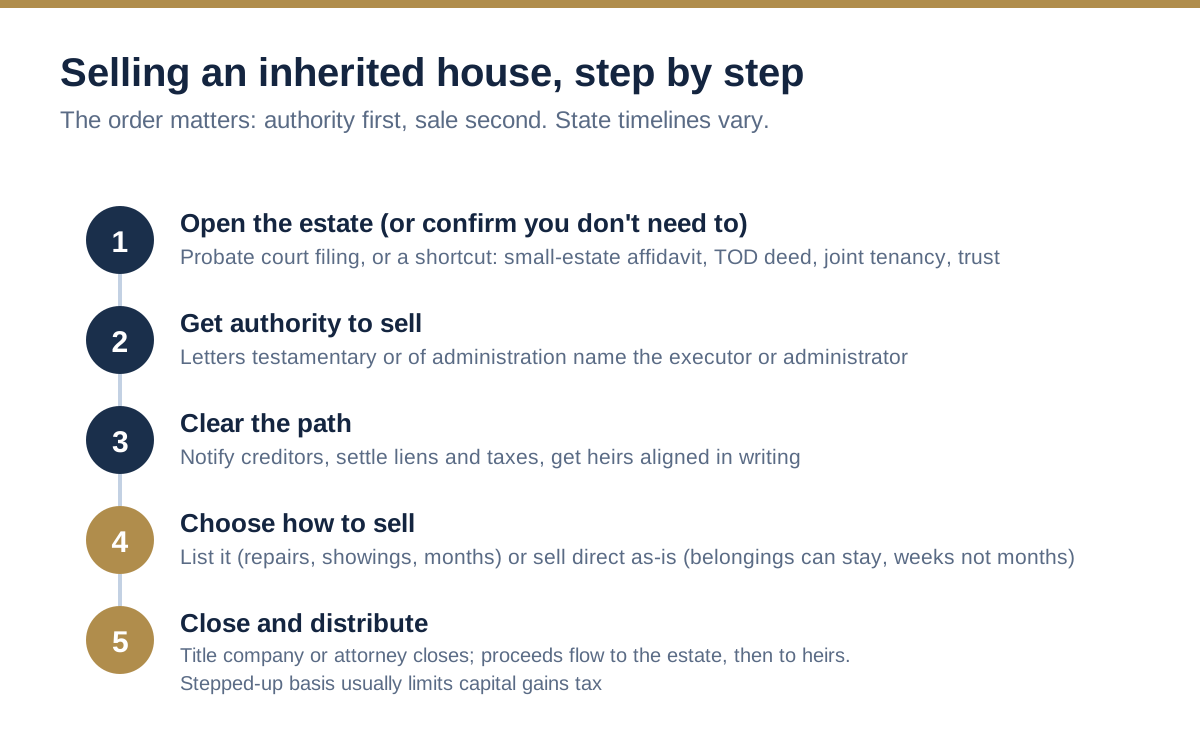
Whichever route the family picks, the sequence that saves the most grief is the same: open the estate early, get the letters issued, insure the vacant house, and put real numbers in front of every heir before anyone argues about hypothetical ones.
This guide is general information about North Carolina law, not legal advice; the estate's attorney is the authority on your specific file.
From the buyers
How EZ Time Home Buyers Can Help With an Inherited House
We work with executors, heirs, and families in probate all the time, including houses full of belongings and houses three states away from everyone who inherited them. We buy as-is, work around court timelines, and put every offer in writing with the math shown. If the family wants more than a cash number, the Retail Buyer Program handles the work while typically netting more than a typical cash offer, with no commissions or fees.
Frequently Asked Questions
Do we have to finish probate before selling an inherited house in North Carolina?
Usually not. Title vests in the heirs at death (N.C.G.S. 28A-15-2), so ownership exists immediately, and selling while the estate is open is routine. The house stays subject to estate debts during the creditor period, which runs at least three months from the published notice to creditors (N.C.G.S. 28A-14-1), so closing attorneys typically want the estate file open and the personal representative joining the deed. Full administration takes nine to eighteen months, but the house sale rarely waits for it.
Will we owe North Carolina taxes on an inherited house we sell?
There's no North Carolina estate tax (repealed retroactive to January 1, 2013) and no inheritance tax (repealed in 1999). Your basis steps up to the date-of-death value under 26 U.S.C. 1014, so selling near that value produces little or no capital gain. The main sale cost is the state excise tax of $1 per $500 of price, 0.2%, so $500 on a $250,000 sale (N.C.G.S. 105-228.30).
What happens if one heir refuses to sell the inherited house?
Every co-owner must sign the deed, so one holdout can block a sale. The practical fixes are a buyout priced off an appraisal or a real written offer, or, as a last resort, a partition special proceeding before the Clerk of Superior Court (N.C.G.S. Chapter 46A), where a house that can't be physically divided is typically ordered sold. Partition burns months and significant fees, so most families are better off negotiating around one concrete number.
Does an executor have to fill out the NC disclosure form when selling estate property?
Generally no. N.C.G.S. 47E-2 exempts court-ordered transfers and sales by fiduciaries in the course of estate administration, so a personal representative selling for the estate typically skips the Residential Property Disclosure Statement. An heir who already took title and is selling in their own name usually isn't exempt, but can answer "No Representation" about conditions they have no actual knowledge of (N.C.G.S. 47E-4).
Related Guides
Ready to see both of your numbers?
Tell us about your property once and get a written cash offer, plus what our Retail Buyer Program could net you instead. No repairs, no fees, no pressure to accept.