
The Missouri Foreclosure Process: Timeline, Your Rights, and Ways Out
By Eric Roebuck · Updated August 27, 2026 · 8 min read
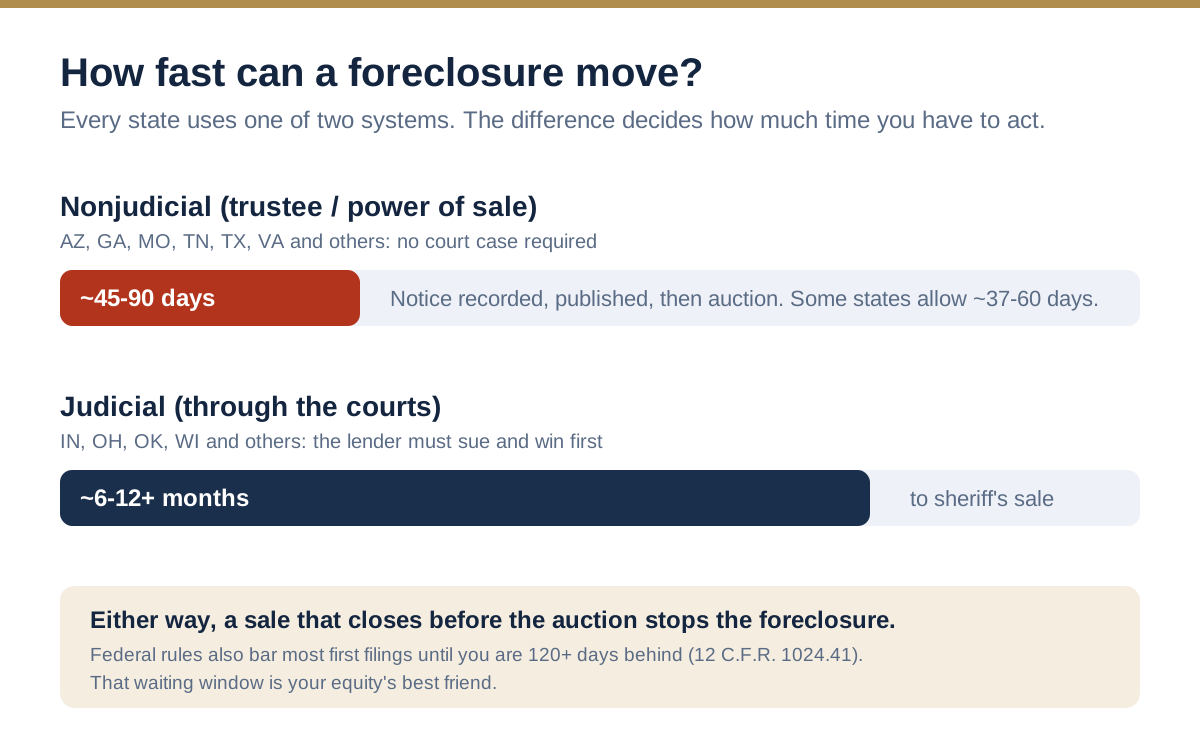
Missouri runs one of the fastest foreclosures in America. Once the trustee starts, the law requires only a 20-day mailed notice (Mo. Rev. Stat. 443.325) and newspaper publication before the auction, so the whole process commonly finishes in 45 to 60 days. Your real protection is the federal rule that nothing can start until you're more than 120 days behind. Here is the clock, stage by stage, and every legitimate way off of it.

Why Missouri Foreclosures Move So Fast
When you bought your house, you almost certainly signed a deed of trust rather than a true mortgage. That document names a trustee and contains a power of sale, which is the whole story of Missouri foreclosure speed: the trustee can sell the house at public auction without the lender ever filing a lawsuit.
No judge reviews the case, no court confirms the sale afterward, and there is no settlement conference requirement like the ones judicial states impose. Missouri does have a judicial foreclosure option on the books, but lenders almost never use it because the trustee's route is faster and cheaper.
That design has two consequences worth internalizing early. First, the burden of raising problems falls on you; nobody neutral checks the lender's paperwork unless you sue or file bankruptcy. Second, deadlines arrive by mail and newspaper, not by a court summons, so families regularly underestimate how close the auction actually is.
The Timeline, Stage by Stage
Here's the full arc from first missed payment to auction, with the rules that govern each stage.
Months 1 to 4: The Federal Cushion
Under federal mortgage-servicing law, the servicer cannot make the first foreclosure filing or referral until your loan is more than 120 days delinquent (12 C.F.R. 1024.41). During this window you'll get late notices, a formal breach or demand letter giving you roughly 30 days to cure, and outreach about loss mitigation options.
This is the longest stretch of runway you will ever have. Loans referred to foreclosure typically also get accelerated, meaning the lender declares the entire balance due, not just the missed payments.
The Trustee's 20-Day Notice
Once the loan is referred, the trustee sets a sale date and mails notice of the sale to you at least 20 days before it happens (Mo. Rev. Stat. 443.325). Read that again: twenty days, not months. The same statute requires notice to anyone who recorded a request for it.
Newspaper Publication of the Sale
Notice of the sale runs in the newspaper (Mo. Rev. Stat. 443.320). In counties containing a city of 50,000 or more, that means a daily paper for at least 20 insertions continuing to the day of sale; elsewhere, a weekly paper for four successive issues. Publication and the mailed notice run in parallel, which is why the whole trustee phase compresses to roughly 45 to 60 days.
Auction Day on the Courthouse Steps
The sale happens at public auction, usually on the courthouse steps in the county where the property sits. The lender nearly always opens with a credit bid, bidding some or all of the debt it's owed without cash changing hands. If nobody outbids it, the lender takes the house. The trustee then signs a trustee's deed to the winner, and the new owner can begin eviction. There is no confirmation hearing and no built-in waiting period after the hammer falls.
Your Rights at Each Stage
The right to be reviewed for alternatives. If you submit a complete loss mitigation application more than 37 days before the sale, the servicer must evaluate you for every option it offers, and it generally cannot run the sale while a timely, complete application is under review (12 C.F.R. 1024.41). This dual-tracking protection is federal, and it's the strongest lever most Missouri homeowners have. Submit early and in writing, and keep proof.
Reinstatement: contractual, not statutory. Missouri law gives you no statutory right to reinstate, meaning to catch up the arrears and stop the sale. But the standard Fannie Mae and Freddie Mac uniform deed of trust grants that right by contract, typically until five days before the sale. Pull your deed of trust and read the reinstatement paragraph; the deadline in your document is the one that counts.
Redemption: real on paper, rare in practice. Missouri allows redemption after the sale only in one narrow scenario: the lender itself (or someone bidding for it) bought the house at auction. Even then you must give written notice of intent to redeem at the sale or within 10 days before it, post a bond with surety within 20 days after the sale covering interest, costs, taxes, and more, and then redeem within one year (Mo. Rev. Stat. 443.410, 443.420). Fail the bond and the right evaporates. We have never met a homeowner who successfully used it. Plan as if the auction is final, because functionally it is.
Deficiency exposure: the part nobody warns you about. If the auction brings less than you owe, the lender can sue you for the difference. Missouri measures that deficiency by the debt minus the foreclosure sale price, not the home's fair market value, a rule the Missouri Supreme Court reaffirmed in First Bank v. Fischer & Frichtel (Mo. banc 2012). Since auction prices routinely come in below market, letting a house go to sale can leave you with no house and a five-figure judgment. Courts will only set aside a sale for a price so low it shocks the conscience, which almost never happens.
Surplus funds. The reverse case: if bidding exceeds the debt plus costs, the surplus belongs to junior lienholders and then to you. It happens at auctions on high-equity homes, but the auction discount means you'd almost always have netted far more selling conventionally.
Every Real Way Out
We buy houses from Missouri sellers in foreclosure every month, and we'll say plainly: selling is not always the right answer. Here is the honest menu.
- Catch up or work out a repayment plan. If the arrears are a few thousand dollars and income has recovered, reinstating under your contract or spreading the arrears over 6 to 12 months of payments is the cheapest fix.
- Loan modification. The servicer reworks the loan, often adding the arrears to the balance and extending the term. Slow, paperwork-heavy, and it only works if you can afford the modified payment, but it's the main tool for keeping the house.
- Forbearance. A temporary pause or reduction for a temporary problem, a job gap or a medical event, with a plan for repaying the paused amounts afterward.
- Bankruptcy. Filing triggers an automatic stay that immediately halts the sale (11 U.S.C. 362), and a Chapter 13 plan can spread arrears over three to five years; talk to a bankruptcy attorney about whether the math works for you.
- Deed in lieu of foreclosure. You hand the lender the keys and the deed. It avoids the auction, but you walk away with none of your equity, so it only makes sense when there's no equity to protect.
- Sell before the sale. If you have equity, this is usually the option that leaves you with the most money, and it works at any point before the trustee's hammer falls, though every week of delay narrows the buyer pool to cash.
Our stop foreclosure guide walks through each of these in more depth, including how to pressure-test a modification offer.
The Equity Math of Selling vs. Letting It Go
Run the numbers on a real example. Say the house would bring $200,000 on the open market and you owe $130,000 including arrears and fees.

At auction, the lender credit-bids around what it's owed. If a third party pushes bidding to $150,000, the debt and costs are paid and you might see a modest surplus. More often the lender's bid wins, you receive nothing, and roughly $70,000 of equity simply transfers to whoever bought the discount. Either way you also take the foreclosure on your credit for seven years.
Sold before the auction, even at an as-is cash price below full market value, that equity is yours. A direct sale at $175,000 with no commissions or repair credits pays off the $130,000, stops the foreclosure the day it closes, and wires you the balance.
This is the comparison that matters: not our offer against a perfect retail sale you no longer have time for, but our offer against the auction. Our cash offer calculator lets you run your own numbers before anyone visits the house.
Timing is the constraint. A financed retail buyer needs 30 to 45 days to close, which the trustee's 20-day notice does not allow. We close in two to three weeks because there's no lender, no appraisal, and no inspection renegotiation, and we coordinate directly with the trustee to confirm the payoff and stop the sale.
In St. Louis, where the city's occupancy inspection can complicate a rushed retail closing, and in Kansas City and Independence alike, the mechanics are the same: title work starts the day you sign.
If the house is in good shape and the sale date is still months out, ask us about our Retail Buyer Program instead; it lands more than a typical cash offer with the same simple process. Every market we serve is on our Missouri page.
What to Do This Week, Whatever Stage You're In
If you're one to three payments behind, call the servicer and ask for a loss mitigation application; the 120-day federal floor means nothing has started yet, and every option on the menu is still open.
If the breach letter has arrived, submit that application complete and in writing, and get a realistic market opinion on the house at the same time, because you're choosing between keeping and selling and you need both numbers.
If the trustee's 20-day notice is in your hands, act on parallel tracks today: loss mitigation review, a bankruptcy consult, and a cash sale conversation all at once, then take the best exit that firms up.
And whatever stage you're in, verify every date directly with the trustee named in your notice, not with a caller promising rescue for an upfront fee. Foreclosure rescue scams follow the publication lists in every Missouri county. Anyone legitimate, us included, gets paid at a title company closing, never before.
The broader legal landscape for sellers is in our guides to selling a house in Missouri and selling before foreclosure.
This guide is general information, not legal advice; for foreclosure defense, deficiency exposure, or a bankruptcy decision, talk to a Missouri attorney, and we're glad to work alongside yours.
From the buyers
How EZ Time Home Buyers Can Help Before Foreclosure
A sale that closes before the auction pays off the loan, stops the foreclosure, and puts your remaining equity in your pocket instead of losing it at the courthouse. We close in as little as 2-3 weeks, coordinate payoff directly with your lender through a licensed title company, and show you the math in writing before you commit to anything. No fees, and no pressure: if keeping the house is possible, we'll say so.
Frequently Asked Questions
How long does the foreclosure process take in Missouri?
Measured from your first missed payment, roughly six months: federal law bars the first foreclosure referral until you're more than 120 days delinquent (12 C.F.R. 1024.41). Measured from the trustee's start, only about 45 to 60 days: a mailed sale notice at least 20 days before the auction (Mo. Rev. Stat. 443.325) plus newspaper publication (Mo. Rev. Stat. 443.320), then the courthouse-steps sale. Missouri is among the fastest foreclosure states in the country.
Can I get my house back after a Missouri foreclosure auction?
Almost never. Missouri's only redemption right applies when the lender itself was the winning bidder, and it requires written notice at the sale or within 10 days before it, a surety bond posted within 20 days after the sale, and full redemption within one year (Mo. Rev. Stat. 443.410, 443.420). The bond must cover interest, costs, and taxes, which puts it out of reach for nearly every homeowner. Treat the auction as final and use your leverage before it.
Can the lender come after me for money after the auction?
Yes. Missouri allows deficiency judgments, calculated as the debt minus the foreclosure sale price rather than the home's fair market value, a rule the Missouri Supreme Court reaffirmed in First Bank v. Fischer & Frichtel (2012). Because auction prices usually run below market, letting a house go to sale can mean losing the home and still owing tens of thousands. A pre-auction sale that pays the loan in full eliminates that exposure entirely.
How late can I stop a Missouri foreclosure by selling?
Legally, any closing that pays off the loan before the auction stops it, even days before. Practically, you need enough runway for title work, which takes about two to three weeks on a cash sale. Most deeds of trust also let you reinstate by paying the arrears until five days before the sale, and a timely, complete loss mitigation application filed more than 37 days out generally pauses the sale during review (12 C.F.R. 1024.41). The earlier you move, the more of your equity survives.
Related Guides
Ready to see both of your numbers?
Tell us about your property once and get a written cash offer, plus what our Retail Buyer Program could net you instead. No repairs, no fees, no pressure to accept.