
The Virginia Foreclosure Process: Timeline, Your Rights, and Ways Out
By Eric Roebuck · Updated August 27, 2026 · 8 min read
Virginia foreclosure is nonjudicial and fast: the trustee owes an owner-occupant 60 days' written notice before sale, any other property just 14 days (Va. Code 55.1-321), and the auction can be held as soon as eight days after the first newspaper ad (Va. Code 55.1-322). There is no post-sale redemption here, so everything that can save your house or your equity happens before the hammer falls. Here is the full clock, stage by stage, and every real way off of it.
Virginia Forecloses Without a Judge
Nearly every Virginia home loan is secured by a deed of trust, not a true mortgage. That document names a trustee and gives them the power to sell the house at auction if the borrower defaults, no lawsuit, no judge, no courtroom.
The lender's whole process is a series of letters, two newspaper ads, and an auction, which is why Virginia runs one of the fastest foreclosure timelines in the country, a point our broader Virginia selling guide makes from the seller's side.
We tell every seller in default the same thing: in a judicial state you measure your runway in months, in Virginia you measure it in weeks, and the calendar only moves one direction.
The good news is that the same speed works for you if you act early. A house can be sold, refinanced, or brought current at almost any point before the auction. It just cannot be any of those things afterward.
The Timeline, Stage by Stage
Every Virginia foreclosure follows roughly the same sequence, and each stage has its own clock.
Missed payments and the federal 120-day floor
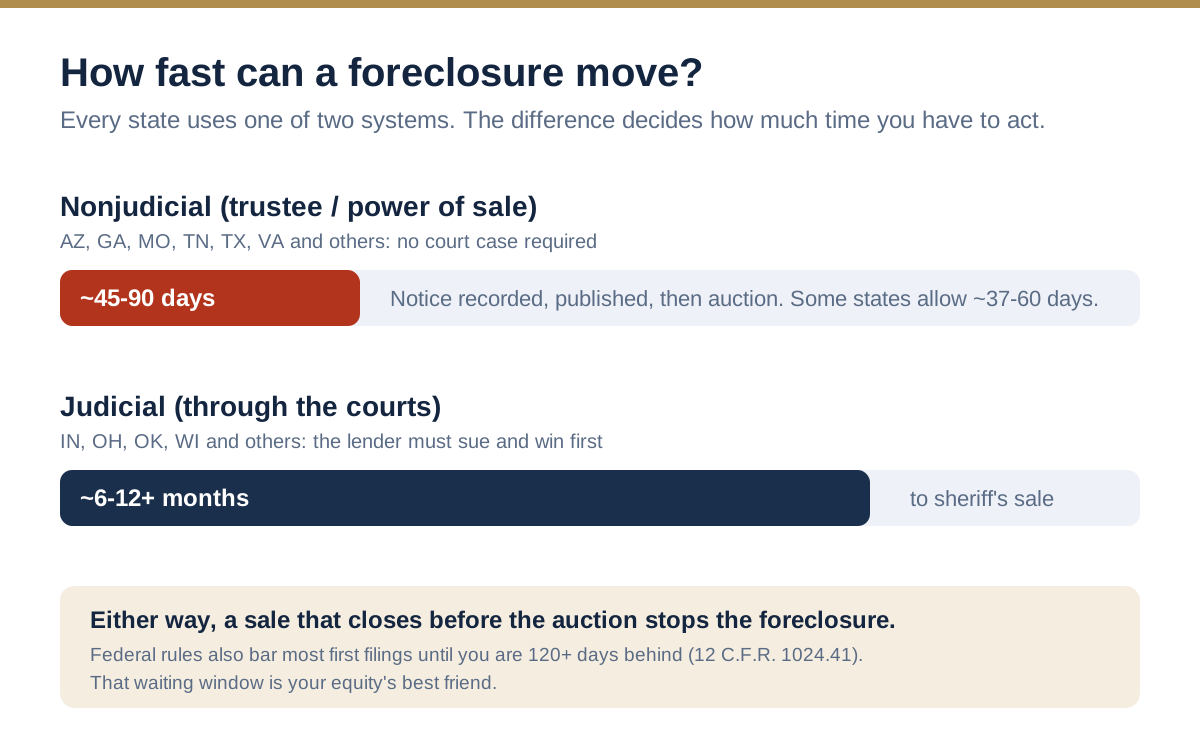
One missed payment triggers late fees and phone calls, not foreclosure. Federal mortgage-servicing rules bar the servicer from making the first official foreclosure move until you are more than 120 days delinquent (12 C.F.R. 1024.41), and during that window the servicer must reach out about loss mitigation options. Four months sounds like breathing room. In Virginia it is most of the breathing room you will get, because the state adds so little time after it.
The breach letter and acceleration
Somewhere in those months a formal default or "breach" letter arrives, typically giving 30 days to cure under the standard deed of trust's own terms. If the arrears are not paid, the lender accelerates the loan: the entire balance comes due, not just the missed payments. After acceleration, catching up is no longer a right unless your loan documents make it one, which most do (more on that below).
The trustee's notice: 60 days or 14
Virginia's central foreclosure statute is Va. Code 55.1-321. For owner-occupied residential property, the trustee must send written notice at least 60 days before the sale date, and the notice must contain real information: the date and amount of your last payment received, the total arrears, the remaining principal balance, and referrals to HUD-approved housing counseling and legal aid.
For every other property, a rental, a vacant house, the inherited home nobody moved into, the notice requirement is 14 days. Families dealing with an estate get burned by that difference constantly; the 60-day runway everyone has heard of simply does not apply to a house with no occupant.
Advertising and the auction
The trustee advertises the sale in a local newspaper. When the deed of trust sets the advertising terms, as most do, publication can be as little as once a week for two weeks, and the sale may be held as soon as eight days after the first ad runs (Va. Code 55.1-322). The auction itself usually happens on the circuit courthouse steps.
The lender almost always opens with a credit bid, bidding the debt it is owed rather than cash, and if nobody outbids it, the lender takes the house.
After the hammer
The trustee deeds the property to the winning bidder and accounts for the money to the Commissioner of Accounts. Sale proceeds follow a strict order under Va. Code 55.1-324: the costs of the sale and trustee's commission first, then priority taxes, then the mortgage debt and junior liens, and only then any residue to you.
If you were still living there, the new owner can pursue possession, and you become an occupant facing eviction in a house you no longer own. Virginia provides no statutory right of redemption after a trustee's sale. Once the auction closes, it is over.
Add it up: an owner-occupied home can go from trustee's notice to auction in roughly 60 days, and a non-owner-occupied one in a few weeks. That is the whole state-law timeline.
Your Rights at Each Stage
Before acceleration, you have the absolute right to cure: pay the arrears and fees, and the loan simply resumes.
After acceleration, reinstatement in Virginia is contractual, not statutory. The standard Fannie Mae and Freddie Mac deed of trust used for most Virginia loans grants a right to reinstate by paying the past-due amounts and costs up until shortly before the sale, and Virginia law gives effect to reinstatement language in the deed of trust (Va. Code 55.1-325). Read your deed of trust, or have a housing counselor read it with you; the notice's HUD counseling referral exists for exactly this.
Until the auction, you can always redeem by paying the full accelerated balance, usually by refinancing or selling. This equitable right of redemption ends at the sale, permanently.
On loss mitigation, the federal rules keep working for you deep into the process: submit a complete loss mitigation application more than 37 days before the scheduled sale and the servicer generally must review it and hold off on the sale while it does (12 C.F.R. 1024.41).
After the sale, your exposure is not necessarily zero. If the auction brings less than you owe, Virginia allows the lender to sue you separately for the deficiency; it takes a new lawsuit on the note, and many lenders never bother, but the right exists. Virginia has no mandatory settlement conference or mediation program to slow any of this down.
Every Real Way Out
We buy houses from Virginia sellers in foreclosure every month, and we will tell you plainly: selling to us is the right answer only some of the time. Here is the honest menu.
Catch up or reinstate. If the arrears are a few thousand dollars and your income has recovered, this is the cheapest fix there is. Family loans have saved more houses than any program.
Loan modification or forbearance. The servicer reworks the loan's terms or pauses payments. Slow, paperwork-heavy, and entirely worth pursuing if you want to keep the house; a HUD-approved counselor (free, listed in your trustee notice) will fight the paperwork with you.
Bankruptcy. A Chapter 13 filing triggers an automatic stay that stops a scheduled sale immediately and lets you cure arrears over years, at real cost to your credit and with real discipline required; talk to a bankruptcy attorney, not a blog.
Deed in lieu. You hand the lender the keys and the deed. It avoids the auction, but it also surrenders every dollar of equity, so it only makes sense when there is none.
Sell before the sale. If you have equity, this is usually the option that saves it. A sale that closes before the auction pays off the loan in full, ends the foreclosure, and puts the remaining equity in your pocket instead of leaving it on the courthouse steps.

The Equity Math of Selling vs. Letting It Go
Here is the arithmetic that matters, with round numbers. Say the house would bring $300,000 on the open market and you owe $210,000 including arrears and fees.
At auction, the lender opens with a credit bid near its $210,000 payoff. Third-party bidders at Virginia trustee sales are professionals buying sight-unseen for cash, and they bid accordingly, well below retail.
If the hammer falls at $240,000, the waterfall under Va. Code 55.1-324 runs costs, taxes, and debt first, and you might see $20,000-something of what was $90,000 in equity. If the credit bid wins, you see nothing at all.
Foreclosure also keeps adding trustee's fees, legal costs, and interest to the payoff every week you wait, so the debt side of the equation grows while you deliberate.
Sell before the auction at even $270,000 and the same math returns you roughly $55,000 after the payoff and modest closing costs. A below-retail sale you control beats an auction you do not, every time there is equity in the house. And if there is no equity, a negotiated short sale or deed in lieu still usually leaves your credit in better shape than a completed foreclosure.
Can a Sale Actually Close in Time?
In Virginia, usually yes, if you start when the notice arrives rather than the week of the auction. A cash sale has no lender, no appraisal, and no financing contingency, so the calendar is just title work.
Our closings across Norfolk, Newport News, Hampton, and the rest of Virginia typically run two to three weeks from contract to settlement, and Virginia's Wet Settlement Act requires your proceeds to be disbursed within two business days of closing (Va. Code 55.1-903).
We give you a written offer with the payoff and your net itemized, coordinate directly with the trustee for exact payoff figures, and set the closing date against your sale date, with the same process we use on every house.
On a 60-day owner-occupied clock, that fits with room to spare; on a 14-day clock, it fits only if you call immediately. If the house is in good condition and the timeline allows, our Retail Buyer Program can get you more than a typical cash offer with the same easy process.
Our foreclosure options guide compares all of these paths, and can I sell my house before foreclosure answers the timing questions in detail.
If the Trustee's Letter Arrived This Week
Do three things before Friday. Read the notice and mark the sale date, because every option above is measured backward from it. Call the HUD-approved counseling number in the letter, because it is free and counselors move servicers faster than borrowers can.
Then get a real payoff figure and a real value on the house, because those two numbers, not fear, should decide whether you fight for the loan or fight for the equity. Virginia's process is fast, but it is not faster than a homeowner who starts on day one.
Foreclosure law and loan documents vary, and this guide is general information, not legal advice. A Virginia attorney or HUD-approved housing counselor is the authority on your specific situation.
From the buyers
How EZ Time Home Buyers Can Help Before Foreclosure
A sale that closes before the auction pays off the loan, stops the foreclosure, and puts your remaining equity in your pocket instead of losing it at the courthouse. We close in as little as 2-3 weeks, coordinate payoff directly with your lender through a licensed title company, and show you the math in writing before you commit to anything. No fees, and no pressure: if keeping the house is possible, we'll say so.
Frequently Asked Questions
How long does the foreclosure process take in Virginia?
Once you are more than 120 days delinquent (the federal floor under 12 C.F.R. 1024.41), Virginia's own timeline is among the shortest anywhere: at least 60 days' written notice before sale for owner-occupied homes, only 14 days for any other property (Va. Code 55.1-321), with the auction allowed as soon as eight days after the first newspaper advertisement (Va. Code 55.1-322). In practice an owner-occupied home can reach auction roughly 60 days after the trustee's notice, and a vacant or inherited house within a few weeks.
Can I stop a Virginia foreclosure after the trustee's notice arrives?
Usually, yes. Most Virginia deeds of trust let you reinstate by paying the arrears and costs up until shortly before the sale (Virginia law honors that language, Va. Code 55.1-325), and you can always pay off or sell the house any time before the auction. A complete loss mitigation application submitted more than 37 days before the sale generally forces the servicer to pause and review it (12 C.F.R. 1024.41), and a bankruptcy filing stops a scheduled sale through the automatic stay. After the auction, though, Virginia gives you no right of redemption.
Will I still owe money after a Virginia foreclosure sale?
Possibly. Sale proceeds pay the trustee's costs and commission, priority taxes, then the mortgage and junior liens, with any surplus paid to you (Va. Code 55.1-324). If the auction brings less than the debt, Virginia permits the lender to file a separate lawsuit for the deficiency. Many lenders write small deficiencies off, but the exposure is real, which is one more reason a pre-auction sale that pays the loan in full usually beats letting the auction happen.
Can I sell my house in Virginia after foreclosure has started?
Yes, at any point before the auction. A closed sale pays off the accelerated balance, ends the foreclosure, and returns the remaining equity to you. The constraint is the calendar: a cash closing needs about two to three weeks of title work, which fits comfortably inside the 60-day owner-occupied notice period but barely inside the 14-day window for vacant and inherited properties (Va. Code 55.1-321). Get the trustee's payoff figure immediately, and tell any buyer the sale date up front so closing is scheduled against it.
Related Guides
Ready to see both of your numbers?
Tell us about your property once and get a written cash offer, plus what our Retail Buyer Program could net you instead. No repairs, no fees, no pressure to accept.