
Selling an Inherited House in Virginia: Probate, Taxes, and Your Options
By Carson Whaley · Updated August 26, 2026 · 8 min read
Virginia charges heirs no estate or inheritance tax, probate opens across the counter at the circuit court clerk's office rather than in a courtroom, and title to the house vests in the heirs the day the owner dies. Most families we work with go from first clerk appointment to a closed sale in under 90 days. Here is how the process actually runs, what it costs, and where it stalls.

The Deed Moves Before the Paperwork Does: How Virginia Handles a House at Death
Virginia treats an inherited house differently than most heirs expect. Title to real estate vests in the heirs or devisees at the moment of death. Estate lawyers here like to say the title "drops like a stone": if the will leaves the house to you, it is yours, subject to the estate's debts, and if there is no will, it passes to the heirs in the order Virginia's intestacy statute sets out (Va. Code 64.2-200). The house does not sit in legal limbo waiting for a judge to act.
What death does not deliver is marketable title. Before anyone can close a sale, the land records have to show who owns the place now, and every buyer's title company will insist on the estate paperwork behind that answer. Virginia's tools for this are refreshingly simple. The personal representative files a List of Heirs with the circuit court clerk (Va. Code 64.2-509), and when there is no will and nobody qualifies on the estate, the family can record an affidavit identifying the decedent's real estate and heirs at law (Va. Code 64.2-510). Those filings, plus the probate steps below, are what turn "the house is ours now" into a deed you can actually sign.
One more thing vesting means in practice: the estate's obligations follow the house. The mortgage, tax liens, and valid creditor claims all get resolved at or before closing. That is why the first job on every inherited sale we buy is pinning down exactly who signs and what gets paid off, and it is a title question, not a family debate.
Probate Runs Through the Clerk's Office, and It Is Faster Than You Think
Virginia has no separate probate court. Circuit courts hold probate jurisdiction (Va. Code 64.2-443), and clerks have independent statutory authority to admit wills to probate and appoint the executor or administrator (Va. Code 64.2-444). The whole opening act usually happens across a counter, by appointment, at the clerk's office in the county or city where the person lived. Bring the original will, a death certificate, and a rough list of assets. Many families walk out the same day qualified as executor or administrator, certificates in hand. Routine oversight afterward runs through a Commissioner of Accounts rather than a courtroom.
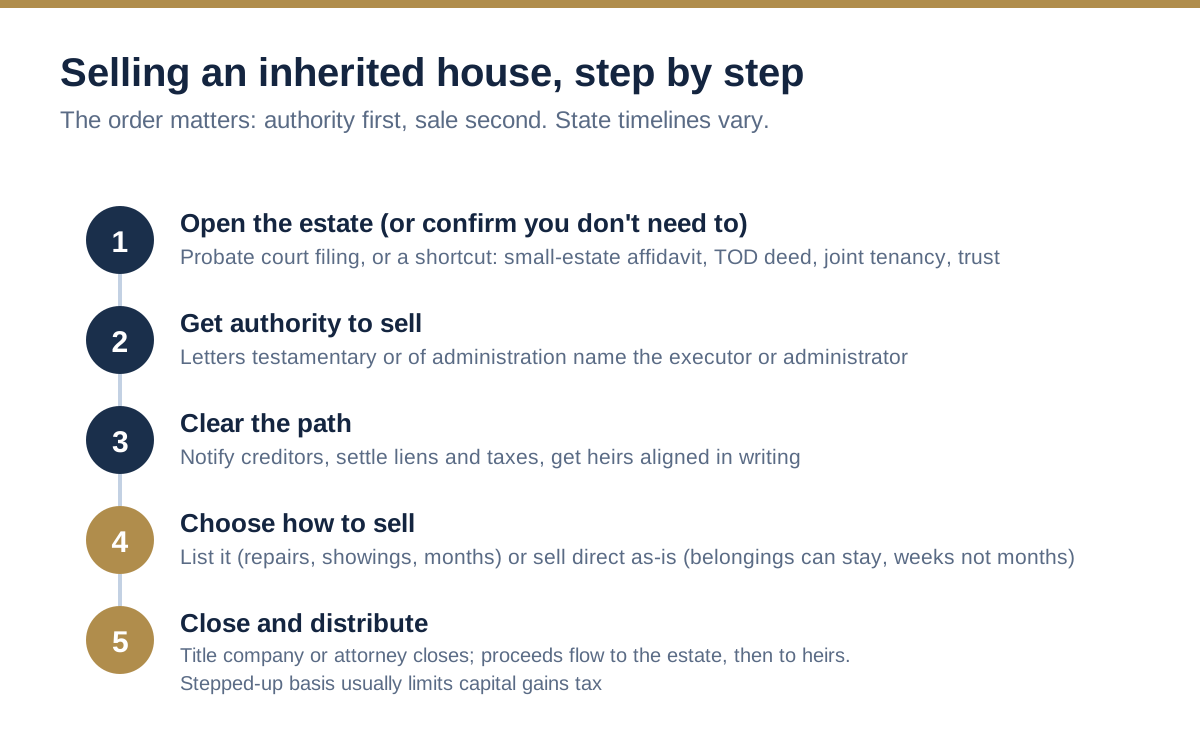
A few Virginia specifics shape how the sale itself plays out.
Who Signs: The Will's Power of Sale
If the will gives the executor a power of sale or directs the house to be sold, the executor can typically sign the contract and deed. If the house passed straight to the devisees or heirs, they are the sellers, all of them. The estate's attorney and the settlement agent sort this out from the will and the land records, usually in days.
The $75,000 Small Estate Affidavit: Personal Property Only
Successors can collect a decedent's personal probate estate of $75,000 or less by affidavit once 60 days have passed since death (Va. Code 64.2-601). The affidavit never transfers real estate, but it spares many families a formal qualification just to reach bank accounts, which keeps the overall estate simple while the house sells.
Selling Before the Estate Closes
The sale rarely waits for the estate to wrap up. Qualification takes days to a few weeks. Once authority and title are settled, the house can go under contract, and a contract can even be signed earlier, contingent on qualification. Full estate administration, with its creditor period and final accounting to the Commissioner of Accounts, takes months longer, but proceeds simply sit in the estate account until distribution. The house closes; the estate catches up.
Our probate guide walks the authority-and-approval sequence step by step, and our inherited house resource covers the national picture. The Virginia-specific headline is that this is one of the fastest probate systems in the country when someone keeps it moving.
Taxes on a Virginia Inheritance: Better News Than You Expect
Heirs brace for a tax bill that usually never comes.
Virginia has no estate tax and no inheritance tax. The General Assembly repealed the state estate tax for deaths on or after July 1, 2007, and Virginia has no inheritance tax on what heirs receive. You will not owe Richmond anything simply for inheriting.
The federal estate tax is irrelevant to almost everyone. The federal exemption is $15 million per person for 2026 deaths. Unless the estate approaches that number, no federal estate tax is due.
The stepped-up basis does the heavy lifting. Under federal law (26 U.S.C. 1014), your cost basis in the house resets to its fair market value on the date of death. Say your father paid $85,000 for the Richmond house in 1994 and it was worth $340,000 when he died. Your basis is $340,000. Sell it for $350,000 and your taxable gain is $10,000, not $265,000. This single rule makes most inherited-house sales nearly tax-free, and it is why a date-of-death appraisal or valuation is a document worth paying for and keeping forever.
What you do pay at closing. As our Virginia selling guide covers in detail, the seller-side grantor's tax runs $0.50 per $500 of price, about 0.1 percent (Va. Code 58.1-802). Sellers inside Northern Virginia also pay the regional WMATA capital fee and congestion relief fee, each $0.10 per $100 (Va. Code 58.1-802.3 and 58.1-802.4); Hampton Roads sellers instead pay the smaller $0.06 per $100 regional transportation improvement fee (Va. Code 58.1-802.5), and Richmond adds no regional fee. Property taxes keep accruing until closing and get prorated on the settlement statement.
Three Heirs, One House: How Virginia Sorts Out Disagreement
Most inherited houses have more than one owner the moment the title vests, and co-ownership is where these sales bog down. The workable outcomes are the obvious ones: one heir buys the others out at an agreed value, the group rents it (rarely ends well among siblings), or everyone sells and splits the proceeds.
In our experience the standoffs are usually about information, not money. The heir in Norfolk sees the tax assessment; the heir in Denver saw a Zestimate; nobody has the same number. Share every document and every offer with every heir at the same time. We present offers on group calls for exactly this reason, so five people in four states hear the same numbers in the same sentence.
If agreement truly fails, any co-owner can file a partition suit (Va. Code 8.01-81). Since 2020, Virginia's partition statute incorporates the Uniform Partition of Heirs Property Act, which stacks the process against a forced fire sale: the court must first consider dividing the land itself, then allowing one or more co-owners to buy the property at a court-determined appraised value (Va. Code 8.01-81.1), and only orders a sale as a last resort (Va. Code 8.01-83). That protects families from being bought out for pennies, but a partition case still takes many months and real legal fees. Nearly every family does better negotiating a buyout or a joint sale than paying lawyers to reach the same destination slower.
The House Itself: Belongings, Insurance, and Two Virginia Clocks

The slowest part of most inherited sales is not the law. It is forty years of belongings. Take the photographs and the things that matter, then be honest about the rest: an estate-sale company takes a cut, a dumpster takes a weekend, and a buyer like us takes the house contents included, so "cleaned out" never has to appear on your to-do list. We buy as-is, furniture and all, more often than not.
Two clocks run while the family decides:
Insurance. Homeowner's policies can limit or lapse coverage when the owner dies or the house sits empty. Call the insurer early and ask for an estate or vacant endorsement. Some Virginia localities also require vacant buildings to be registered (Va. Code 15.2-1127).
The mortgage. Here is the trap we warn every Virginia heir about: a house nobody occupies gets only 14 days of foreclosure notice before sale, not the 60 days an owner-occupant receives (Va. Code 55.1-321), and the auction can follow as soon as eight days after the first advertisement (Va. Code 55.1-322). If mortgage payments stopped when the owner passed, the estate may be weeks, not months, from losing the house. Open every letter addressed to the estate, and if one is from a trustee, act that day.
Your Ways to Sell, Compared Honestly
Disclosure is the easy part. Virginia is already a buyer-beware state (Va. Code 55.1-703), and transfers by a fiduciary administering an estate are exempt from the Residential Property Disclosure Act entirely (Va. Code 55.1-702). Executors are not expected to know the roof's history, and the law does not pretend otherwise. Nothing, however, protects active concealment or lying to a direct question; that stays fraud in Virginia.
Listing With a Real Estate Agent
Listing makes sense when the house is updated, vacant-ready, and the heirs have patience and nearby hands. Budget 5 to 6 percent in commissions, whatever repairs the buyer's inspector negotiates, and carrying costs (insurance, utilities, taxes, lawn) for every month on market, multiplied by however many heirs are fronting them.
Selling As-Is to a Direct Buyer
A direct as-is sale trades some price for certainty and speed, and on a dated house the gap is smaller than people assume once repairs, commissions, and months of carrying costs come off the listing number. We buy inherited houses across Richmond, Norfolk, Virginia Beach, and everywhere else we serve in Virginia, coordinate directly with the estate's attorney and the clerk's paperwork, and can issue a firm written offer before qualification is even final so the estate can act the moment authority exists. If the house is in good shape and the family wants a stronger number with the same easy process, ask us about our Retail Buyer Program; it gets sellers more than a typical cash offer without the listing circus.
An Order of Operations for Virginia Heirs
Families that move smoothly through this do roughly the same five things in the same order. Get death certificates and book the clerk's appointment first, since nothing signs without authority. Secure and insure the house the same week. Get a date-of-death value in writing to lock the stepped-up basis. Let the estate's attorney or a settlement agent answer the who-signs question before anyone argues about price. Then, and only then, choose how to sell, with every heir looking at the same numbers. Do those in order and the house usually closes before the estate's first accounting is even due.
Every estate is different and this guide is general information, not legal or tax advice. The estate's Virginia attorney is the authority on your specific situation.
From the buyers
How EZ Time Home Buyers Can Help With an Inherited House
We work with executors, heirs, and families in probate all the time, including houses full of belongings and houses three states away from everyone who inherited them. We buy as-is, work around court timelines, and put every offer in writing with the math shown. If the family wants more than a cash number, the Retail Buyer Program handles the work while typically netting more than a typical cash offer, with no commissions or fees.
Frequently Asked Questions
Does Virginia have an inheritance tax on a house I inherit?
No. Virginia repealed its estate tax for deaths on or after July 1, 2007, and has no inheritance tax, so heirs owe the state nothing for inheriting. The federal estate tax only touches estates near the $15 million per-person exemption (2026). When you sell, the stepped-up basis under 26 U.S.C. 1014 resets your cost basis to the home's date-of-death value, so capital gains tax applies only to appreciation after the death, which for most families is little or nothing.
Do we have to go through probate to sell an inherited house in Virginia?
Usually some clerk's-office paperwork, yes, but Virginia makes it light. Title vests in the heirs or devisees at death, and probate runs through the circuit court clerk (Va. Code 64.2-443 and 64.2-444), often in a single appointment. If there is a will, it gets admitted and the executor qualifies; if not, a List of Heirs (Va. Code 64.2-509) or real estate affidavit (Va. Code 64.2-510) establishes ownership of record. The $75,000 small estate affidavit (Va. Code 64.2-601) covers personal property only and never transfers the house.
Can the executor sell the house without all the heirs agreeing?
It depends on the will. If the will grants the executor a power of sale or directs a sale, the executor can generally sign without unanimous consent, though good executors share every offer with every beneficiary anyway. If the house passed directly to the devisees or heirs, they own it, and every owner must sign the deed. When co-owners deadlock, Virginia's partition statute (Va. Code 8.01-81) applies the Uniform Partition of Heirs Property Act: buyout at appraised value comes before any forced sale, but the case takes months, so a negotiated deal nearly always beats it.
What does it cost to sell an inherited house in Virginia?
At closing, the seller pays the grantor's tax of $0.50 per $500 of price (Va. Code 58.1-802), about $350 on a $350,000 sale, plus settlement fees and prorated property taxes. Northern Virginia sellers add two regional fees of $0.10 per $100 each (Va. Code 58.1-802.3 and 58.1-802.4); Hampton Roads sellers add only the $0.06 per $100 regional transportation fee (Va. Code 58.1-802.5), and Richmond sellers add nothing. A listing adds 5 to 6 percent commissions, repairs, and months of carrying costs. Estate sales by a fiduciary are also exempt from the disclosure statement requirement (Va. Code 55.1-702).
Related Guides
Ready to see both of your numbers?
Tell us about your property once and get a written cash offer, plus what our Retail Buyer Program could net you instead. No repairs, no fees, no pressure to accept.