
The Wisconsin Foreclosure Process: Timeline, Your Rights, and Ways Out
By Carson Whaley · Updated August 26, 2026 · 8 min read
A Wisconsin foreclosure runs through the circuit court and typically takes 9 to 12 months or more from first missed payment to a confirmed sheriff's sale: 120 days of federal pre-filing protection (12 C.F.R. 1024.41), months of litigation, then a redemption period of 3 to 6 months after judgment during which you keep possession and can still sell. Here is every stage, every right you hold, and every real way out, with the statutes attached.
The Wisconsin Foreclosure Timeline, Stage by Stage
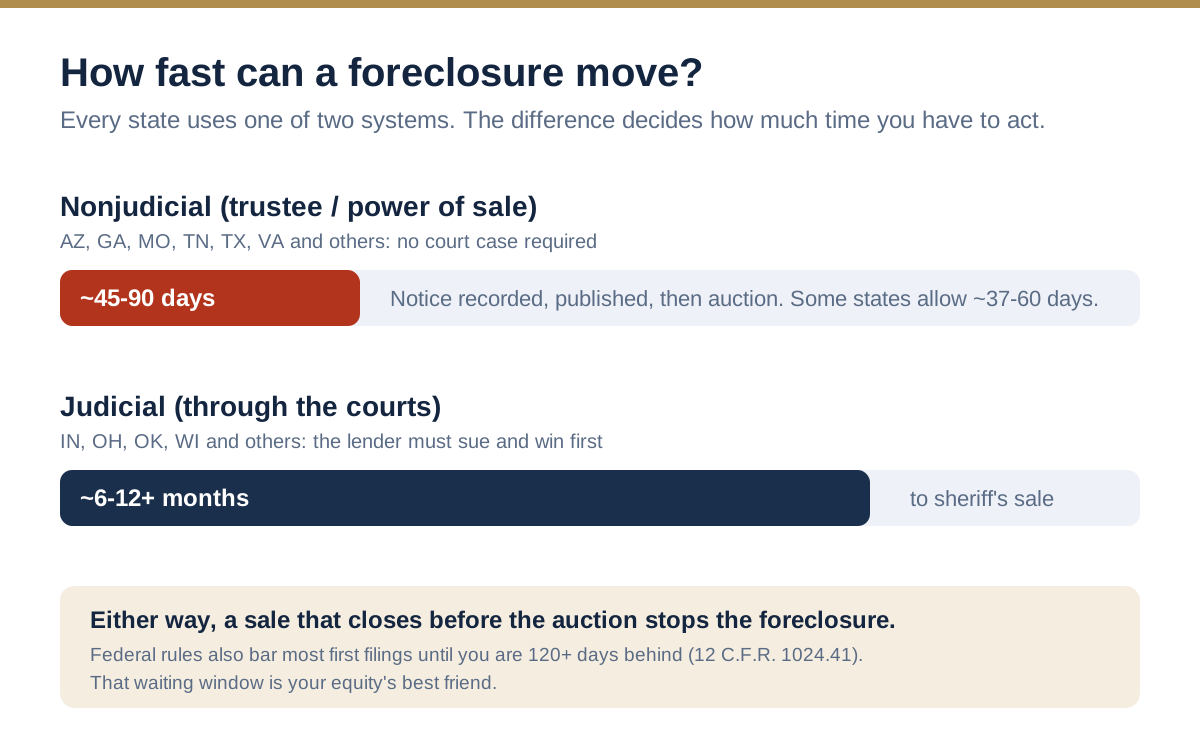
Wisconsin forecloses only through the courts (Wis. Stat. ch. 846). There is no power-of-sale shortcut here: every foreclosure is a lawsuit in the circuit court for your county, with a judge, a public case number, and deadlines you can read. That structure is slow by design, and the time it creates belongs to you as much as to the bank, if you use it.
Months 1 to 4: missed payments and the federal floor
One missed payment triggers a late fee after the grace period, usually day 16. By around day 30 the delinquency hits your credit report. Federal servicing rules then kick in: the servicer must generally make live contact attempts by day 36 and tell you about loss mitigation options in writing by day 45 (12 C.F.R. 1024.39). Somewhere in this stretch a breach letter arrives, typically giving 30 days to cure before the loan accelerates.
The hard floor: federal law bars the servicer from making the first foreclosure filing until you are more than 120 days delinquent (12 C.F.R. 1024.41(f)). Four missed payments, minimum, before a Wisconsin case can even open. Nothing is lost yet at this stage, and everything is still on the table.
The lawsuit: summons, complaint, and 20 days that matter
The foreclosure starts when the lender files a summons and complaint in circuit court and records a lis pendens against the property. You have 20 days after personal service to file a written answer (Wis. Stat. 802.06(1)(a)). Do not skip this. An answer, even a simple one you file yourself, prevents an immediate default judgment, forces the lender to prove its case, and typically adds months to the calendar. It also preserves defenses (bad accounting, standing problems, servicing violations) that vanish with a default.
Wisconsin also has a statewide, voluntary foreclosure mediation network (administered regionally through programs like Mediate Wisconsin). Homeowners are encouraged to apply within about 15 days of receiving the summons, though later requests are often accepted. Mediation pauses nothing by itself, but it puts you and the lender's representative at the same table with a neutral, which is where many modifications actually get done.
Judgment and the election that sets your clock
If the case is not resolved, the court enters a foreclosure judgment fixing the amount owed. At that moment the lender's choice about a deficiency sets your redemption period. For mortgages signed on or after April 27, 2016, on an owner-occupied one-to-four-family home on 20 acres or less:
- Lender pursues a deficiency: no sheriff's sale until 6 months after judgment (Wis. Stat. 846.10(2)).
- Lender waives the deficiency, which most residential lenders do: no sale until 3 months after judgment (Wis. Stat. 846.101).
- Mortgage predates April 27, 2016: the older periods apply, up to 12 months (Wis. Stat. 846.10(2)).
The trapdoor is abandonment. If the court makes an affirmative finding that the property is abandoned, the sale can occur just 5 weeks after judgment (Wis. Stat. 846.102). Moving out, shutting off utilities, and letting the mail pile up can collapse a 6-month window into 35 days. Keep the house occupied, or at least convincingly lived-in, until you have executed your plan.
The sheriff's sale
Before the sale, notice must run in a county newspaper once each week for 3 successive weeks and be posted publicly (Wis. Stat. 846.16 and 815.31). The auction itself happens between 9 a.m. and 5 p.m., usually on the courthouse steps or in a sheriff's office conference room. The lender bids with a credit bid, paper credit against its own judgment, up to the full amount owed without producing a dollar of cash. A third-party bidder must put down a deposit and pay the balance within 10 days after the court confirms the sale (Wis. Stat. 846.17).
Confirmation: the actual finish line
The auction is not the end. No sale is final until the court confirms it at a hearing on at least 5 days' notice to every party who appeared (Wis. Stat. 846.165), and when the lender seeks a deficiency, the court must be satisfied the property's fair value was credited before any deficiency is awarded. You keep possession of the house, and any rents it produces, until confirmation (Wis. Stat. 846.101). Only after confirmation does the buyer take title and, if needed, obtain a writ to remove occupants.
Add it up: 120 days of federal runway, a contested case that often runs 3 to 6 months, then 3 to 6 more months of redemption, then notice, sale, and confirmation. A year from first missed payment to lost keys is the normal shape of a Wisconsin foreclosure, not the worst case.
Your Rights at Each Stage
Reinstatement before judgment. The standard mortgage contract most borrowers signed gives you the right to reinstate, catching up just the missed payments, late fees, and costs rather than the full balance, up until the court enters judgment. If you can get current, the case ends and the loan continues as before.
Redemption before the sale. At any time before the sheriff's sale you can redeem the property by paying the full judgment amount plus interest and costs (Wis. Stat. 846.13). That is the whole balance, not the arrears, so in practice redemption happens through a refinance or a sale of the house. Note the direction Wisconsin runs: redemption comes before the sale here. Once the sale happens and is confirmed, there is no post-sale redemption period to save you.
The right to sell. Nothing in ch. 846 takes away your power to convey your own property. From the first missed payment through the eve of the sheriff's sale, you can sell the house, pay off the judgment from proceeds, and keep every remaining dollar.
Possession until confirmation. You are not trespassing in your own home during redemption. The statute leaves you in possession, with the rents and profits, until the court confirms the sale (Wis. Stat. 846.101).
Deficiency protection. Most residential lenders waive the deficiency to get the shorter 3-month redemption, which means no judgment follows you after the house is gone. If a lender does pursue one, the fair-value requirement at confirmation (Wis. Stat. 846.165) stops it from credit-bidding $50,000 for a $200,000 house and suing you for the artificial gap.
Loss mitigation rights. Submit a complete loss mitigation application more than 37 days before the sale and the servicer must evaluate you for all available options, with restrictions on foreclosing while the review is pending, plus appeal rights if a modification is denied (12 C.F.R. 1024.41).
Every Real Way Out
- Catch up. Reinstatement is the cheapest exit if the hardship was temporary. Family loans, retirement funds, and hardship assistance programs all get used for this.
- Loan modification or forbearance. The servicer reworks the loan term, rate, or missed payments. Apply early and completely; a complete application is what triggers your federal protections. Mediation is often where these get finished.
- Bankruptcy. A filing triggers an automatic stay that halts the foreclosure immediately, and a Chapter 13 plan can spread the arrears over years; talk to a bankruptcy attorney about whether the math works.
- Deed in lieu. You hand the lender the keys and the deed in exchange for a release. It ends the case but surrenders any equity, so it only makes sense when there is none.
- Sell before the sale. If the house is worth more than the payoff, selling converts a public auction into a private closing and turns your equity into cash. Wisconsin's redemption period is precisely a selling window, and this guide covers the mechanics. If the house is worth less than the payoff, a short sale with lender approval beats a foreclosure on your record. Our foreclosure options page compares all of these side by side.
The Equity Math: What an Auction Costs You
Here is the calculation that should drive the decision. Say the judgment is $150,000 and the house would bring $230,000 retail. At the sheriff's sale, the lender opens with a credit bid near its judgment. The only competition is cash investors bidding on a property they usually cannot inspect inside, so they discount hard. If nobody outbids the lender, your $80,000 of equity transfers to the bank with the deed. If an investor bids $175,000, the surplus above the judgment eventually reaches you, but you turned $80,000 of equity into maybe $25,000, before the interest, attorney fees, and costs that compounded all year get their cut.
A sale you control runs the same math in your favor. We buy Wisconsin houses in foreclosure regularly, in Milwaukee, Racine, Kenosha, and across the state, and the sequence is simple: we get a payoff statement from the lender's attorney, make a written as-is offer showing our numbers, and close through a title company that pays the judgment at closing and wires you the difference. Two to three weeks from contract to closing once title work is done, which fits comfortably inside even the 3-month redemption window. Caught early, before judgment, there can even be time for our Retail Buyer Program, where we prep and market the house to retail buyers and you collect more than a typical cash offer with the same easy process.
Compare every path in writing: reinstatement figure, modification terms, our offer, a realistic listed net with months of carrying costs, and the auction outcome. The worst decision in foreclosure is the one made by default.
How to Use Wisconsin's Long Clock
The homeowners who come out of this with money and options do roughly the same five things. Open every envelope; the scariest ones contain your deadlines, and deadlines are leverage. File an answer within the 20 days, with a lawyer or without one. Ask about mediation in the first two weeks. Keep the house looking occupied so the 5-week abandonment track (Wis. Stat. 846.102) never enters the conversation. And price the house both ways, as-is and fixed up, the same week the summons arrives, because every month of delay feeds interest and fees that come out of your side of the table. The Wisconsin selling guide covers what a sale itself involves, transfer fee and all.
Judgment is not eviction. In Wisconsin it is the start of a measured, statutory stretch of months in which you still own the house, still live in it, and can still convert it to cash. Use the clock; it is the one asset the process hands you for free.
This article is general information about Wisconsin foreclosure law, not legal advice; for your specific case, talk to a Wisconsin attorney or a HUD-approved housing counselor.
From the buyers
How EZ Time Home Buyers Can Help Before Foreclosure
A sale that closes before the auction pays off the loan, stops the foreclosure, and puts your remaining equity in your pocket instead of losing it at the courthouse. We close in as little as 2-3 weeks, coordinate payoff directly with your lender through a licensed title company, and show you the math in writing before you commit to anything. No fees, and no pressure: if keeping the house is possible, we'll say so.
Frequently Asked Questions
How long does foreclosure take in Wisconsin?
Longer than most people fear. Federal rules bar the first filing until you are more than 120 days delinquent (12 C.F.R. 1024.41), the court case itself commonly takes 3 to 6 months, and after judgment Wisconsin imposes a redemption period before the sheriff's sale: 3 months if the lender waives a deficiency (Wis. Stat. 846.101), 6 months if it pursues one (Wis. Stat. 846.10(2)), and up to 12 months for pre-2016 mortgages. With notice, sale, and confirmation added, first missed payment to a confirmed sale typically runs 9 to 12 months or more.
Can I still sell my house after a Wisconsin foreclosure judgment?
Yes, right up until the sheriff's sale. The judgment starts your redemption period, and during it you remain in possession (Wis. Stat. 846.101) and keep full power to sell. A sale pays the judgment, interest, and costs from the proceeds (satisfying your redemption right under Wis. Stat. 846.13), and every dollar above the payoff is yours. A cash closing takes two to three weeks once title work is done, which fits inside even the 3-month window if you start promptly.
Will the bank come after me for money after the foreclosure sale?
Usually not in Wisconsin. Most residential lenders waive the deficiency in exchange for the shorter 3-month redemption period (Wis. Stat. 846.101), which means no personal judgment survives the sale. If a lender does elect to pursue a deficiency, it must wait 6 months for the sale (Wis. Stat. 846.10(2)) and the court will not award a deficiency at confirmation unless satisfied the property's fair value was credited against the debt (Wis. Stat. 846.165). Check the complaint and judgment to see which election your lender made.
What happens if I move out of the house during foreclosure?
It can cost you months. If the court makes an affirmative finding that the property is abandoned, the sheriff's sale can be held just 5 weeks after judgment instead of 3 to 6 months (Wis. Stat. 846.102). Empty rooms, dead utilities, and piled-up mail are exactly the evidence lenders use. Until you have completed your plan, whether that is a modification, a sale, or an orderly move, keep the house occupied and maintained; the redemption time is only yours if the property does not look walked away from.
Related Guides
Ready to see both of your numbers?
Tell us about your property once and get a written cash offer, plus what our Retail Buyer Program could net you instead. No repairs, no fees, no pressure to accept.