
Selling an Inherited House in Wisconsin: Probate, Taxes, and Your Options
By Eric Roebuck · Updated August 26, 2026 · 9 min read
Most Wisconsin heirs can go from opening an estate to a closed house sale in 3 to 6 months, owe zero state tax on the inheritance (Wisconsin's inheritance tax died in 1992 and its estate tax in 2008), and pay little or no capital gains tax thanks to the stepped-up basis. The route depends on how the house was titled the day the owner died, and Wisconsin has one shortcut almost no other state offers: a $50,000 small-estate affidavit that covers real estate.

Who Can Sign the Deed: How Title Passes at Death in Wisconsin
When a Wisconsin homeowner dies, the house does not freeze. It changes hands by operation of law at the moment of death. The practical question is who has the power to sign a deed, and that depends entirely on how the property was titled:
- Held in a living trust: the successor trustee can sell without any court involvement.
- Survivorship marital property or joint tenancy: the surviving spouse or co-owner already owns the whole thing. Recording a Termination of Decedent's Property Interest form (HT-110) with the county register of deeds, along with the death certificate, clears title. No probate for the house.
- Transfer-on-death designation: Wisconsin authorizes TOD deeds for real estate (Wis. Stat. 705.15). The named beneficiary records the death paperwork and owns the house outright.
- Titled solely in the decedent's name: probate, with or without a will. The will names who inherits and who serves as personal representative; it does not skip the process.
One Wisconsin-specific point worth checking before anything else: this is a marital property state (Wis. Stat. ch. 766). A surviving spouse frequently already owns the home outright through survivorship marital property even when the deed language looks ambiguous, which means no probate at all for the real estate. A probate attorney or a title company can usually answer this from the recorded deed in a day, so ask before you assume you need a court file.
The Probate Paths: A Real Shortcut and a Friendly Main Road
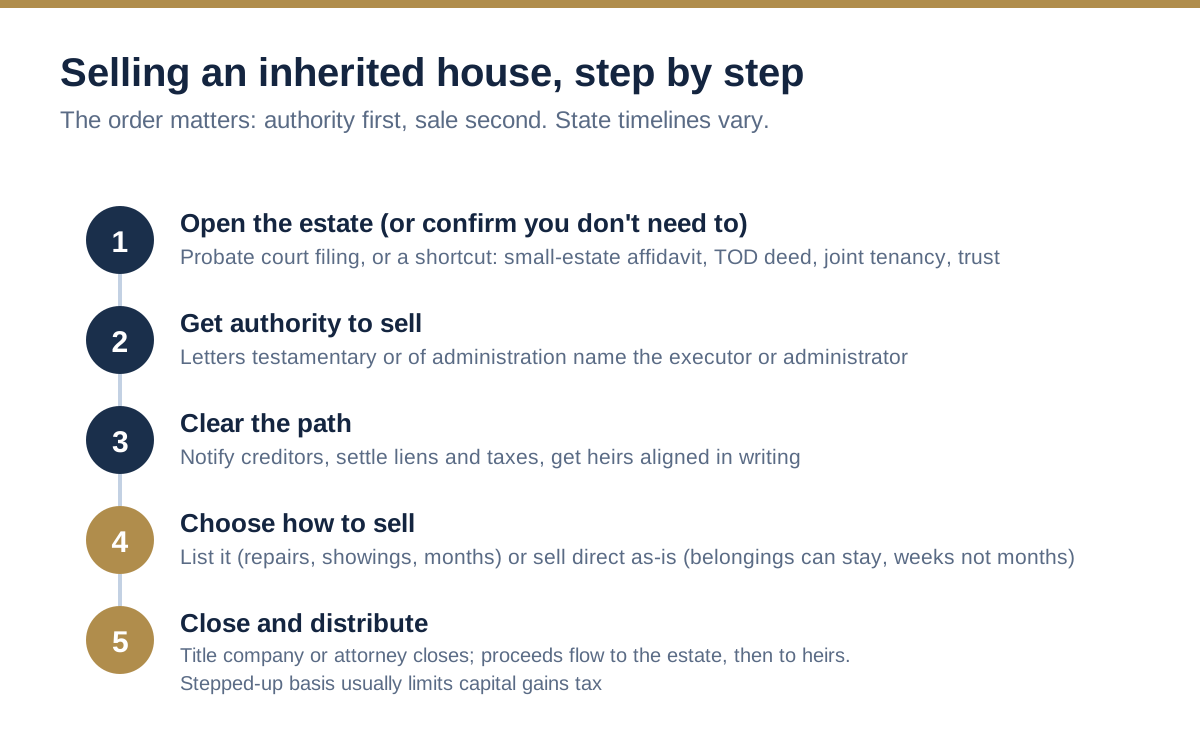
If the house does need probate, Wisconsin runs one of the more forgiving systems in the country. There is a small-estate affidavit that, unusually, includes real estate, an informal process that skips courtroom hearings for routine steps, and a formal track most families never see. The overall shape is the same everywhere: open the estate, get authority, clear title and debts, sell, distribute.
Transfer by Affidavit: the $50,000 shortcut that includes the house
If the decedent's entire Wisconsin estate subject to administration is $50,000 or less in gross value, an heir can collect and transfer property by affidavit (Wis. Stat. 867.03, form PR-1831) with no court file opened at all. Most states cap their small-estate affidavits far below house prices and exclude real estate entirely. Wisconsin includes it. When real estate passes this way, the affidavit is recorded with the register of deeds and the recipient can then sell as owner. A $50,000 ceiling excludes most houses on their own, but it regularly rescues hunting land, fractional interests in the family cottage, and modest rural properties. It costs almost nothing to use. Check it before assuming you need probate.
Informal administration: how most Wisconsin estates actually run
Most Wisconsin probates proceed informally (Wis. Stat. ch. 865) through the county's probate registrar, without hearings on routine steps and, unlike formal administration, without a required attorney. The sequence:
- File the application with the register in probate for the county where the decedent lived, along with the original will if there is one.
- Personal representative appointed. The registrar issues domiciliary letters, the document every title company must see before anyone signs a deed for the estate. Expect a few weeks to a couple of months, depending on the county docket and whether all interested parties sign consents.
- Notice to creditors. The claims deadline is set 3 to 4 months from the order (Wis. Stat. 859.01). The house sale does not have to wait for it; proceeds simply sit in the estate account while claims resolve.
- Sell during administration. With letters in hand, the personal representative can generally market, contract, and close on estate real estate like a normal owner, through a normal title company.
- Close the estate. Wisconsin expects estates to wrap up within 12 months of opening, and the registrar can grant extensions when needed.
Formal administration (a circuit court judge, hearings, a mandatory attorney) exists for contested wills, hostile heirs, and messy creditor problems. Our probate walkthrough maps the court sequence in more detail, and our Wisconsin selling guide covers the state's general sale rules.
The realistic answer to "when can we actually sell?": a cooperative family in an informal administration can usually go from filing to a closed sale in 3 to 6 months, and a fair chunk of that is just the ordinary mechanics of any home sale.
Taxes: Mostly Better News Than Heirs Expect
Wisconsin makes this section short. There is no Wisconsin inheritance tax (repealed for deaths on or after January 1, 1992) and no Wisconsin estate tax (none for deaths after December 31, 2007, when the federal credit it piggybacked on disappeared). Heirs owe the state nothing for inheriting. The federal estate tax is irrelevant for almost everyone; it touches only estates above roughly $15 million per person in 2026.
What actually matters is the stepped-up basis. Under federal law (26 U.S.C. 1014), your cost basis in inherited property resets to its fair market value on the date of death. Your parents' $40,000 purchase price from 1985 is erased. If the house was worth $240,000 when the owner died and the estate sells it for $245,000 a few months later, the taxable gain is about $5,000 minus selling costs. Often it rounds to zero. This is why most inherited-house sales are nearly tax-free, and why the most valuable piece of paper in the whole file is a date-of-death appraisal or broker analysis. Get one even if you plan a quick as-is sale; it protects every heir's tax position for good.
Two smaller items. The transfer to heirs itself is exempt from Wisconsin's real estate transfer fee, since conveyances by will, descent, or survivorship pay nothing (Wis. Stat. 77.25(11)); the eventual sale pays the ordinary $3 per $1,000 fee (Wis. Stat. 77.22). And property taxes keep accruing on the empty house, billed each December, so every extra season of ownership quietly builds the proration bill that lands on the closing statement.
When Several Heirs Own One House
Three siblings inherit one ranch house. One wants to keep it, one wants money now, and one lives in Arizona and answers texts weekly. That is the normal case, not the exception, and Wisconsin gives it a workable structure:
- Sell from the estate. While the house is still in administration, the personal representative is the only required signature. One signer, one clean transaction, proceeds divided by the will or intestacy shares. Most estates that intend to sell should sell here, before the deed scatters into multiple names with multiple spouses and multiple title problems.
- Buy each other out. The stepped-up value gives you a fair, defensible number. The heir who keeps the house refinances or pays cash for the other shares, documented in writing while everyone is still speaking.
- Partition, the last resort. If co-owners truly deadlock after the house has been distributed, any one of them can force a sale through a partition action (Wis. Stat. ch. 842). Everyone pays lawyers, the court sells the house anyway, and Thanksgiving never recovers. Treat partition as the option whose existence motivates a deal, not one to actually use.
Most standoffs are really information gaps. Share every offer, every payoff figure, and every document with every heir at the same time. When we buy from multi-heir estates we present the numbers on a group call for exactly this reason: nobody wonders what their sibling was told.
The House Itself: Contents, Insurance, and a Wisconsin Winter
Before any sale strategy, the physical house needs three decisions made early.

The belongings. Forty years of possessions is its own project. Pull the documents, photos, and true heirlooms first, then give yourself permission not to hand-sort the rest. An estate sale service takes a cut and takes weeks; donation runs faster; and a buyer like us will purchase contents included, so the china cabinet nobody wants simply stops being your problem.
The insurance. Call the carrier early. Homeowner's policies commonly restrict or void coverage once the named insured dies or the house sits vacant for 30 to 60 days, which describes almost every estate house. Ask for a vacant or estate endorsement. It costs more; an uninsured fire costs everything.
The winter. This is the most Wisconsin risk in probate. An empty house in January is one furnace failure from burst pipes, and a February freeze-out can turn a $180,000 house into a $110,000 house over a weekend. Keep heat at 55 or higher, or drain the lines and put antifreeze in the traps. Milwaukee also charges registration fees on vacant buildings, so a Milwaukee estate house has a meter running on top of the risk. If the estate opens in fall, the cheapest month to sell the vacant house is usually the one before the snow.
Choosing How to Sell, With Real Numbers in Front of You
Start with a rule most executors never hear: a personal representative who never occupied the property is exempt from Wisconsin's Real Estate Condition Report (Wis. Stat. 709.01(2)). You disclose what you actually know if asked, and you can never actively conceal a defect, but the standard form obligation usually does not apply to an estate sale. That removes one chore; it does not answer the strategy question.
Listing the house makes sense when it is retail-ready or close to it. Plan on cleanout, repairs, showings, a 5-6% commission, and a financed buyer's inspection-and-appraisal gauntlet. In strong markets like Madison, a clean inherited house can draw multiple offers. A dated one tends to get ground down through inspection amendments by buyers who remember their leverage right after the home inspection.
Selling as-is to a direct buyer trades some price for speed and certainty. We buy inherited houses across Wisconsin, from Milwaukee flats to Green Bay ranches, contents included, and we coordinate directly with the estate's attorney. We can issue a firm written offer while the appointment is still pending, so the estate can sign the day the domiciliary letters issue, and our process closes in two to three weeks once title is clear. The offer shows the after-repair value, the repair budget, and our margin, so heirs can compare it against a realistic net from listing rather than against a fantasy list price.
The middle path exists too. Estates with time and a house worth prepping can ask about our Retail Buyer Program: we handle the work and market the house to retail buyers, and the estate collects more than a typical cash offer with the same easy process, just on a longer timeline. The right answer is whichever number, net of months and carrying costs, the heirs prefer with everything on paper. The inherited house guide walks through that comparison, and the Wisconsin hub covers every market we buy in.
Whatever route you pick, do these three things this week: confirm how the house is titled, call the insurance carrier, and get a date-of-death value in writing. Those three moves protect the estate no matter what happens next.
This guide is general information about Wisconsin law, not legal advice; for a specific estate, the probate attorney is the authority.
From the buyers
How EZ Time Home Buyers Can Help With an Inherited House
We work with executors, heirs, and families in probate all the time, including houses full of belongings and houses three states away from everyone who inherited them. We buy as-is, work around court timelines, and put every offer in writing with the math shown. If the family wants more than a cash number, the Retail Buyer Program handles the work while typically netting more than a typical cash offer, with no commissions or fees.
Frequently Asked Questions
Do I have to pay inheritance tax on a house I inherit in Wisconsin?
No. Wisconsin repealed its inheritance tax for deaths on or after January 1, 1992, and it has had no state estate tax for deaths after December 31, 2007. The federal estate tax only applies to estates above roughly $15 million per person in 2026. What matters for most heirs is the stepped-up basis (26 U.S.C. 1014): your cost basis resets to the home's value at the date of death, so selling soon after inheriting usually produces little or no taxable capital gain.
Can we really transfer a house in Wisconsin with just an affidavit and no probate?
Sometimes, yes. If the decedent's entire Wisconsin estate subject to administration is $50,000 or less in gross value, an heir can use a Transfer by Affidavit (Wis. Stat. 867.03, form PR-1831), and unlike most states' small-estate procedures, Wisconsin's covers real estate. The affidavit gets recorded with the register of deeds and the recipient can then sell. The $50,000 ceiling excludes most homes, but it regularly works for hunting land, cottage shares, and modest rural properties.
How long after a death can we sell the house in Wisconsin?
If the house avoids probate (trust, survivorship marital property, joint tenancy, or a TOD deed under Wis. Stat. 705.15), you can sell as soon as the death paperwork is recorded, often within weeks. If it needs probate, most estates use informal administration (Wis. Stat. ch. 865): the registrar issues domiciliary letters in a few weeks to a couple of months, and the personal representative can then sell during administration without waiting for the 3 to 4 month creditor claim period (Wis. Stat. 859.01) to end. Filing to closed sale commonly runs 3 to 6 months.
As the executor, do I have to complete Wisconsin's Real Estate Condition Report?
Usually not. Personal representatives, trustees, and other court-appointed fiduciaries who never occupied the property are exempt from the condition report requirement (Wis. Stat. 709.01(2)), which covers most estate sales. The exemption is not a license to hide problems: nobody may actively conceal a known defect. If you know about the wet basement or the dead furnace, say so; with an as-is buyer it just becomes part of the price instead of a lawsuit later.
Related Guides
Ready to see both of your numbers?
Tell us about your property once and get a written cash offer, plus what our Retail Buyer Program could net you instead. No repairs, no fees, no pressure to accept.